
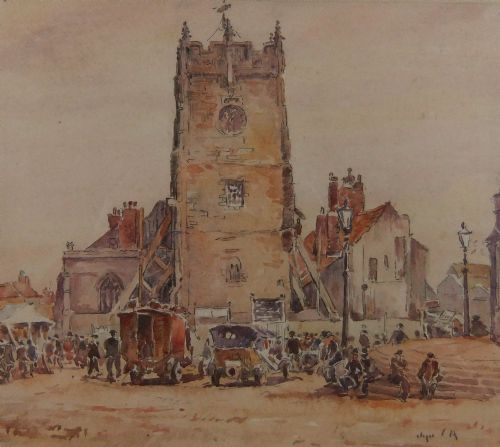


Vintage Townscape Watercolour
A vintage townscape watercolour brings a historic street or market scene into a room through the delicate wash of pigment.
Vintage Townscape Watercolour
A vintage townscape watercolour depicts urban views, streets, and buildings through delicate pigment application on paper. Buyers seek these original works to capture the architectural character and bustling atmosphere of past decades.
The selections available span from the late nineteenth century through to the mid-twentieth century, encompassing Victorian, Edwardian, and mid-century British movements. Pieces frequently feature named locations such as Yorkshire towns, Lincolnshire bridges, and continental buildings.
Most examples take the form of framed original artwork or drawings, combining watercolour with ink and pencil under glass. These works range from tightly detailed topographical records to looser impressionistic street scenes.
Materials and technique
Artists executed these works primarily using watercolour paint on paper surfaces, frequently establishing structural outlines with pencil and ink before applying fluid washes. This combination allowed painters to capture both precise architectural details and shifting atmospheric light.
Framing typically involves wood or gilt wood surrounds fitted with protective glass to preserve the delicate pigments from light exposure and atmospheric moisture. The physical support relies upon traditional paper substrates which register the subtle gradients characteristic of the medium.
The inventory spans works dated from 1890 to 1960, utilising paper, watercolour, ink, pencil, wood, glass, and gilt wood.
Assessing quality and execution
Quality in these watercolours depends upon the artist's ability to command perspective, scale, and the natural fluidity of the pigment without overworking the paper. Superior examples demonstrate confident brushwork that suggests movement and architectural weight simultaneously.
The handling of light and shadow differentiates a mere topographical record from a compelling work of fine art. The best pieces use the white of the unpainted paper deliberately to create brilliance, while lesser works rely on heavy, opaque corrections.
John Smith Atherton·William Manners·J W Hogley·Joseph W Milliken·Angus Rands·Walter Emsley·Fred Lawson·Annie L Lee·J D Walker
The Vintage Townscape Watercolour Glossary
- Watercolour
- A paint consisting of a pigment suspended in a water-based solution, applied in translucent washes to paper. It requires a swift and decisive hand because mistakes cannot easily be painted over.
- Topography
- The detailed mapping and description of specific localities, forming the primary subject of these townscapes. Artists recorded recognizable streets, bridges, and market squares with varying degrees of topographical accuracy.
- Gilt wood
- Wood coated with a thin layer of gold leaf or gold-coloured pigment, commonly used for traditional picture framing. It provides a warm border that enhances the tonal range of the artwork within.
- Wash
- A semi-transparent layer of diluted watercolour paint spread evenly across the paper to create skies, shadows, or background walls. Skilled application prevents unsightly pooling at the edges of the stroke.
Vintage Townscape Watercolour: Frequently Asked Questions
How should I hang a watercolour?
Watercolours are sensitive to light and should be positioned away from direct sunlight to prevent the pigments from fading over time. Maintaining a stable room temperature also protects the paper and the framing materials from warping.
Using conservation-grade glass and backing boards provides an extra layer of defence against environmental humidity. Professional framing ensures the paper does not touch the glass directly, preventing condensation damage.
Are these works signed?
Many of the pieces bear the artist's signature, often inscribed directly into the lower corner of the paper composition. Signatures help authenticate the work and link the piece to a specific regional school or period.
Unsigned works still appear, attributed through stylistic comparisons, gallery labels, or accompanying documentation on the reverse of the frame. These pieces rely entirely on their visual execution and provenance for identification.
What subjects are most common?
British market towns, historic bridges, and coaching inns dominate the available subjects, reflecting a strong regional interest among early twentieth-century painters. Scenes often capture daily commerce and architecture in locations across Yorkshire and Lincolnshire.
Continental street scenes also feature, showing the broader travel habits of artists during the Edwardian era. These foreign subjects offer a different architectural vocabulary while retaining the same traditional medium.
How do I date a watercolour?
Dating relies heavily on period framing styles, artist biography records, and internal clues such as architectural changes or clothing styles depicted in the street scene. Inscribed titles and dates on the mount or reverse offer the most direct evidence.
Stylistic shifts also provide clues, moving from the tighter realism of the late Victorian period to the freer interpretation seen in mid-century British fine art. Comparing handling techniques with documented works by the same hand narrows the active period further.