
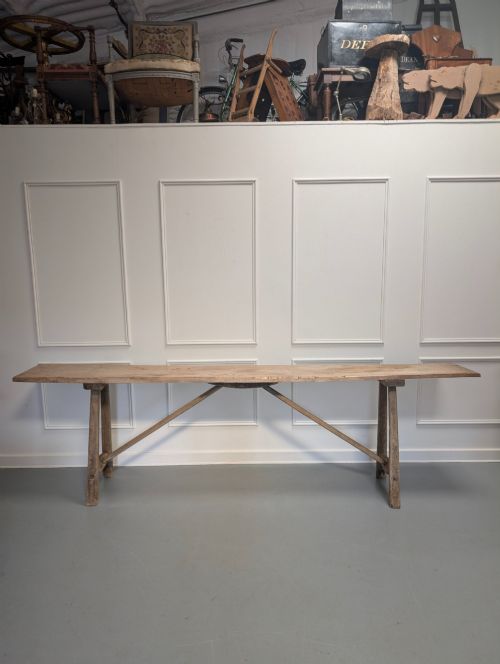
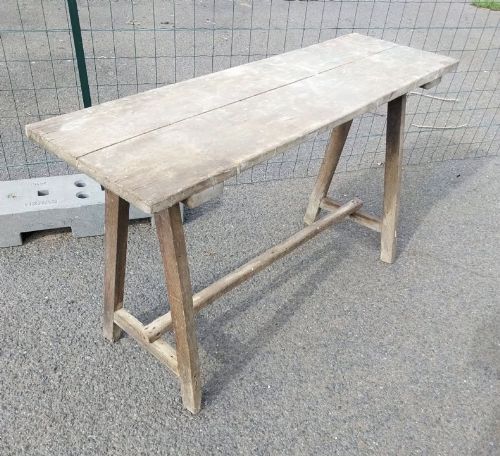
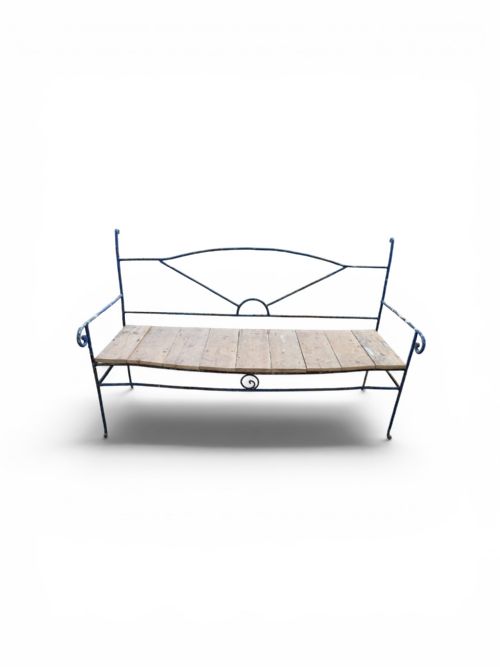
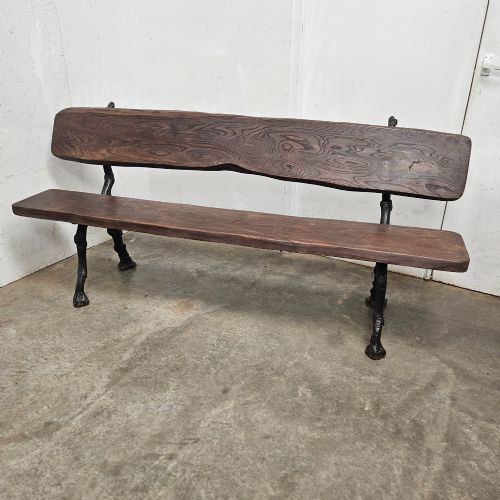
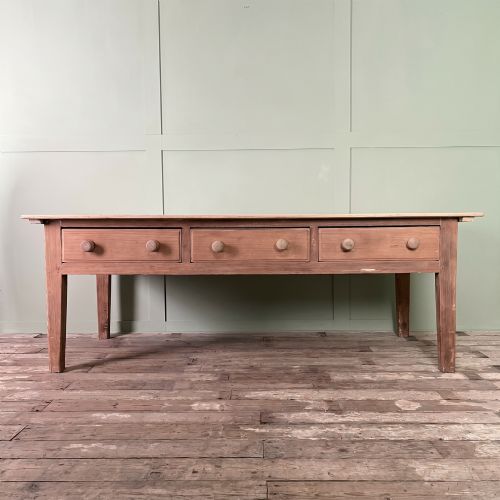
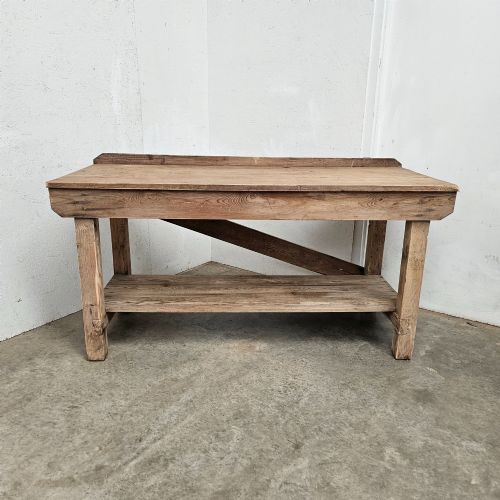


Vintage Timber Work Bench
These heavy timber work benches bring honest utility and robust construction into modern rooms.
Vintage Timber Work Bench
A vintage timber work bench provides heavy-duty utility and surface space forged from practical trades and workshops. Buyers seeking a vintage timber work bench find items derived from French artisans, industrial foundries, and domestic dairies.
The assortment relies heavily on French and English origins, spanning the nineteenth century up to the Edwardian period. Examples range from scrubbed sycamore trestle tables and watch makers tables to butchers blocks and rustic garden seating.
Most pieces combine timber tops with structural iron or wooden bases designed for heavy labour. Forms include artisan benches with integrated vices, potting tables with lower shelves, and heavy foundry tables.
Materials and construction
Construction relies on durable domestic hardwoods and softwoods selected for hard daily use. Workshops utilised oak, pine, elm, sycamore, and beech to build thick surfaces capable of absorbing impact.
Metal components added necessary rigidity and mechanical function to the wooden frames. Cast iron and wrought iron appear in vices, bases, and structural supports alongside heavy timber joints.
Period origins span from the 1850s through the Edwardian era.
Assessing quality and character
Quality rests in the integrity of the original construction and the depth of surface wear accumulated through use. Thick timber slabs showing authentic tool marks and operational vices demonstrate superior practical heritage.
Proportion and material combination dictate the visual balance of each piece. Superior examples maintain structural soundness alongside genuine patination earned from workshop duties.
Trussant & Cie
The Vintage Timber Work Bench Glossary
- Faux bois
- Imitation wood. This technique appears in garden seating designed to mimic natural timber branches using other materials.
- Trestle table
- A table comprising two or more supports connected by a horizontal beam. This form provides sturdy legroom for various prep and work tasks.
- Butchers block
- A thick-topped wooden block designed for food preparation. These items exhibit heavy end-grain or plank construction built to withstand severe cutting.
- Sycamore
- A durable European hardwood. Makers favoured this timber for dairy prep tables and work surfaces due to its resistance to splitting.
Vintage Timber Work Bench: Frequently Asked Questions
How are work benches cleaned?
Maintenance involves gentle dusting and occasional waxing to preserve the dry timber surfaces.
Harsh chemical cleaners should be avoided to protect the historic patina and original wood grain.
Were these used indoors?
Original functions varied widely from industrial workshops and watch makers rooms to dairies and kitchens.
Many designs also served outdoors as garden benches or potting tables depending on their material treatment.
How do I date a bench?
Dating relies on identifying construction methods, ironwork styles, and regional timber characteristics.
Nineteenth-century examples often display hand-cut joints and heavier wear compared to Edwardian pieces.
Can they hold heavy equipment?
Solid timber construction and iron bracing provide immense load-bearing capacity for modern tasks.
These surfaces were originally built to withstand intense physical labour and heavy artisan tools.