


Vintage Terrier Picture
These vintage terrier picture examples capture the character of working and companion dogs through oil on canvas, pastel, and original etching.
Vintage Terrier Picture
A vintage terrier picture represents canine subjects through various media, including oil paintings, watercolours, pastels, and original etchings. These artworks capture the distinct personality and conformation of breeds such as the Jack Russell, Cairn terrier, and West Highland terrier.
The selections span distinct historical periods from the nineteenth century through the mid-twentieth century. Pieces range from Victorian realisms and sporting art to early twentieth-century realism and mid-century works.
Examples appear framed behind glass or mounted on canvas, reflecting the domestic and sporting contexts of British country houses and farmyards.
Materials and techniques
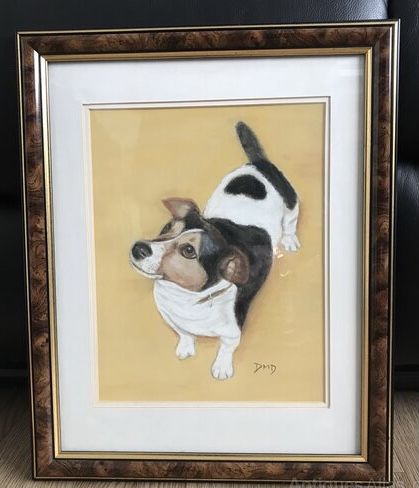
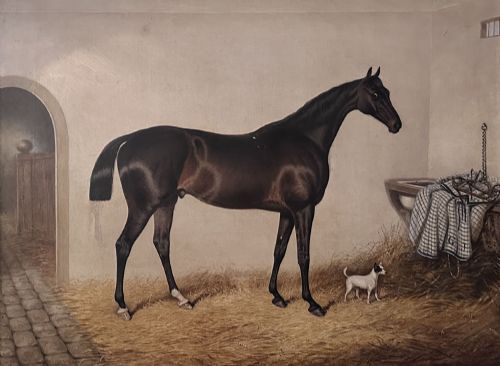
Works are executed in oil paint upon canvas or paper, utilising traditional brushwork to render the texture of canine coats. Pastels and watercolours provide softer tonal transitions when placed under glass.
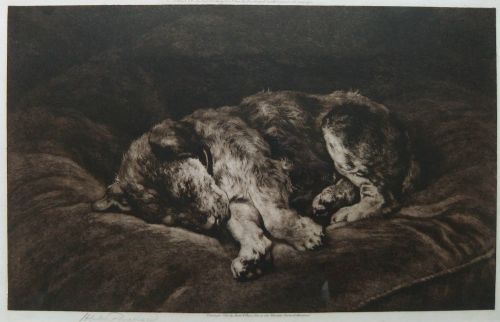
Printmakers employed etching techniques on paper to produce detailed monochrome impressions, often signed by the artist. Wooden frames enclose many of these works, serving to protect the paper, canvas, or board beneath.
One terrier guards a trapped rat in a Victorian farmyard scene while another keeps watch near a cage.
Evaluating quality in canine art
Quality rests upon the artist's ability to render the anatomy, expression, and alertness characteristic of terrier breeds. Stronger works demonstrate confident handling of paint, pastel, or ink rather than stiff mechanical reproduction.
The condition of the medium matters greatly, with well-preserved paper, stable canvas, and original framing elements maintaining the integrity of the piece. Attribution to a named artist or follower of a known school elevates the standing of the work.
Herbert Dicksee·Percival Glenfern·M.E.Hankinson·Samuel Fulton
The Vintage Terrier Picture Glossary
- Etching
- A printmaking technique where lines are bitten into a metal plate with acid before being inked and pressed onto paper. This process allows for fine, precise detail.
- Pastel
- A dry medium made of powdered pigment and a binder, applied directly to paper to create velvety textures. It is typically displayed under glass for protection.
- Oil on Canvas
- Pigments suspended in a drying oil applied to a stretched woven fabric support. This combination offers rich colour depth and durability.
- Realism
- An artistic approach focused on depicting subjects accurately and truthfully without idealisation. In these works, it manifests in the lifelike portrayal of animal anatomy and environment.
Vintage Terrier Picture: Frequently Asked Questions
What periods do these terrier pictures cover?
The available works span from the Victorian era, including pieces from the eighteen-sixties and nineteenth century, through to the early twentieth century and nineteen-forties and sixties.
Each period brings distinct stylistic approaches, moving from Victorian realism and sporting art towards mid-century interpretations.
How should I care for a pastel terrier picture?
Pastels use dry pigment and must remain sealed behind glass to prevent the surface from smudging or losing particulate matter. Keep them away from direct sunlight to protect the colours from fading.
Avoid hanging them in damp environments where moisture could damage the paper support.
What is the difference between an etching and an oil painting?
An etching is a printed work on paper created from an inked metal plate, usually rendered in monochrome lines. An oil painting uses coloured pigments suspended in oil on canvas or board, offering rich colour and textured brushwork.
Both forms capture terrier subjects but employ entirely different artisan techniques.
Where were these dog portraits displayed originally?
Many originated in English country houses, farmyards, and domestic interiors where sporting art and pet portraits celebrated working animals and companions. They reflected the owner's affinity for specific breeds.
Today they translate easily into various interior styles, from traditional studies to contemporary living spaces.