
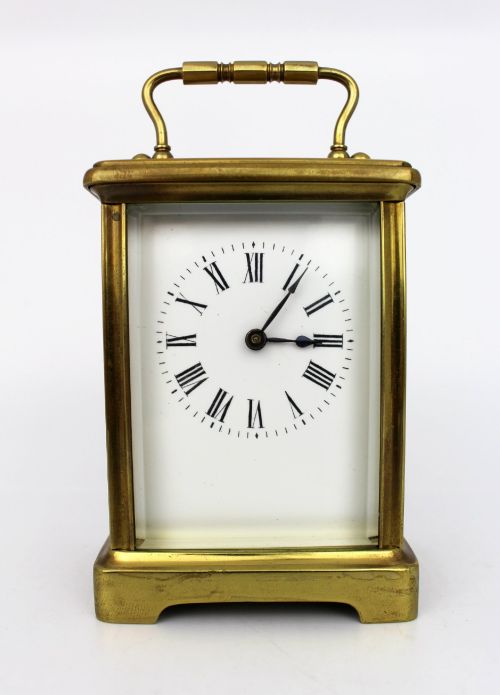


Vintage Swiss Desk Clock
These vintage swiss desk clock examples range from brass carriage models to mid-century atmos timepieces designed to sit on a working surface.
Vintage Swiss Desk Clock
Originating largely from Swiss workshops, these clocks demonstrate a distinct lineage of horological craftsmanship. The pieces available here reflect diverse aesthetic movements including Victorian, Edwardian, Art Deco, and Mid-Century Luxury.
How They Were Made
Manufacturers utilised durable base metals such as brass, gilt metal, chrome, and rhodium plating to construct sturdy outer casings that housed intricate mechanical movements. Many models incorporated glass panels or domed bell-jars to protect the internal escapements from dust while revealing the functioning gears.
Decorative surfaces frequently employed champlevé enamel, silver mounts, and leather travel cases to enhance visual appeal and practical utility. Dial designs ranged from clean minimalist faces to complex skeletonised layouts displaying the inner jewels and wheels.
Current listings feature materials including brass, glass, enamel, leather, and silver across Victorian, Art Deco, and Mid-Century periods.
What Varies in Quality
The standard of a timepiece rests heavily on the complexity of its movement, such as eight-day power reserves, alarm functions, or grande sonnerie striking mechanisms. Fine execution appears in the crispness of the metal case casting and the precision finish applied to internal jewelled components.
Originality heavily influences overall merit, distinguishing pieces retaining their fitted leather travel cases, authentic dials, and matching components from those with replacement parts. The reputation of the maker and the presence of original documentation or packaging further define the hierarchy of these horological objects.
Harrods of London·Imhof·Jaeger LeCoultre·Van Cleef and Arpels·Luxor·Asprey·J. F. Bautte Et Cie·Mappin and Webb
The Vintage Swiss Desk Clock Glossary
- Carriage clock
- A small, portable spring-driven clock traditionally designed for travellers during the nineteenth and early twentieth centuries. These pieces typically feature a rectangular brass case with glass panels and a swing handle.
- Strut clock
- A timepiece supported by a hinged prop or easel attached to the back of the case, allowing it to stand upright on a desk or mantel. They often fold flat for travel.
- Atmos clock
- A mechanical timepiece driven by changes in atmospheric temperature and pressure, manufactured notably by Jaeger-LeCoultre. This ingenious system eliminates the need for manual winding.
- Skeleton clock
- A timepiece designed with an open framework that exposes the gears, springs, and escapement to view. This style highlights the mechanical complexity of the movement.
- Grande sonnerie
- A sophisticated striking mechanism that chimes the hours and quarters automatically as time progresses. Such complications represent advanced horological skill.
Vintage Swiss Desk Clock: Frequently Asked Questions
How do atmos clocks work without winding?
Atmos clocks operate using a hermetically sealed chamber containing a gas and liquid mixture that expands and contracts with temperature fluctuations. This movement winds the mainspring continuously, allowing the clock to run without human intervention.
Because they rely on subtle environmental changes, these timepieces require a stable location free from strong drafts. Levelling feet and a locking lever help protect the delicate internal mechanism during relocation.
How do I identify a carriage clock period?
Early carriage clocks often feature heavy mercury gilding, complex escapements, and heavier brass castings typical of the nineteenth century. Later twentieth-century examples tend toward sleeker lines and simplified dial layouts.
Examining the platform escapement and the style of the numerals can also help narrow down the manufacturing decade. Maker signatures engraved on the backplate provide the most reliable guide to dating.
Where should I place a desk clock?
These clocks look best on flat surfaces like a study desk, a library table, or a low mantelpiece where their mechanics and cases can be appreciated up close. Positioning them away from direct sunlight and moisture protects delicate enamel and leather elements.
Mechanical models require a stable, level surface to ensure the pendulum or balance wheel beats evenly. Desk placement also allows easy access for manual winding or setting alarms.
What is a travel clock?
Travel clocks are compact timepieces designed to be transported safely, often featuring protective folding leather cases or sliding metal shutters. They usually combine an eight-day movement with an alarm function for use on journeys.
Unlike standard mantel clocks, travel versions prioritize portability and durability without sacrificing precision timekeeping. Many fold flat or incorporate recessed handles for easy packing.