


Vintage Surveying Compass
These vintage surveying compass pieces are heavy brass field instruments built for mapping and navigation, prized by collectors for their precise mechanical heritage.
Vintage Surveying Compass
When you search for vintage surveying compass, you encounter portable navigational instruments and field tools designed for mapping land, mines, and military terrain. These pieces span from the Georgian period through the Victorian and Edwardian eras, reflecting centuries of practical cartography.
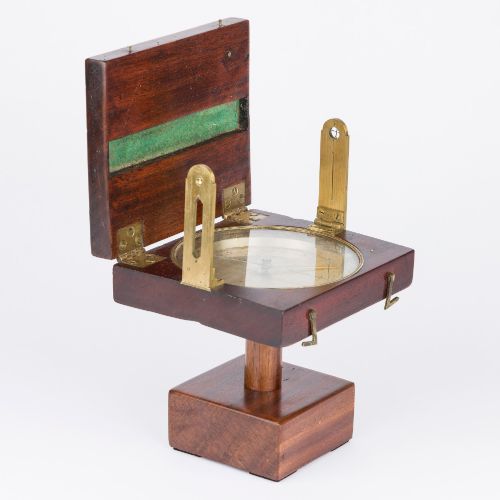
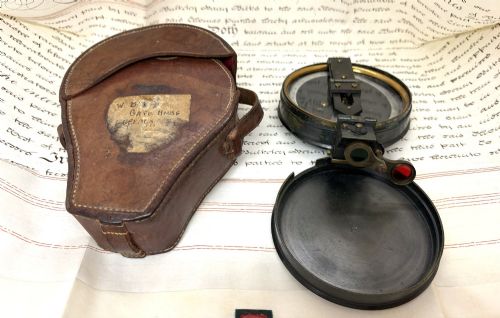
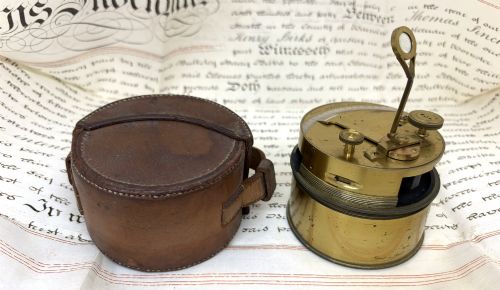
Originating largely from British workshops and makers in London, Birmingham, Leeds, and Madras, these instruments range from military compendiums to pocket-sized travellers' aids. Mahogany storage cases and leather protection frequently accompany the metal bodies.
How they were made
Makers constructed these instruments primarily from cast and turned brass, often applying a silvered finish to the metal dial plates for clear legibility of degrees and cardinal points. Glass protected the delicate needle and face from weather and dust during outdoor use.
Housings and protective storage boxes relied on seasoned mahogany and pine, joined securely to withstand rough transport in the field. Secondary elements utilised boxwood for folding rules and scales, alongside steel components for internal locking mechanisms and needles.
The inventory spans the Georgian, Victorian, and Edwardian periods, utilising brass, mahogany, glass, boxwood, and silvered metal across scientific instrument forms.
What varies in quality
The distinction between standard utility models and superior workshop output lies in the crispness of the engraved graduation marks on the silvered dial and the smoothness of the directional needle movement. Precision engineering in the sighting vanes and leveling bubbles elevates certain examples above basic field equipment.
Original fitted cases made from solid mahogany, complete with maker inscriptions and subsidiary tools like clinometers or folding rulers, indicate higher grade commission pieces intended for professional surveyors and military officers.
G. Davis of Leeds·P. Orr, Madras·Baker, London·W&S Jones·Stanley, London·Barker & Son·Watkins·J Hicks·R. Field & Son
The Vintage Surveying Compass Glossary
- Prismatic compass
- A pocket-sized navigational instrument containing an internal prism that allows the user to read the magnetic bearing simultaneously while sighting an distant landmark.
- Theodolite
- A precision optical instrument mounted on a tripod for measuring horizontal and vertical angles in large-scale land surveying and civil engineering.
- Clinometer
- A specialised tool used for measuring angles of slope, elevation, or depression of an object with respect to gravity.
- Beam compass
- A drafting instrument consisting of a long wooden or metal bar with two adjustable sliding heads used for drawing large circles or measuring distances.
- Silvered metal
- A thin layer of silver applied to the brass dial face to provide a matte, high-contrast background for black engraved graduations.
Vintage Surveying Compass: Frequently Asked Questions
What is a prismatic compass?
A prismatic compass is a portable field instrument that incorporates an internal glass prism to reflect the bearing scale. This enables the user to view the magnetic heading and the target simultaneously through the sighting vane.
Military and civilian surveyors relied on these units for rapid route mapping and reconnaissance work where speed and directional accuracy mattered equally.
How do I date a brass compass?
Dating relies on stylistic details, typography on the silvered dial, and maker signatures recorded in historical trade directories. Georgian and early nineteenth-century pieces often feature hand-engraved lettering and simpler brass mountings.
Later Victorian and Edwardian examples introduce standardised military broad arrows, prismatic optics, and patent markings that narrow down the production era.
What is a mine's compass used for?
A mine's compass is a specialised directional instrument adapted for underground surveying where iron ore and subterranean darkness present unique mapping challenges. These heavy brass units often included specific sighting arrangements to measure traverse angles in confined spaces.
Compasses from this category frequently survive with fitted mahogany boxes and specialised leveling plates to secure accurate readings underground.
How should I display a wooden cased compass?
Displaying these instruments involves placing them on a stable shelf or inside a cabinet away from direct sunlight and excessive humidity. Keeping the mahogany case treated and the brass elements clean preserves the original finish without altering the patina.
Many collectors prefer to exhibit the instrument resting beside its open wooden box to showcase both the exterior timber grain and the interior dial face.