
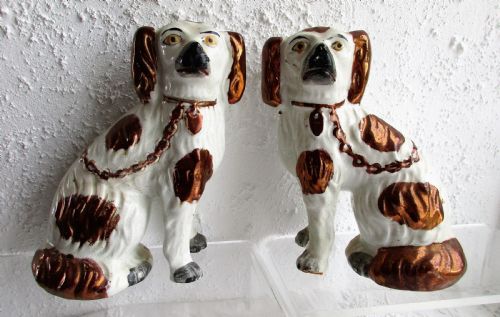


Vintage Staffordshire Fireplace Dogs
These vintage staffordshire fireplace dogs are earthenware mantel ornaments that bring mid to late nineteenth-century Victorian character directly to your hearth.
Vintage Staffordshire Fireplace Dogs
When you search for vintage staffordshire fireplace dogs, you encounter nineteenth-century ceramic figures modelled primarily as spaniels, greyhounds, and pugs. These decorative objects typically appear in pairs facing one another, designed to sit upon mantelpieces.
The pieces on this page span the Victorian era, specifically from the mid-nineteenth century through to nineteen hundred. You will find them grouped as pairs or in collections of four and five.
Most examples represent seated spaniels, often referred to as comforter spaniels, alongside greyhounds and pugs. They function purely as decorative figures rather than utilitarian items.
Factors of quality
The visual impact is also determined by the scale and the richness of the decorative finish, particularly where gold leaf or gilt highlights accent the glazed ceramic surface. Pairs that retain their original matched balance and strong colouring command greater visual presence.
These ceramic canines kept silent watch over Victorian hearths without ever needing a walk in the rain.
The Vintage Staffordshire Fireplace Dogs Glossary
- Earthenware
- A porous type of pottery fired at lower temperatures, commonly used for nineteenth-century decorative figures before being glazed.
- Copper Lustre
- A metallic glaze finish applied to pottery that produces a reflective, coppery sheen. It was frequently used to highlight the collars and markings on nineteenth-century figures.
- Glaze
- A glassy coating fused to the ceramic body through firing to seal the earthenware and provide a smooth surface for enamel colours.
- Gilt
- A thin layer of gold or gold-coloured leaf applied to the ceramic surface to create decorative highlights and gilded accents.
Vintage Staffordshire Fireplace Dogs: Frequently Asked Questions
Where did fireplace dogs sit?
These ceramic figures traditionally sat upon the mantelpiece above the fireplace, facing inward toward each other.
They were arranged as pairs to guard the hearth and provide domestic ornament in Victorian parlours.
What breeds are represented?
The primary breed depicted in these nineteenth-century figures is the spaniel, often known as the comforter spaniel.
You will also encounter greyhounds and pugs amongst the earthenware and ceramic figures.
How do I date these figures?
Dating relies on stylistic characteristics, manufacturing methods, and period indicators ranging from eighteen sixty to nineteen hundred.
Victorian pieces show specific applications of glaze, copper lustre, and hand-painted enamel typical of that era.
Were they always made in pairs?
Most decorative figures were produced and sold as matched pairs designed to sit symmetrically on either end of a mantel.
Larger collections of four or five pieces also appear within nineteenth-century pottery groups.