




Vintage Signed Boat Painting
A vintage signed boat painting brings the movement of coastal tides and harbour craft directly to your wall through an artist's personal hand.
Vintage Signed Boat Painting
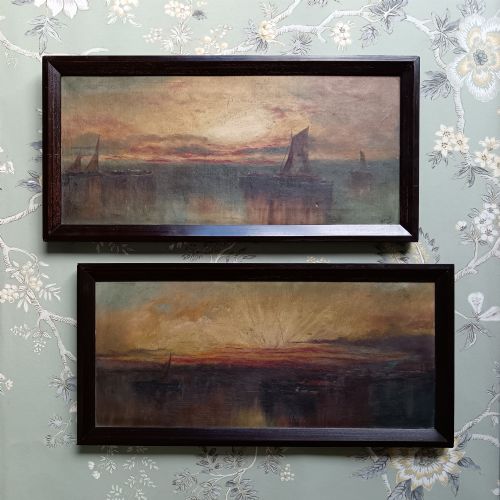
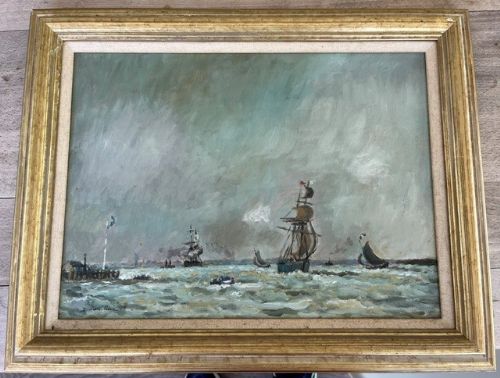
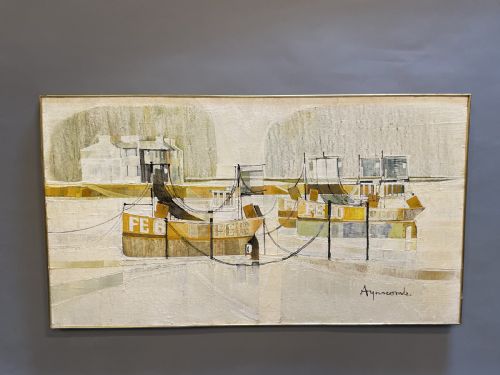
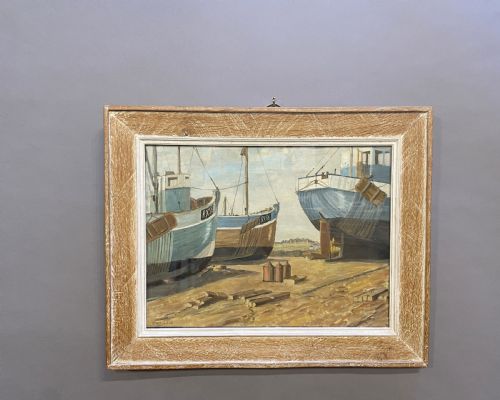
When you search for a vintage signed boat painting, you encounter original works that capture maritime subjects from fishing vessels and barges to racing yachts. These pieces range from intimate watercolours on paper to substantial oil paintings on canvas and board, reflecting coastal and river scenes.
The selections span distinct creative periods including the Edwardian era, the nineteenth century, and mid-twentieth century movements like Modern British and French Impressionism. You are most likely to meet works executed in oil or watercolour, bearing signatures that connect the composition to a named hand or period maker.
Materials and execution
Artists record these maritime subjects using oil on canvas, board, and wood panels alongside watercolour on paper. Oil pigments allow for textured impasto applications that render choppy seas and industrial estuaries with tactile depth.
Watercolour works rely on the pale luminosity of paper grounds to capture coastal light in harbours from Whitby to the Maas. Frames often incorporate gilt finishes that complement the historical palette of these works.
Listings feature works from the Edwardian period through to the 1960s, executed in oil, watercolour, and acrylic on wood, paper, and canvas.
Distinctions in execution
The distinction between standard examples and finer works rests upon the confidence of the brushwork and the clarity of the coastal atmosphere. Superior paintings convey the specific weight of water and vessel construction through decisive handling rather than formulaic marking.
Quality also appears in the preservation of the original support, whether canvas, board, or paper, and the legibility of the artist's signature or contemporaneous attribution. Stronger pieces integrate the marine elements with a coherent sense of light specific to the recorded location.
Kenneth Cozens·B. Nash·Thomas Bush Hardy·Tom Clough·William Tuck·T.S. Wallis·John Bell·Fred Lawson·Carleton Grant·E. Elliot·Charles Edward Wilson·Maurice Sijs·Stanton·Sam Barnes Robson·John Riddle
The Vintage Signed Boat Painting Glossary
- Board
- A rigid flat support used by artists in place of canvas, frequently seen in mid-century oil paintings. It provides a stable surface for rapid en plein air execution.
- Impasto
- Paint applied in thick layers that stand out from the surface, giving a three-dimensional quality to waves and skies. This technique imparts tangible texture to the pigment.
- Seascape
- A work of art depicting the sea, coastal views, or marine vessels in motion. It forms the primary subject category for these maritime paintings.
- Watercolour
- A painting method in which the paints are made of pigments suspended in a water-based solution. It is traditionally applied to paper supports to achieve translucent effects.
Vintage Signed Boat Painting: Frequently Asked Questions
What periods do these paintings cover?
The works span from the nineteenth century through the Edwardian era and into the mid-twentieth century, including post-war British and mid-century modern examples.
This broad chronological range records changing artistic interpretations of coastal and harbour life over more than a century.
What surfaces were used by the artists?
Painters utilised oil on canvas, board, and wood panels alongside watercolour applied directly to paper supports.
Each material interacts differently with the pigments, yielding either smooth fluid passages or textured impasto surfaces.
How do I choose between oil and watercolour?
Oil paintings offer heavier textures and rich pigment depth suitable for dramatic seas and turbulent harbour water. Watercolours provide lighter, luminous interpretations of coastal light and river scenes.
Your preference depends on whether you favour tactile brushwork or transparent atmospheric washes.
Where do these maritime scenes originate?
The geographic scope includes British harbours such as Whitby and Folkestone, alongside European locations like Dutch waterways and Italian coastal views.
Artists frequently travelled to working ports to document local fishing fleets and trading vessels in their natural element.