


Thames Barge Artwork
Thames barge artwork captures the commercial life of the river in oil paint and watercolour.
Thames Barge Artwork
Thames barge artwork records the historic river traffic and maritime scenes of London and the surrounding waterways. These works focus on the working vessels that once crowded the Thames, depicted by artists working across multiple centuries.
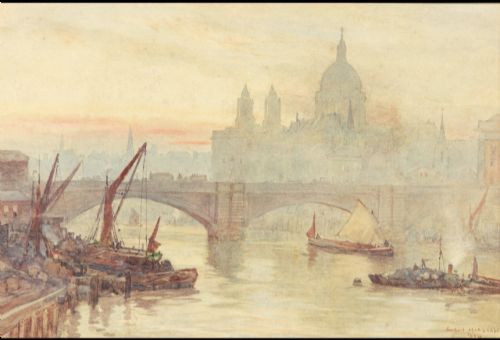
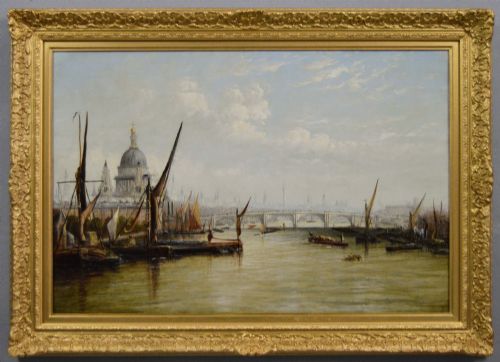
The pieces available include detailed oil paintings on canvas and delicate watercolours on paper. Subjects range from busy city townscapes featuring St Pauls and Blackfriars Bridge to quiet estuary riverscapes and industrial views.
Originating from periods such as the seventeenth, nineteenth, and twentieth centuries, these works display diverse styles from British Maritime Realism to Victorian Marine painting. Buyers find both framed townscapes and river views showing barges under sail or at anchor.
How they were made
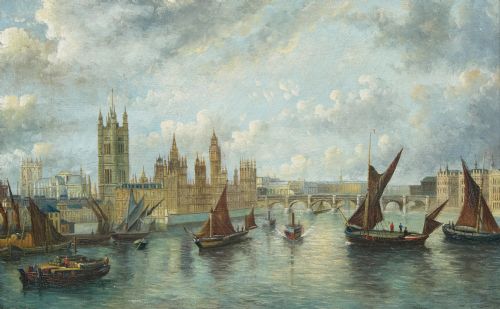
Artists applied oil paint and impasto to canvas or prepared wood panels, sometimes incorporating gesso and gold leaf within the framing and preparation. These traditional painting techniques allowed for textured representations of water, sky, and vessel hulls.
Watercolour paintings on paper utilise fluid washes to capture atmospheric river conditions and light effects across the Thames. Framed presentations often utilise timber mouldings to protect the painted surfaces.
Listings include oil paintings, watercolours, and fine art spanning from the seventeenth century through to the 1960s.
What varies in quality
The standard of a piece rests upon the artist's ability to render maritime anatomy and atmospheric perspective with convincing accuracy. Works by listed historical painters demonstrate a surer handling of tone and composition than anonymous school pieces.
Condition of the canvas, panel, or paper surface dictates the longevity and visual integrity of the artwork. Original framing and the stability of the paint layers further distinguish finer examples.
Francis Moltino·John Macvicar Anderson·Edward Henry Eugene Fletcher·E Elliot·Walter Duncan·Jacob Knyff·Gordon Meadows·Hubert Thornley
The Thames Barge Artwork Glossary
- Oil on Canvas
- A traditional painting medium where pigments suspended in oil are applied to a stretched woven fabric support. This combination offers rich depth of colour and durable texture.
- Impasto
- Paint applied thickly to a canvas so that the brush or palette knife marks remain visibly standing proud of the surface. This technique adds tactile relief to water and sky elements.
- Watercolour
- A paint medium consisting of coloured pigments suspended in a water-soluble vehicle, typically applied to paper. It yields transparent washes that create luminous river scenes.
- Gesso
- A plaster-like mixture used as a smooth base coat on wood panels or frames before painting or gilding. It provides a stable foundation for the final artistic layers.
- British School
- A classification for artworks produced by artists working within Britain, encompassing various historical movements and regional painting traditions.
Thames Barge Artwork: Frequently Asked Questions
What periods do these artworks cover?
The inventory spans multiple centuries, with pieces originating from the seventeenth, nineteenth, and twentieth centuries.
Victorian and Edwardian eras are particularly well represented among the surviving maritime paintings and watercolours.
Are these works painted on canvas or paper?
Artists used several supports, most notably oil on canvas and wood panels for heavier compositions.
Watercolours on paper form another significant group, offering lighter depictions of river life.
Which London landmarks appear in these scenes?
Compositions frequently incorporate prominent city architecture such as St Pauls Cathedral, Blackfriars Bridge, and the Houses of Parliament.
These structures provide historical context for the river traffic shown in the foreground.
What materials make up the frames?
Many works are housed in traditional timber frames, occasionally accented with gesso and gold leaf.
These materials complement the period aesthetic of the nineteenth and twentieth-century paintings.