
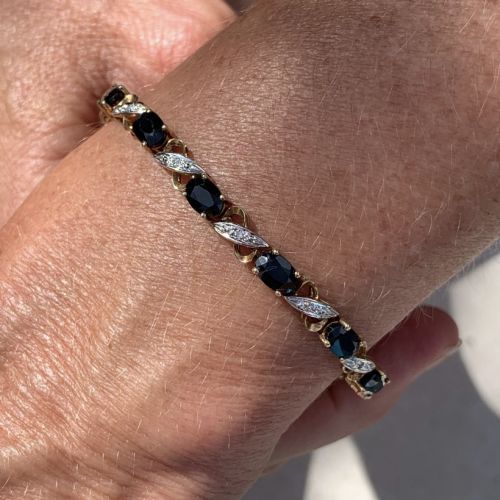


Vintage Sapphire Bracelet
A vintage sapphire bracelet brings deep blue stones together with precious metals across Edwardian, Art Deco and mid-century designs.
Vintage Sapphire Bracelet
A vintage sapphire bracelet is a wrist ornament set with blue corundum alongside diamonds, pearls or rubies, spanning periods from the Victorian era through the mid-twentieth century. The selection includes delicate Edwardian bangles and line bracelets from the nineteen-twenties and nineteen-thirties.
Buyers meet varied forms here, ranging from slender nine-carat yellow gold mounts to platinum creations featuring substantial diamond weights. Art Deco geometric settings and nineteen-fifties fine jewellery pieces appear alongside earlier nineteenth-century styles.
How they were made
Goldsmiths utilised platinum and various carats of gold, including eighteen-carat yellow gold, eighteen-carat white gold, nine-carat yellow gold and nine-carat rose gold. These metals form secure mountings for gemstones such as natural sapphires, Ceylon sapphires, basaltic sapphires and diamonds.
Craftsmen incorporated rose-cut diamonds, seed pearls and rubies into detailed geometric frameworks, line settings and star motifs. French import pieces demonstrate specific continental manufacturing standards of the mid-twentieth century.
Listings feature items from the Victorian, Edwardian, Art Deco, Retro and mid-century periods, mounted in platinum and various carats of gold.
What varies in quality
The choice of precious metal and the weight of the supporting diamonds dictate the character of each piece. Platinum and higher carat golds elevate the substance of the jewellery, while substantial stone carat weights shift the visual balance.
Design execution separates standard pieces from refined work, particularly in period styles like Art Deco where symmetry and stone arrangement define the overall execution.
The Vintage Sapphire Bracelet Glossary
- Platinum
- A dense, durable white precious metal favoured in early twentieth-century jewellery manufacturing for secure stone settings. It allows for delicate yet robust structural work.
- Line bracelet
- A flexible bracelet featuring a continuous symmetrical line of gemstones, often diamonds and sapphires. This style gained significant popularity during the Art Deco period.
- Ceylon sapphire
- A sapphire originating from Sri Lanka, historically recognised for a vibrant and luminous blue colour. These stones appear in mid-century fine jewellery.
- Rose-cut diamond
- An antique diamond cut featuring a flat base and a domed crown with triangular facets. This traditional technique is found on Edwardian and earlier pieces.
- Seed pearl
- A very small natural or cultured pearl utilised in clusters and floral motifs. They complement sapphires in Edwardian and Victorian designs.
Vintage Sapphire Bracelet: Frequently Asked Questions
How do I style a vintage sapphire bracelet?
These bracelets pair easily with evening wear or formal attire, drawing the eye with their deep blue stones and precious metal settings. Their classic proportions also suit daily wear when matched with simple accessories.
Mixing different periods, such as pairing an Art Deco platinum line bracelet with a later mid-century piece, creates a layered look. Consider the metal tone of your other jewellery to maintain a cohesive appearance.
What periods do these bracelets come from?
The selection spans from the Victorian and Edwardian eras through the nineteen-twenties, thirties, forties, fifties and sixties. Each decade brings distinct manufacturing characteristics and aesthetic choices.
Early pieces often feature detailed gold work or delicate platinum settings, while later twentieth-century items showcase bolder geometric lines or abstract clasps.
Are diamonds always used with sapphires?
Diamonds frequently accompany sapphires in these pieces, especially in Art Deco line bracelets and Edwardian settings where contrasting white stones enhance the blue colour of the sapphire. Total diamond weights vary significantly across the designs.
Some pieces incorporate pearls, rubies or emeralds instead of or alongside diamonds, while others rely purely on gold mountings and sapphire clusters.
How are different gold carats used?
Makers utilised nine-carat gold, fifteen-carat gold, eighteen-carat yellow gold, eighteen-carat white gold and nine-carat rose gold depending on the period and origin. Lower carat golds offer durability for daily wear, while higher carats provide a richer yellow tone.
White gold and platinum became popular choices in the twentieth century to provide a bright background for diamonds and sapphires.