




Vintage Rural Scenery Painting
These vintage rural scenery painting examples capture quiet country fields, cottages and rivers through oil and watercolour.
Vintage Rural Scenery Painting
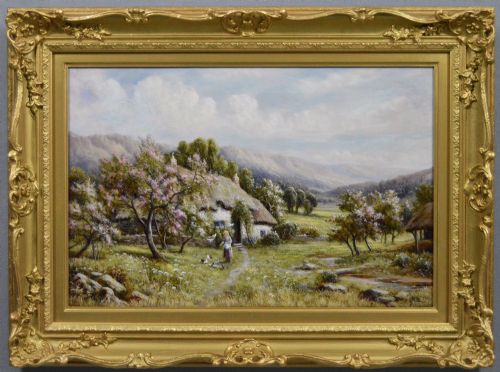
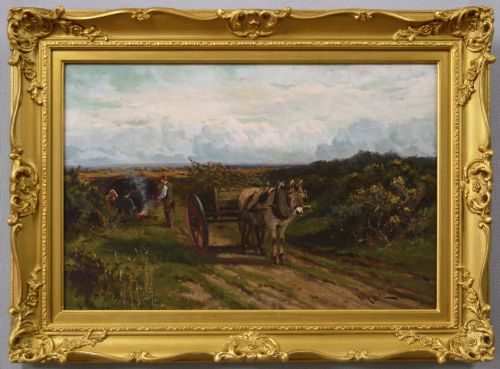
A vintage rural scenery painting represents the countryside through the eyes of artists working from the nineteenth century into the mid-twentieth century. These pieces capture quiet landscapes, agricultural fields, distant mountains, and traditional cottages using established artistic traditions.
Buyers browsing this selection encounter works created across several distinct decades, stretching from the Victorian period through to mid-century modern interpretations. The subjects range from English country scenes and Welsh mountain views to Dutch windmills and Scottish landscapes.
The format varies between large oil paintings on canvas and more intimate watercolours on paper. Most examples focus on human activity within the landscape, depicting figures working the land, leading animals, or walking along river banks.
Materials and construction
Artists relied primarily on oil paint applied to canvas or wood panels, alongside watercolours and gouache executed on paper. These traditional mediums allowed painters to build texture and depth when depicting foliage, sky, and rustic buildings.
Frames frequently complement the artwork, utilising gilt wood that enhances the visual weight of larger oil paintings. The combination of durable canvas supports and layered oil pigments has ensured the survival of these rural depictions over generations.
The selection includes traditional British landscapes alongside mid-century modern interpretations of rural scenery.
Aspects of quality
Distinction in these paintings often rests upon the handling of light and atmospheric perspective across open fields and skies. Stronger works demonstrate confident brushwork and a clear understanding of composition that draws the viewer into the rural setting.
The articulation of detail within the landscape, such as the depiction of figures, buildings, and vegetation, separates standard decorative works from accomplished artistic achievements. Preservation of the original canvas and the accompanying period frame also influences the standing of a piece.
Robert John Hammond·Harry Pennell·William Hoggatt·Samuel Towers·Arthur Walker Redgate·John B. MacDonald·Alastair Flatterly·Daniel Sherrin·Reginald Mills
The Vintage Rural Scenery Painting Glossary
- Canvas
- A heavy woven fabric stretched across a wooden frame to serve as a support for oil painting. It provides a durable surface that holds thick applications of pigment.
- Gouache
- An opaque water-based paint that includes a white pigment to create solid, flat areas of colour. It offers greater coverage than traditional watercolour.
- Watercolour
- A painting method where fine pigment particles are suspended in a water-soluble binder applied to paper. This technique allows for translucent washes and delicate effects.
- British Impressionism
- An artistic movement focusing on light, everyday subjects, and loose brushwork adapted from French styles by British painters. It prioritises the fleeting visual impression of a scene.
- English School
- A loose grouping of painters working within English traditions of landscape and portraiture. It spans multiple centuries and defines distinct national approaches to composition.
Vintage Rural Scenery Painting: Frequently Asked Questions
What periods do these paintings date from?
The works span from the nineteenth century through the mid-twentieth century. Painters recorded rural life across the Victorian era, the Edwardian period, and into the nineteen-fifties and sixties.
This timeline demonstrates shifting artistic approaches to the countryside, moving from detailed realism toward broader mid-century interpretations of landscapes.
How were these landscape paintings displayed?
Most oil paintings were housed in substantial gilt wood frames designed to project the artwork forward into a room. Watercolours on paper required protective glass and matting to preserve the delicate medium.
Framing choices often reflect the aesthetic preferences of the period in which the painting was created or later restored.
What subjects appear in these scenes?
The compositions focus on agricultural labour, country cottages, river banks, and open fields. Common elements include farm workers, figures with animals, and traditional rural architecture.
Artists frequently set these human elements against expansive backdrops such as Welsh mountains, Scottish terrain, or English cornfields.
How do watercolours differ from oils here?
Watercolours utilise paper supports and translucent washes of pigment to create lighter, more immediate impressions of the countryside. Oil paintings employ canvas or wood panels with thicker, layered paint.
Oils generally allow for deeper texture and richer colour saturation compared to the delicate nature of works on paper.