


Vintage Rosewood Music Holder
A vintage rosewood music holder organises scores and sheets with the distinct warmth of nineteenth-century timber.
Vintage Rosewood Music Holder
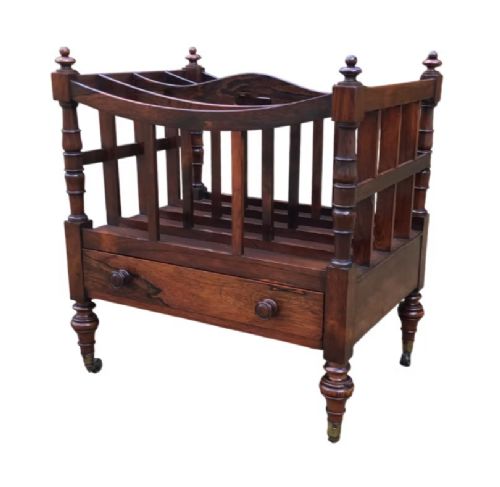
A vintage rosewood music holder typically takes the form of a Canterbury or magazine rack designed for domestic sheet music storage. These pieces appear across Regency, William IV, and Victorian periods, often featuring partitioned compartments for papers and folios.
Makers constructed these stands with differing division counts, sometimes incorporating a single lower drawer for smaller accessories or carrying handles at the top. The forms range from country house proportions to compact designs suited for smaller drawing rooms.
Originating predominantly from English and French workshops, these holders served as movable furniture pieces placed beside pianos and reading tables. The selections available encompass boat-shaped bodies and upright four-division frameworks.
Materials and Construction
Craftsmen utilised dense rosewood veneers and solid timber foundations, pairing the dark grain with brass castors and carrying handles. This combination provided both structural stability and a polished surface finish.
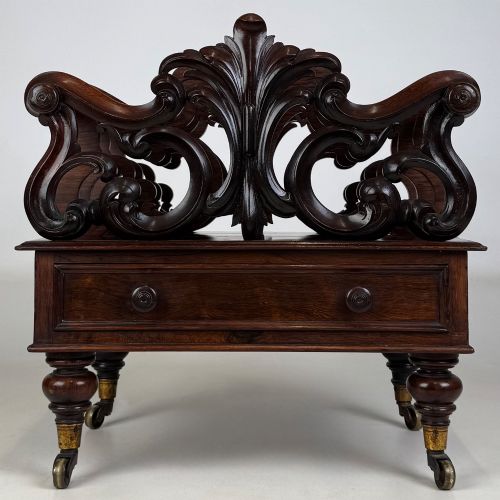
Joinery methods involved precise division framing for the upright slats, alongside hand-carved details such as foliate motifs or Prince of Wales feathers. Metal components like brass hinges and castors completed the movable assembly.
Judging Quality in Rosewood Stands
Quality depends on the crispness of the carved woodwork and the harmonious grain matching across the rosewood surfaces. Finer examples display meticulous attention to the fretwork divisions and the integration of any lower storage drawers.
Structural integrity of the slatted partitions and the original state of the brass castors distinguish superior specimens. The depth of the timber's natural colour and the restraint applied to decorative carving further separate workshop standards.
The Vintage Rosewood Music Holder Glossary
- Canterbury
- A low stand fitted with upright divisions for holding sheet music, newspapers, or folios. This term is frequently used interchangeably with music rack.
- Folio stand
- A larger display or storage rack designed to hold oversized art prints, maps, or bound music sheets. These stands often share similar partitioning to standard canterburys.
- Regency
- An English design period spanning the early nineteenth century defined by classical restraint and architectural lines. Pieces from this era often incorporate bold rosewood grains and brass detailing.
- William IV
- A transitional stylistic period bridging the Regency and Victorian eras during the 1830s. Furniture from this time typically exhibits robust proportions and heavier carved ornamentation.
- Foliate
- Ornamentation modelled upon leaves and foliage. Carvers applied this design to the upright supports and rails of nineteenth-century stands.
Vintage Rosewood Music Holder: Frequently Asked Questions
What is a music holder used for?
These stands were historically designed to hold sheet music, folios, and periodicals near a piano or seating area.
Today, they serve a similar domestic function for organising modern magazines, books, and vinyl records.
How do I tell Regency from Victorian styles?
Regency pieces generally display cleaner classical lines and restrained brass mounts characteristic of the early nineteenth century.
Victorian examples tend to feature heavier carved details, such as foliate designs or more elaborate pierced woodwork.
Did they all include drawers?
Not all music holders feature a lower drawer; many rely solely on the partitioned upper framework for storage.
Those that include a drawer underneath the partitions provide enclosed space for smaller items like tuning keys or manuscript papers.
How do I clean rosewood furniture?
Rosewood surfaces require gentle dusting with a soft cloth to protect the polished timber finish from abrasive particles.
Avoid harsh chemical cleaners and excessive moisture, using only specialised wax polishes formulated for antique hardwoods.