

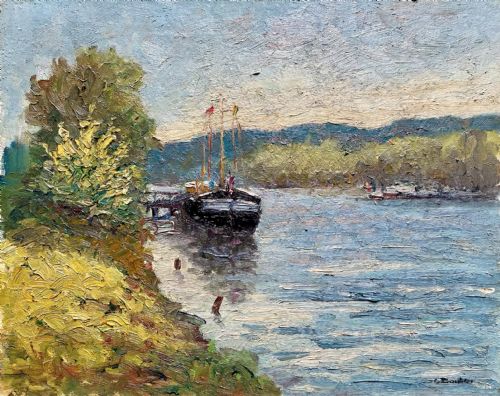


Vintage Riverbank Painting
A vintage riverbank painting brings quiet water and changing light indoors, capturing pastoral scenes in oil, watercolour, and pastel.
Vintage Riverbank Painting
A vintage riverbank painting captures watercourses, pastoral meadows, and aquatic life across British and European landscapes. These artworks range from late nineteenth-century Victorian naturalism to mid-century impressionist interpretations.
The most common examples on this page are oil on canvas and watercolour paintings depicting figures fishing, cattle grazing, and boats moored by the water. Artists rendered these rural views with attention to seasonal changes, particularly autumn and summer foliage.
The selection spans several decades, including works from the nineteenth century through to the nineteen-sixties. Landscapes appear in various formats, framed on wood and protected under glass.
Materials and methods
Artists painted these river scenes primarily with oil paint on canvas or board, utilising the rich texture of the medium to build depth in water and foliage. Watercolour on paper served artists who sought lighter, more fluid washes for skies and reflections.
Canvases stretch across wooden frames, often housed within period timber mouldings. Pastels on paper appear alongside these primary paint mediums, capturing soft atmospheric effects along the water's edge.
Listings feature works spanning from the nineteenth century through the nineteen-sixties, executed in oil, watercolour, and pastel.
Judging the work
The strength of a composition depends on how the artist handles light upon the water and the surrounding banks. Brushwork varies from the tight detail of Victorian naturalism to the looser, atmospheric strokes of post-impressionism.
Signatures and attributed provenance elevate certain works, while strong framing protects the canvas or paper over decades of display. The balance between the natural landscape and human elements, such as fishermen or cattle, defines the visual success of each piece.
Frederick Marriott·Archibald Kay RSA RSW·Walter Follen Bishop·Phyllis Morgans·Harry Davis·Henry John Sylvester Stannard·Robert John Hammond·Augustus William Ennes·Sonia Mervyn·Thomas E Francis·George Neil·David Adolph Constant Artz
The Vintage Riverbank Painting Glossary
- Impressionism
- A style of painting that focuses on accurate depiction of light in its changing qualities. Artists use small, thin yet visible brush strokes.
- Watercolour
- A paint wherein the colour pigments are suspended in a water-soluble vehicle. This medium creates translucent washes of colour on paper.
- Pastel
- A dry painting medium in the form of a stick, consisting of pure powdered pigment and a binder. It leaves a velvety matte surface.
- Pastoral
- A genre of painting depicting the rural life of shepherds, cattle, and rivers in an idealized and peaceful manner.
Vintage Riverbank Painting: Frequently Asked Questions
How do I hang a canvas painting?
Hang your canvas using sturdy picture wire attached securely to the wooden stretcher frame. Position the artwork at eye level away from direct sunlight and moisture.
Ensure the wall fixings match the weight of both the painting and its wooden frame for secure long-term display.
Are watercolours sensitive to light?
Watercolour paintings on paper require protection from direct sunlight to prevent the pigments from fading over time. Framing behind glass helps shield the delicate paper surface from atmospheric dust.
Keep these pieces in rooms with stable light levels and moderate humidity to preserve the integrity of the paper.
How do I identify the period of a painting?
Examine the materials, including the type of canvas, the stretching methods, and the style of the wooden frame. Stylistic clues such as Victorian naturalism or mid-century impressionism point towards specific decades.
Signatures, dates inscribed on the reverse, and artist records provide the most accurate chronological markers.
What subjects feature in these river scenes?
Common motifs include fishermen by the water, children fishing, cattle grazing on the banks, and boats moored near trees. These pastoral subjects reflect popular British and European landscape traditions.
Artists frequently returned to specific waterways, such as the Seine or local wooded rivers, to capture changing seasonal light.