



Vintage Repeating Mantel Clock
A vintage repeating mantel clock is a mechanical timepiece designed for travel or domestic use that chimes the hours and quarters on demand.

Vintage Repeating Mantel Clock
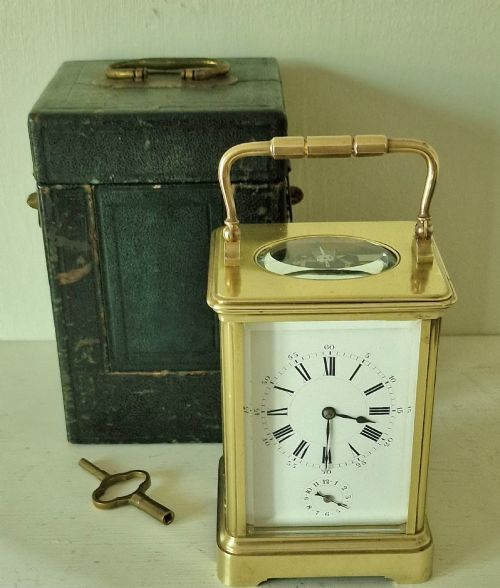
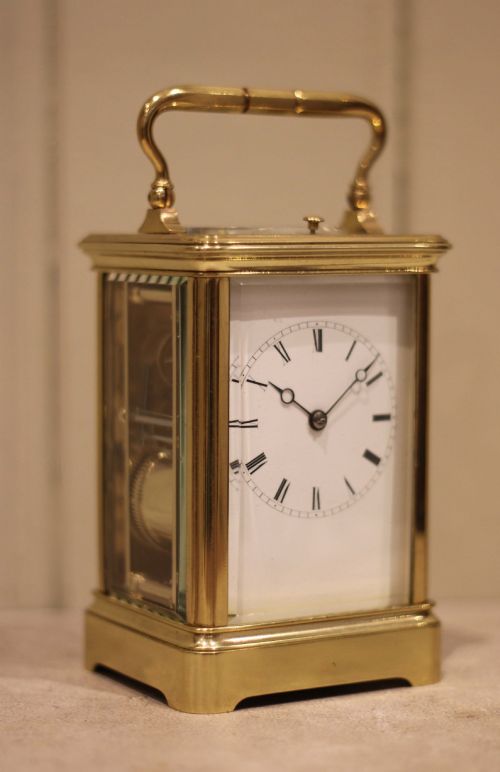
When you search for a vintage repeating mantel clock, you are primarily looking at French carriage clocks and British bracket clocks produced across the nineteenth and early twentieth centuries. The vast majority of examples you will meet on this page are French carriage clocks housed in brass or gilded metal frames with glass panels.
These pieces combine portability with complex striking and repeating mechanisms developed to tell the time in the dark. They range from plain brass gorge cases to elaborately engraved models featuring enamel bandings, enamel paintings, and alarm functions.
How they were made
The mechanical movements relied on steel components and brass plates, incorporating eight-day trains, escapements, and specialised gong or bell strike systems. Many cases utilised traditional forms such as the gorge case or doucine case, finished with original gilding or polished bright surfaces.
Vintage Repeating Mantel Clock Retail Price Guide 2026
Typical asking prices for vintage repeating mantel clock among the pieces listed under this phrase on Sellingantiques today, from the lower quarter to the upper quarter. They describe what is for sale here now, not the wider market.
One exceptional nineteenth-century carriage clock specifically notes race horse interest in its provenance.
What varies in quality
The distinction between standard production and the finest horology lies in the complexity of the movement and the integrity of the case. Petite sonnerie, grande-sonnerie, and five-minute repeating complications demand exceptional skill, separating basic striking clocks from high-tier examples.
Case execution and maker attribution also drive the upper tier of quality. Heavy gorge cases with original fire gilding, intricate hand-engraved masks, and signed movements by known makers command attention above routine commercial output.
Bishop Bournemouth·Drocourt·Dwerrihouse And Bell·Henry Jacot·J W Benson·L Epee·Dent
The Vintage Repeating Mantel Clock Glossary
- Repeating movement
- A mechanism that sounds the last hour or quarter-hour when a button or pendant is depressed by the user. This function was essential before electric lighting.
- Gorge case
- A distinct rectangular carriage clock case style featuring stepped mouldings to the top and base. It provides a solid architectural housing for the brass movement.
- Striking
- An independent train within the clock that sounds the hours or half-hours automatically on a bell or gong. It relies on a separate spring barrel from the time-keeping train.
- Carriage clock
- A small, spring-driven clock designed to be portable, equipped with a folding handle on top. They originated in France for officers and travellers.
- Enamel dial
- A metal face coated with fused glass powder and fired in a kiln to produce a durable white surface. Numerals are painted onto the smooth ground.
Vintage Repeating Mantel Clock: Frequently Asked Questions
How do I wind my clock?
Most of these timepieces use a specialised double-ended winding key inserted into arbours on the backplate or dial face.
Take care not to overwind the mainsprings, keeping a steady rotation until resistance meets your hand.
Where were these clocks made?
The majority of the carriage clocks originate from French workshops, particularly in Paris, during the nineteenth century.
British makers contributed bracket clocks and occasional retail variants housed in mahogany or gilded metal.
How do I tell the periods apart?
Earlier nineteenth-century examples often feature heavier plates, specific escapement types like platform cylinder or lever setups, and classic gorge frames.
Late nineteenth and early twentieth-century pieces frequently introduce refined enamel paintings, decorative bandings, and serial numbers stamped on the movement.