


Vintage Relief Carved Table
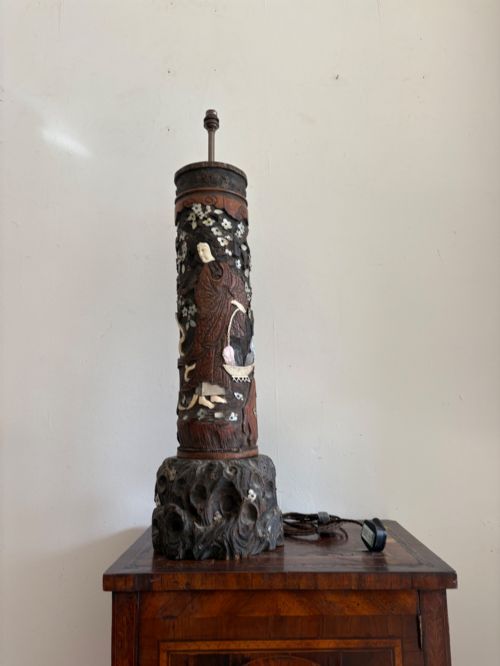
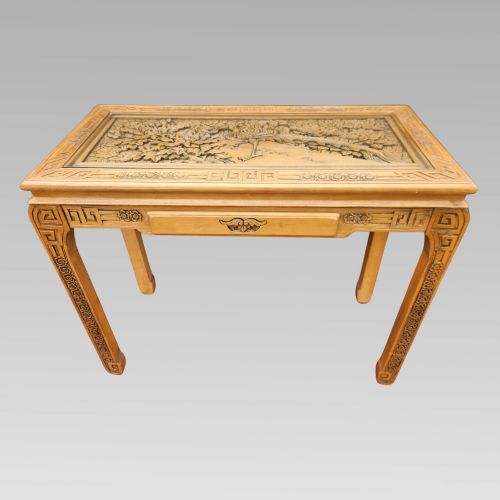
These vintage relief carved table pieces bring deep texture and worldly craft into a room.
Vintage Relief Carved Table
When a buyer explores a vintage relief carved table, they encounter items shaped by diverse global aesthetics, from Anglo-Indian and Chinese export traditions to Art Deco expressions. These objects range from compact coffee tables and nests of three or four tables to side consoles and folding variants.
The version most commonly met on this page is the low coffee table or nested set in teak or camphorwood, featuring carved elephants or intricate foliage. Alongside these, buyers find side tables and tea tables rooted in the nineteenth century or the early decades of the twentieth century.
Materials and construction
Makers utilised dense timbers such as teak and hardwood as the foundation for deep chisel work, allowing intricate motifs to emerge directly from the wood grain. In certain examples, mother of pearl inlay enhances the carved surfaces.
Joinery methods varied according to origin, incorporating folding mechanisms for portability in oriental pieces or sturdy frames designed for tea service and display in Victorian and Art Deco settings.
Listings span periods from the 1800s and Victorian era through the 1920s and 1930s, featuring teak, hardwood, and mother of pearl.
Judging quality in carved furniture
The distinction at the top of the range lies in the depth and crispness of the chisel work, where motifs retain sharp edges and organic fluidity rather than a flat, machine-pressed finish. The choice of timber also dictates quality, with dense teak and camphorwood offering superior durability.
Proportion and structural integrity separate fine examples from simpler items, particularly in nested sets and folding designs where stability relies on precise alignment of the carved elements.
The Vintage Relief Carved Table Glossary
- Relief carving
- A sculptural technique where figures or patterns project from a flat background. This method creates dramatic shadow and tactile depth on table tops and friezes.
- Nest of tables
- A set of graduated tables designed to fit neatly beneath one another. They provide flexible surface space in compact rooms.
- Chinoiserie
- European artistic style reflecting Chinese motifs and techniques. It often appears on lacquered surfaces with raised detail.
- Meiji Period
- Era in Japanese history spanning the late nineteenth and early twentieth centuries. Pieces from this time demonstrate exceptional decorative detail.
Vintage Relief Carved Table: Frequently Asked Questions
How do I style a carved table?
Pair these pieces with minimalist upholstery to let the textured wood grain and intricate carving remain the visual focus of the room.
They function effectively as low coffee tables or beside seating as lamp stands, bringing organic warmth to contemporary interiors.
What woods were used for these tables?
Makers predominantly worked with dense hardwoods such as teak and camphorwood, which supported deep chisel work without splintering.
These timbers age with a rich patina that deepens the character of the carved surface over decades.
Are nested tables a recent invention?
Nested tables gained popularity during the Victorian era and continued through the Art Deco period as practical space-saving furniture.
Sets of three or four tables allowed households to expand surface area quickly when serving tea or entertaining guests.
How do I identify the period?
Dating relies on combining the timber choice, joinery style, and decorative motifs such as Art Deco elephant carvings or nineteenth-century oriental themes.
Comparing the depth of the carving and the construction methods helps place a piece within the Victorian, Edwardian, or mid-century eras.