


Vintage Postal Scale Weights
Vintage postal scale weights are functional brass and timber desk instruments designed to measure letter post, prized for their sturdy nineteenth and early twentieth century utility.
Vintage Postal Scale Weights
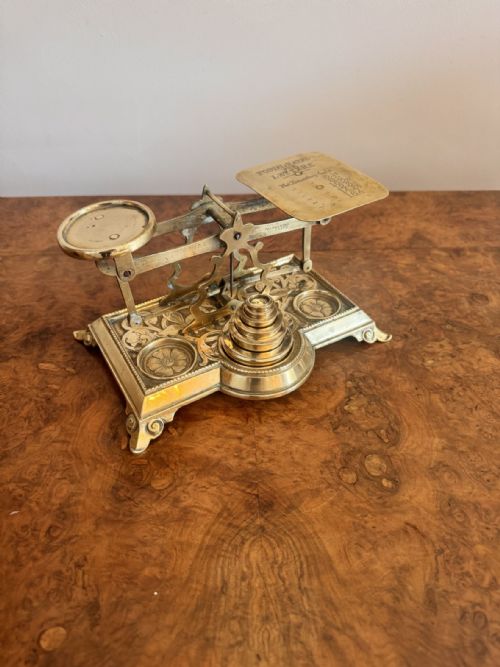
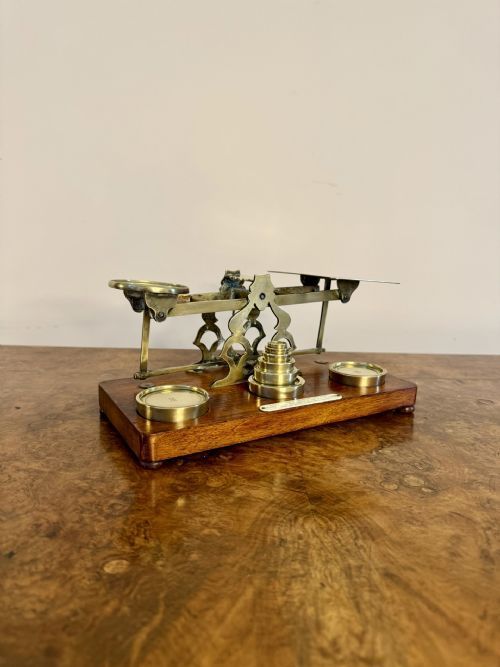
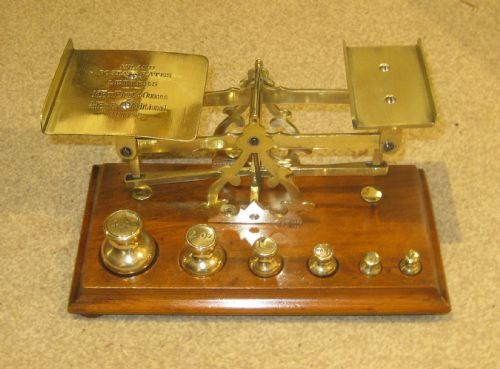
When you search for vintage postal scale weights, you are looking at utilitarian desk pieces from the Victorian and Edwardian eras. These items typically comprise a balanced lever mechanism mounted on a timber base, accompanied by matching metal pieces for measuring correspondence.
The versions you are most likely to meet on this page date from the later nineteenth century up to the early twentieth century. They span the periods recorded in our listings, specifically the 1860s through to 1910.
The forms vary from simple brass platforms to large sets mounted on mahogany, oak, or walnut bases. Many examples include fitted wooden trays or recesses to hold the graduating brass objects securely alongside the main apparatus.
How they were made
Maker workshops constructed these instruments using durable metals and seasoned timbers, pairing cast or turned brass for the scale mechanism and balancing arm. Bases were shaped from hardwoods such as mahogany, oak, walnut, or general hardwood.
The materials reflect the functional demands of Victorian and Edwardian offices, where heavy daily use required solid timber foundations and robust metal components that could withstand constant handling.
Listings span the periods from 1860 to 1910, incorporating both Victorian and Edwardian examples.
What varies in quality
Quality in these instruments is determined by the substance of the timber base and the precision of the brass work. Finer examples display substantial oak or mahogany platforms paired with crisply finished metal components.
Maker attribution elevates certain sets above standard utilitarian pieces. Signed examples from established London makers demonstrate superior finishing on both the timber base and the associated metal elements.
S Mordan·S Mordan Co London
The Vintage Postal Scale Weights Glossary
- Victorian
- Belonging to the reign of Queen Victoria, spanning from 1837 to 1901. Pieces from this era often feature heavier timber bases and robust brass engineering.
- Edwardian
- Relating to the period of King Edward VII, covering 1901 to 1910. Items from this time frequently exhibit lighter wood selections and refined styling.
- Mahogany
- A durable tropical hardwood favoured for nineteenth-century desk accessories. It provides a stable, dark-toned platform for mounted brass mechanisms.
- Brass
- A yellow copper and zinc alloy utilised for the moving arms and measurement platforms. It offers both corrosion resistance and a bright metallic finish.
- Walnut
- A dense, figured timber selected for quality desk furnishings. Its rich grain adds visual depth to the base of the apparatus.
Vintage Postal Scale Weights: Frequently Asked Questions
How did people use postal scales?
Users placed letters or small parcels on the brass platform to determine the correct postage rate before sending correspondence.
The matching metal pieces were added or removed from the opposite side until the lever balanced level, indicating the exact weight class required.
What woods were used for bases?
Cabinet makers utilised dense hardwoods such as mahogany, oak, and walnut to construct stable platforms that supported the brass mechanisms.
These timbers were chosen for their durability and attractive grain, ensuring the instruments could withstand frequent office use while remaining presentable.
How do I date these scales?
Dating relies on stylistic clues and construction methods typical of the Victorian and Edwardian periods recorded in our listings.
Earlier nineteenth-century examples often display heavier mahogany platforms, whereas pieces from the nineteen-tens tend to feature solid oak or alternative Edwardian design traits.
Where were they kept?
These instruments sat on writing desks, in libraries, or within commercial counting houses where daily correspondence required accurate measurement.
Their substantial timber bases kept them stable on heavy furniture during busy office hours.