




Desk Balance Scales
Desk balance scales are precision instruments for weighing mail that bring functional Victorian and Edwardian craftsmanship directly to a modern desktop.
Desk Balance Scales
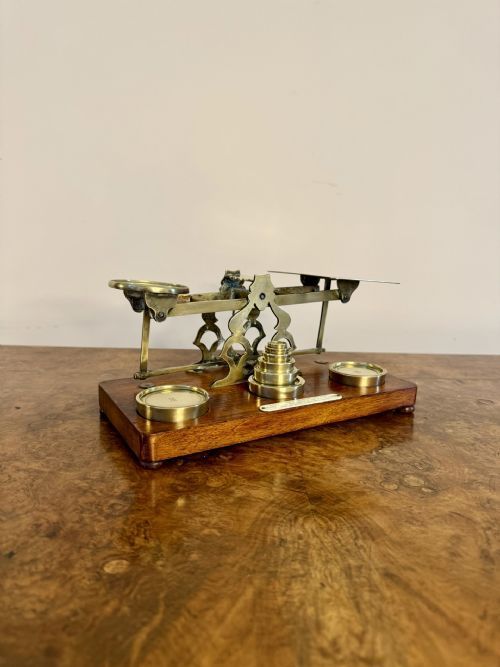
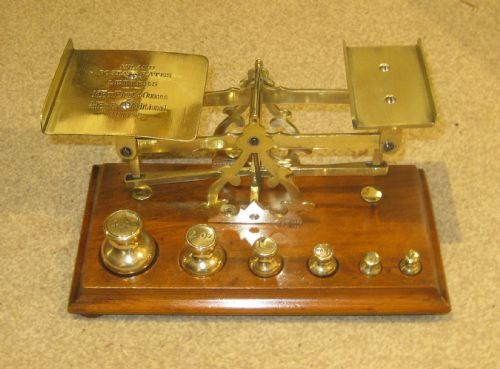
Desk balance scales are compact weighing devices designed specifically for domestic and office correspondence during the nineteenth and early twentieth centuries. These instruments typically feature a central beam with suspended pans, resting on a decorative base used to hold sets of matching brass weights. The examples on this page are predominantly postal scales originating from the Victorian and Edwardian eras, spanning from the mid-nineteenth century up to nineteen-ten.
How they were made
Makers constructed the bases of these scales from dense hardwoods like mahogany, walnut, and oak, often shaping the timber to house matching weight sets neatly beside the mechanism. Brass forms the pivoting beams, pans, and calibrated weights, providing the necessary durability and corrosion resistance for daily office use. More decorative versions incorporate polished marble or striking green malachite into the plinth alongside the metal components.
Metalworking techniques involved casting the brass beams and pans before hand-finishing and polishing them to a bright metallic lustre. Woodworkers turned, joined, and polished the mahogany and oak bases, cutting precise recesses to cradle the individual brass weights securely during weighing operations.
Listings for desk balance scales span the Victorian and Edwardian periods, featuring materials such as mahogany, oak, walnut, marble, and malachite.
What varies in quality
Quality in desk balance scales is determined by the crispness of the brass casting, the richness of the timber grain, and the presence of a complete, matching set of original weights. Pieces bearing maker signatures like S. Mordan and Co or Ratcliff demonstrate superior workshop provenance compared to unsigned domestic instruments. The choice of base materials also elevates a piece, moving from standard hardwoods to exotic stones like malachite or intricately turned architectural forms.
The engineering of the fulcrum and beam balance dictates the mechanical precision of the instrument, where smooth movement separates utilitarian items from fine desk accessories. Superior examples exhibit balanced proportions and integrated storage compartments for weights that fit their housings without excessive play.
S Mordan·Ratcliff Birmingham
The Desk Balance Scales Glossary
- Postal scales
- Weighing devices specifically calibrated to determine letter and parcel postage rates. They became essential desk furniture following postal reforms in the nineteenth century.
- Balance beam
- The horizontal pivoting metal bar that supports the weighing pans at either end. Its precise central fulcrum ensures accurate weight measurement.
- Plinth
- The solid wooden, marble, or stone base that supports the weighing mechanism and provides storage for the matching brass weights.
- Candlestick scale
- An uncommon hybrid design where the central vertical column of the scale resembles a domestic candlestick. These combine illumination styling with weighing functionality.
Desk Balance Scales: Frequently Asked Questions
What are desk balance scales used for?
These instruments were utilised in nineteenth and early twentieth century offices and homes to weigh letters and parcels accurately. Determining the correct weight ensured the proper postage stamps were affixed before dispatch.
Today, they function primarily as decorative desktop objects and tactile pieces of social history. Collectors appreciate their combination of mechanical utility and period craftsmanship.
How do I date desk balance scales?
Dating relies upon stylistic markers, timber choices, and occasionally stamped maker marks or Victorian registry diamond symbols on the brass. Mid-nineteenth-century examples often feature simpler mahogany plinths, while Edwardian versions showcase solid oak or walnut.
Maker signatures from firms like S. Mordan provide a clearer production window when compared with unsigned items. Comparing the shape of the brass pans and the style of the wooden base against known period pieces confirms the era of manufacture.
Are the weights usually original?
Many surviving desk balance scales retain their matching set of stepped brass weights, which nest together or fit into designated slots on the wooden base. Finding a complete set that matches the exact recessed channels adds significantly to the completeness of the piece.
Replacement weights are common due to the small size of the individual pieces becoming easily misplaced over decades of use. Examining the patina and wear on both the scale and the weights helps determine if they have remained together since production.
How do I clean brass scales?
Maintenance requires gentle dusting and occasional cleaning with a soft cloth to preserve the aged metallic patina accumulated over the decades. Harsh chemical polishes should be avoided because they strip away historical surface character and can damage surrounding wood or stone.
Wooden bases benefit from a light application of appropriate furniture wax to nourish the grain without affecting the metal parts. Keeping the instruments away from damp environments prevents corrosion on the brass and warping in the timber plinths.