


Vintage Portrait Cameo
A vintage portrait cameo offers a wearable slice of classical history, bringing hand-carved profiles in shell and stone straight to your lapel.
Vintage Portrait Cameo
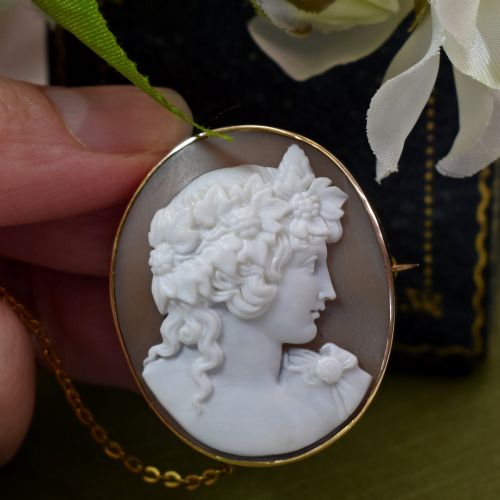
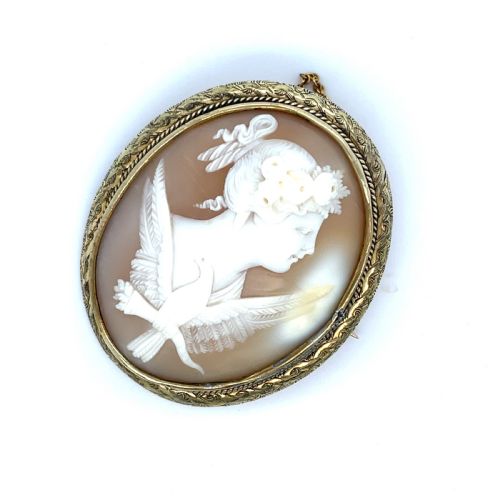
When you search for a vintage portrait cameo, you encounter carved likenesses spanning the Victorian era through the mid-twentieth century, predominantly mounted as brooches, rings, and earrings. These miniature reliefs depict classical figures, mythological deities, and historical profiles carved with immense patience.
The Victorian pieces form the backbone of this selection, often framed in solid gold or pinchbeck and showcasing intricate shell carving. You also find Edwardian iterations and later twentieth-century interpretations in silver, hardstone, and jasperware.
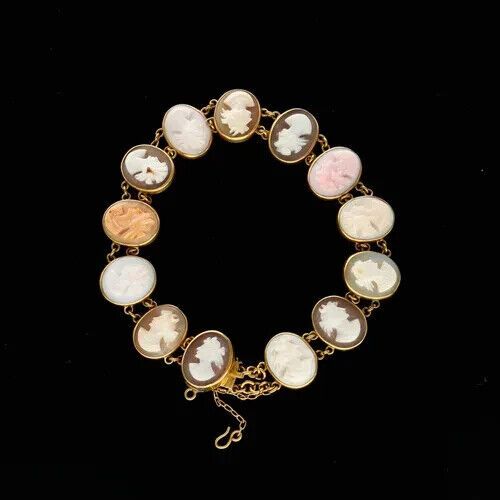
Forms range from simple single-portrait rings to monumental framed wall plaques and matching sets of brooches and earrings. Each piece serves as a wearable portrait that bridges ancient neoclassical themes with nineteenth and twentieth-century jewellery traditions.
Materials and carving techniques
Carvers predominantly utilised natural materials with distinct colour layers, most commonly conch and helmet shells, which reveal a creamy white profile against a peach or pink background. Hardstone and coral also appear, offering robust alternatives for rings and pins that demanded greater durability.
The relief work relies on subtractive carving, where the artisan meticulously pares away the upper layer of material to leave the raised portrait standing proud against a contrasting base. Frames in nine-carat and fifteen-carat gold, silver, or pinchbeck were then custom-made to house these delicate carvings.
Materials documented in these items include natural shell, hardstone, coral, jasperware, and stoneware alongside plaster reliefs.
Distinguishing quality in cameos
The distinction between ordinary and exceptional work lies entirely in the hand of the carver and the depth of the relief. Superior pieces display anatomical precision in the subject's nose, chin, and hair, alongside a smooth, polished background free from natural shell blemishes or tool marks.
Mount quality matches the carving in finer examples, featuring substantial gold frames with detailed wirework, granulation, or integrated safety chains. Lesser pieces often exhibit flat, lifeless profiles cut mechanically or set into simple, lightweight mounts with minimal craftsmanship.
R. Pernice·Wedgwood
The Vintage Portrait Cameo Glossary
- Cameo
- A method of carving an object such as a gemstone, shell, or piece of hardstone where a raised relief is created from a multi-coloured background. This technique contrasts light figures against darker fields.
- Hardstone
- A gemstone such as agate, onyx, or jasper used for carving cameos due to its durability and natural strata. These stones permit microscopic detail that softer materials cannot hold.
- Pinchbeck
- An alloy of copper and zinc invented in the eighteenth century to imitate gold. It provides a warm, durable yellow metal setting for many nineteenth-century pieces.
- Jasperware
- A type of fine stoneware developed with a matte surface, famously produced in blue and white. It yields crisp, neoclassical portrait medallions rather than hand-carved shell reliefs.
- Neoclassical
- An artistic movement drawing inspiration from the classical art and culture of ancient Greece and Rome. This aesthetic heavily dictates the portrait subjects chosen by cameo carvers.
Vintage Portrait Cameo: Frequently Asked Questions
How do I wear a vintage cameo brooch?
Pin your cameo securely to the lapel of a heavy winter coat, the collar of a structured blouse, or centered on a velvet ribbon around the neck. Ensure the fabric has enough weight to support the metal frame without sagging.
Because many Victorian frames feature delicate gold work and integrated pin stems, fasten them carefully and avoid catching the pin on loose knits or delicate silks.
What is the difference between shell and hardstone?
Shell cameos utilise layers from marine molluscs, producing warm pink or peach backgrounds behind opaque white figures. They offer translucent depth but require gentle handling.
Hardstone cameos use banded stones like agate or onyx, yielding crisper details and greater durability suitable for daily ring wear.
How can I date a portrait cameo?
Examine the mounting style, clasp mechanism, and the subject's hairstyle to estimate the period. Victorian pieces often feature heavy gold rope twists and C-scroll clasps.
Edwardian and later twentieth-century examples frequently incorporate safer tubular hinges and roll-over catches alongside lighter metal frames.
Can cameo rings be resized safely?
Resizing depends entirely on the material of the hoop and how the cameo is secured into the shoulders. Plain gold bands are straightforward for a skilled jeweller to adjust.
Solid stone rings or fragile antique mountings require specialist evaluation to prevent cracking the carved material during heating.