




Vintage Playing Card Case
A vintage playing card case protects your cards in style, housing decks for bridge, whist, or patience with distinct period charm.
Vintage Playing Card Case
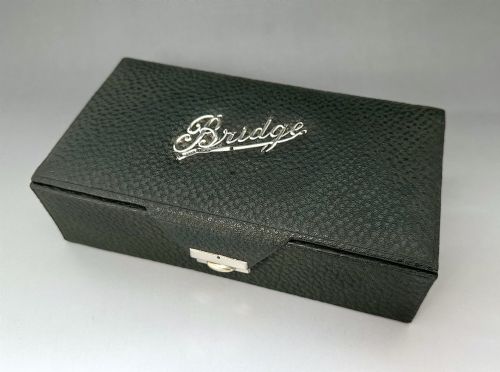
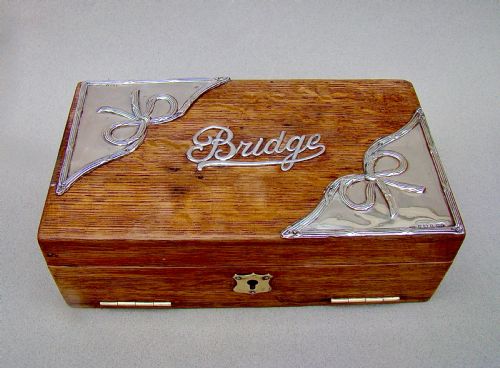
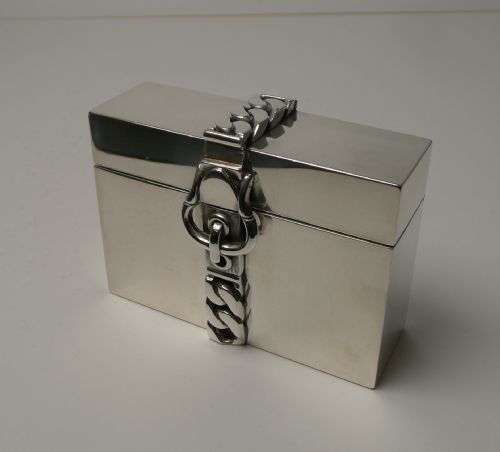
A vintage playing card case brings together the social pastimes of the parlour and the drawing room, taking forms such as bridge boxes, games boxes, and dedicated card caskets. When you search for a vintage playing card case, you encounter pieces designed to hold one or two packs securely, often accompanied by scoring markers, cribbage boards, or small spoons for card suits. The selection on this page draws from the Victorian, Edwardian, and Art Deco eras, alongside mid-century modernist designs from Italy.
How they were made
Makers utilised a combination of precious metals, timber, and fitted materials, with sterling silver and leather forming the backbone of Edwardian and Victorian construction. Silver components were shaped and hallmarked in centres such as Birmingham, often featuring repoussé work, hinges, and secure clasps. Oak and other hardwoods provided structural integrity for larger games boxes and caskets.
Detailing relied on specialised decorative techniques, including enamel and black lacquer applied to Italian silver boxes from the mid-twentieth century. Interiors frequently featured delicate satin linings and custom slots to hold paper cards and counters firmly in place. Bakelite also appears in later twentieth-century pieces, marking the shift towards modern industrial materials.
What varies in quality
The standard of a vintage playing card case rests on the integrity of its construction, the thickness of the silver mounts, and the preservation of internal linings such as satin or leather. Pieces that retain their original fitted trays, working clasps, and crisp hallmarks command greater attention from collectors. The precision of the joinery in wooden boxes and the depth of surface ornamentation on silver lids also signal higher craftsmanship.
Material combination dictates distinction, particularly where enamel, lacquer, or Bakelite integrate with solid silver or sterling silver frames. Simpler utilitarian boxes exist alongside elaborate imported specimens featuring complex multi-game interiors. The clarity of period characteristics, whether Edwardian elegance or Art Deco geometry, defines the overall calibre of each piece.
Levi & Salaman·Nelson and Drake
The Vintage Playing Card Case Glossary
- Bridge box
- A specialised container designed to hold playing cards and scoring equipment specifically for the game of bridge.
- Hallmark
- An official stamp applied to precious metals indicating the standard of purity, the assay office, and the date of manufacture.
- Repoussé
- A metalworking technique where the metal is hammered from the reverse side to create a raised design in relief.
- Bakelite
- An early form of synthetic plastic utilised in twentieth-century manufacturing for handles, boxes, and decorative elements.
- Patience
- A card game played by a single person, giving rise to smaller, dedicated boxes tailored for solo play.
Vintage Playing Card Case: Frequently Asked Questions
What fits inside a card box?
These boxes are dimensioned to hold standard paper playing cards, occasionally with dedicated compartments for scoring counters or small pencils.
Some iterations include rising card trays or partitioned interiors to separate multiple decks for bridge or patience.
How do I date silver boxes?
Silver pieces generally carry hallmarks that indicate the assay office, standard of silver, and a specific date letter corresponding to the year of manufacture.
Stylistic cues such as Edwardian leather mounts or Art Deco geometric lines further help establish the period.
Were these used for travel?
Many Edwardian and Victorian examples utilised sturdy leather casings and secure silver latches to protect cards during journeys.
Heavier wooden games boxes were typically stationary pieces kept on parlour tables for evening entertainment.
What is a bridge box?
A bridge box is a fitted container created to hold the specific cards and accessories required for the card game bridge.
They frequently incorporate hinged lids, satin linings, and specialised slots for scoring pads.