




Vintage Miniature Clock
These vintage miniature clock examples offer precision timekeeping in diminutive scales, combining intricate metalwork and cabinetry to grace desks and mantelpieces alike.
Vintage Miniature Clock
A vintage miniature clock brings together precision horology and cabinetmaking on a tiny scale, designed to sit upon a desk, shelf or mantelpiece without dominating a room. When you examine a vintage miniature clock on this page, you encounter small carriage clocks, bracket clocks and longcase models spanning the Victorian, Edwardian and Art Deco periods.
The carriage clock forms the largest group within these listings, predominantly originating from French and English makers in brass, gilt metal or silver. Alongside these portable designs, you find scaled-down longcase clocks and bracket clocks in mahogany, walnut and tortoiseshell reflecting styles from George II to the Gothic revival.
How they were made
Makers constructed the outer cases of these timepieces using cast and engraved brass, gilded bronze, sterling silver and various hardwoods such as mahogany and walnut. Many metal examples feature glass panels to expose the escapement, whilst others incorporate champlevé, guilloché or Limoges enamel plaques set into the bezels and dials.
Movements were engineered by specialist horologists to fit tight spaces, utilising platforms, escapements and spring-driven gear trains that often provided eight-day runs or alarm functions. Silversmiths and brassworkers hand-chased floral and scroll motifs onto the outer frames, while cabinetmakers scaled down traditional architectural proportions for miniature longcase and bracket clock bodies.
Vintage Miniature Clock Retail Price Guide 2026
Typical asking prices for vintage miniature clock among the pieces listed under this phrase on Sellingantiques today, from the lower quarter to the upper quarter. They describe what is for sale here now, not the wider market.
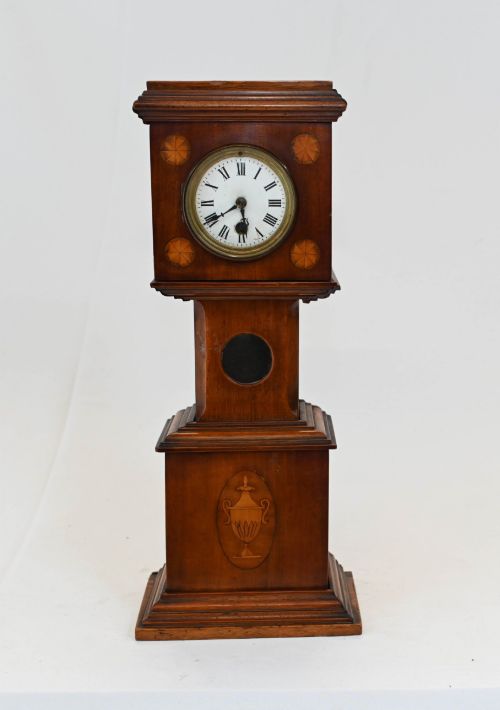
One diminutive watch stand takes the whimsical form of a full-scale grandfather clock, shrinking architectural proportions for a desk.
What varies in quality
The standard of a vintage miniature clock rests upon the crispness of the case chasing, the depth of the gilding or silver work, and the reputation of the horologist who produced the movement. Pieces bearing signatures from established makers like Dent, Mappin & Webb or J C Vickery exhibit superior dial legibility, fine hand-engraving and well-finished gear trains.
Material choice and decorative complexity further separate ordinary timepieces from exceptional ones. Simple brass travel pieces sit at one end, while examples featuring polychrome enamel panels, tortoiseshell veneers or complex striking and chiming mechanisms demonstrate the highest tiers of nineteenth and twentieth-century workshop skill.
Mappin & Webb·J Batson & Son·Dent of London·Henry Matthews·J C Vickery·Adams of Lombard Street
The Vintage Miniature Clock Glossary
- Carriage clock
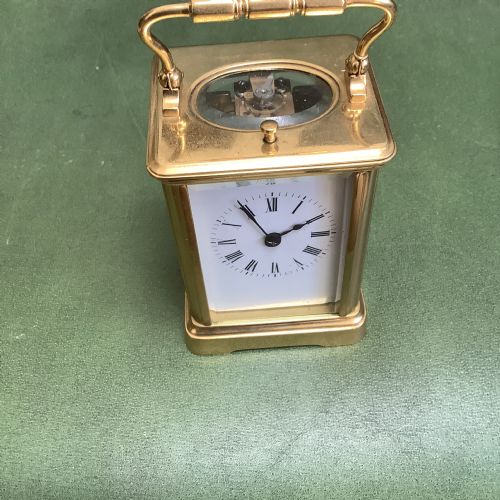
- A small, portable spring-driven timekeeper traditionally fitted with a swinging handle and glass sides. These were originally designed for travel by horse-drawn carriage or train.
- Champlevé enamel
- A technique where troughs are gouged into a metal surface, filled with vitreous enamel powder, and fired. The resulting piece is then ground flush and polished.
- Guilloché
- A decorative mechanical technique whereby precise, intricate geometric patterns are engraved into a metal substrate. This layer is frequently covered with translucent coloured enamel.
- Escapement
- The internal mechanism within a clock that controls the release of power from the mainspring to the gear train. It gives the characteristic ticking sound to mechanical timepieces.
- Bracket clock
- A portable spring-driven clock originally designed to sit upon a wall bracket to aid sound projection. Later examples functioned as decorative desk or mantel ornaments.
Vintage Miniature Clock: Frequently Asked Questions
Were miniature longcase clocks made to keep accurate time?
Miniature longcase clocks were fully functional timekeepers driven by spring mechanisms rather than falling weights. They offered reliable daily or eight-day timekeeping suited for domestic desk and mantel use.
Horologists scaled down standard movement architectures to fit narrow wooden hoods, maintaining pendulum or platform balance regulation. Their accuracy depended upon regular servicing and stable environmental conditions.
How can I tell a French carriage clock from an English one?
French examples from the nineteenth century frequently employ platform escapements with visible balance wheels through glass panels. They often bear distinctive serial numbers or maker stamps on the backplate.
English variants from makers such as Mappin & Webb or J C Vickery often incorporate robust fusee movements or traditional lever escapements. The casework styling also reflects distinct national preferences in chasing and silver hallmarks.
Where should I place a delicate enamel timepiece?
Enamelled and silver pieces require stable interior positions away from direct sunlight and damp environments. Direct heat sources can cause timber cases to warp and enamel panels to craze.
Placing them on a secure mantel shelf or glass-fronted collector cabinet protects the delicate gilt brass and glass panels from accidental knocks. Ensure the selected surface is level to keep the mechanical balance ticking evenly.