





Vintage Mary Charm
These vintage mary charm pieces are French devotional pendants in gold, mother of pearl and enamel that collectors prize for their intricate religious artistry.
Vintage Mary Charm
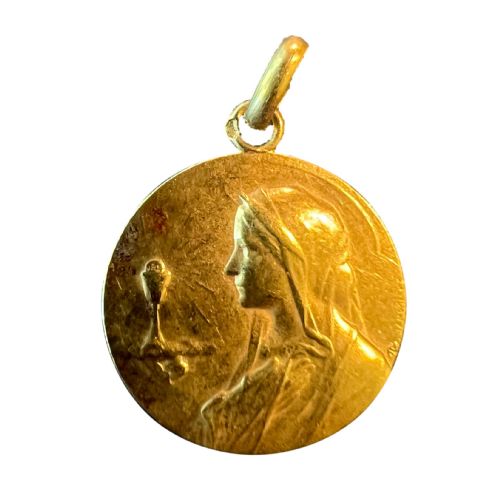
A vintage mary charm is primarily a French religious medal or pendant worn to display devotion to the Virgin Mary and the Madonna and Child. These items date predominantly from the early twentieth century, specifically clustering around the nineteen-ten period.
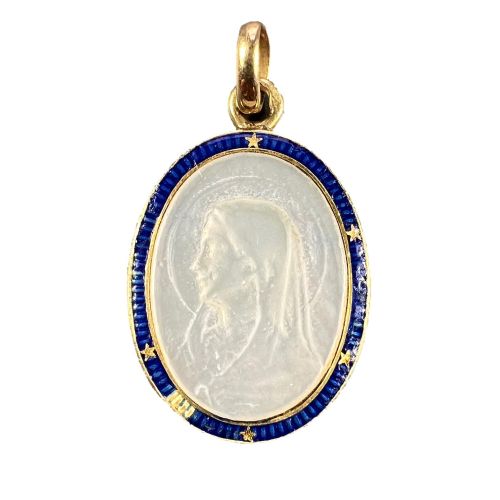
Buyers will most commonly encounter oval and circular gold charm pendants that incorporate devotional imagery such as Notre Dame of Lourdes or the Miraculous Medal. The forms function simultaneously as wearable jewellery and as miniature works of French medallic art.
The selection reflects origins in France, spanning stylistic movements from Art Nouveau and Art Deco to Victorian and Mid-Century aesthetics. Pieces frequently combine textual elements such as Ave Maria or Virgo Virginum with figurative engraving.
How they were made
The body of each pendant is formed from eighteen-carat yellow, rose or white gold, providing a warm metal foundation for the detailed religious motifs. Goldsmiths combined casting and stamping techniques to shape the medals and secure the suspended charm loops.
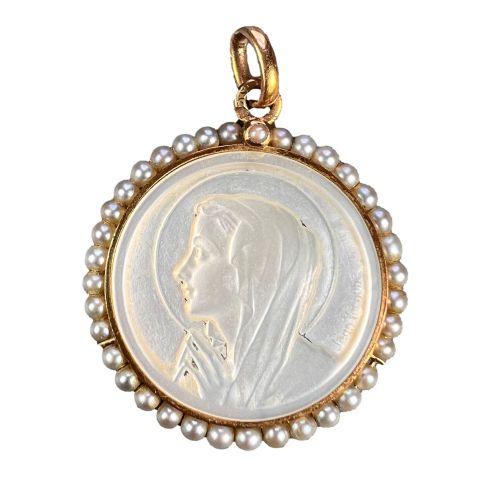
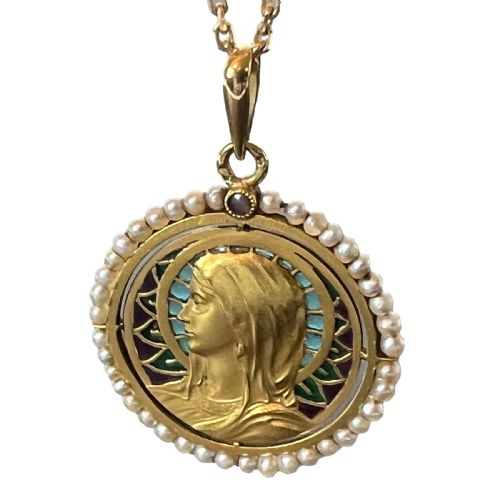
Artisans applied translucent plique-a-jour enamel and opaque enamel directly onto the gold framework to introduce colour and luminosity to the garments and haloes. Mother of pearl was shaped and polished to serve as an iridescent backing plate for carved relief figures.
Seed pearls were hand-threaded and mounted onto the gold settings to border the central devotional scenes. Engravers used fine tools to chisel lettering and minute facial expressions into the metal surfaces.
Vintage Mary Charm Retail Price Guide 2026
Typical asking prices for vintage mary charm among the pieces listed under this phrase on Sellingantiques today, from the lower quarter to the upper quarter. They describe what is for sale here now, not the wider market.
Materials recorded across the selection include eighteen-carat yellow, white and rose gold alongside seed pearls.
What varies in quality
The distinction between standard items and superior examples rests upon the intricacy of the medallist's work and the depth of the metal relief. Signed pieces attributed to known designers demonstrate a higher degree of sculptural precision in the rendering of drapery and expression.
Quality also depends on the preservation of fragile decorative elements such as plique-a-jour enamel and seed pearl surrounds. Intact, unblemished enamel work that allows light to pass through the metal cells elevates the overall execution of the pendant.
Emile Monier·Pageli Perriat·Emile Dropsy·Sellier·Mazzoni·Augis Grun·Serraz
The Vintage Mary Charm Glossary
- Plique-a-jour
- An enamelling technique where enamel is applied to a cellular metal framework without a backing, resembling miniature stained glass. This method lets light pass directly through the translucent coloured sections.
- Miraculous Medal
- A devotional medal whose design was based on Catherine Labouré's vision of the Blessed Virgin Mary. The imagery typically includes specific rays of light and protective devotional symbols.
- Seed Pearl
- Very small natural or cultured pearls used to edge jewellery or form delicate floral patterns. They are often individually drilled and secured with fine wire.
- Mother of Pearl
- The iridescent internal layer of mollusc shells, carved and polished for use as a decorative background plate. It provides a pearlescent contrast to yellow gold settings.
- Medal
- A flat piece of metal struck or cast with commemorative or religious imagery and fitted with a loop for suspension. These items often function as pendants or charms.
Vintage Mary Charm: Frequently Asked Questions
What are vintage mary charms made of?
These pieces are constructed from eighteen-carat gold, encompassing yellow, rose and white variations. Artisans combined this precious metal with mother of pearl, enamel and seed pearls.
Enamelwork ranges from opaque applications to translucent plique-a-jour designs. The materials reflect traditional French jewellery and medallic manufacturing methods of the era.
How were these religious medals worn?
The objects were primarily worn suspended from chains as pendant necklaces or attached to charm bracelets. Their dual classification as pendants and charms allowed for versatile daily wear.
Many examples feature integrated loops specifically designed for secure attachment to personal jewellery chains.
Which periods do the listings cover?
The available items date primarily from the early twentieth century, with nineteen-ten being the most frequently represented year. Additional pieces emerge from eighteen-ninety, nineteen-hundred, nineteen-twenty and nineteen-thirty.
Stylistic influences span French Art Nouveau, Art Deco, Victorian and devotional traditions.
Who made these French medals?
The pieces were produced by named French medallists and workshops such as Emile Dropsy, Emile Monier and Sellier. These makers stamped their work with signatures or characteristic hallmarks.
Their involvement links the pendants to established Parisian medallic art traditions.