


Vintage Mahogany Slope Chest
A vintage mahogany slope chest offers a practical writing surface above concealed compartments, bringing traditional craftsmanship into a modern study.
Vintage Mahogany Slope Chest
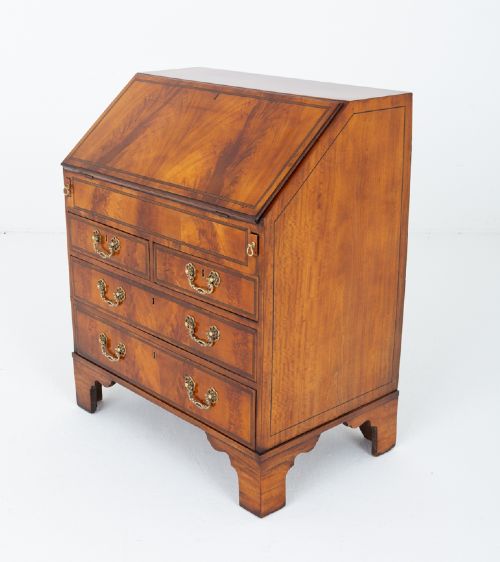
When you search for a vintage mahogany slope chest, you are looking at writing furniture designed with a hinged writing surface that folds down to reveal an organised interior of pigeonholes and small drawers. The pieces on this page span several eras, appearing as Georgian writing bureaux, Victorian and Edwardian variations, and military campaign styles.
The primary form you will meet here is the bureau, often raised on bracket feet or straight legs with graduated drawers beneath the fall front. These range from substantial 18th-century examples down to miniature fall front desks and related writing boxes in mahogany, sometimes augmented by satinwood, walnut, or oak.
Makers and regional workshops approached the form with subtle regional variations, producing everything from simple English writing desks to Dutch marquetry inlaid bureaux and Anglo Indian brass mounted correspondence boxes. Each piece reflects the writing habits and interior needs of its specific decade, from the Georgian period through to the early 20th century.
Materials and construction methods
Constructed predominantly from dense mahogany timber, these pieces frequently utilise solid planks alongside wood veneer surfaces to achieve rich grain patterns and deep colour. Secondary timbers such as oak or fruitwood appear within drawer linings and internal compartments, reflecting the standard workshop practices of the period.
Hardware details such as brass handles, escutcheons, and hinges provide functional strength as well as decorative contrast against the dark wood. More elaborate examples incorporate specialist techniques like marquetry inlay or delicate bone and mother of pearl details to enhance the exterior surfaces.
Listings on this page span the Georgian, Victorian, and Edwardian periods, showcasing mahogany, walnut, oak, and satinwood.
Assessing quality in slope chests
The distinction between standard examples and the finest pieces lies in the selection of the timber and the precision of the joinery within the hidden compartments. Superior pieces display thoughtful arrangement of grain across the drawer fronts and seamless integration of the fall front mechanism.
ROBERT GILLOWS II
The Vintage Mahogany Slope Chest Glossary
- Bureau
- A writing cabinet featuring a sloping fall front that opens to form a desk surface above a bank of drawers. This term is frequently used interchangeably with writing desk in older listings.
- Fall Front
- The hinged panel on a slope chest that pulls down or folds forward to create a flat writing surface. It conceals the internal pigeonholes and small drawers when closed.
- Campaign
- Furniture constructed in modular sections with brass corners and recessed handles for ease of transport during military deployment. These pieces prioritise robust construction and portability.
- Marquetry
- The decorative technique of applying thin veneers of different woods, and occasionally other materials, in patterns to form pictorial or geometric designs on a surface.
- Pigeonhole
- A small, open compartment within the fitted interior of a bureau designed for sorting letters and stationery. Better examples often feature concealed drawers hidden beneath these partitions.
Vintage Mahogany Slope Chest: Frequently Asked Questions
What is a vintage mahogany slope chest?
A vintage mahogany slope chest is a traditional form of writing furniture featuring an angled lid that lowers to create a desk. These pieces combine storage drawers with internal compartments designed for letters and documents.
Most examples date from the Georgian era through to the early 20th century, encompassing styles such as military campaign boxes and Dutch marquetry bureaux.
How do I use a slope chest today?
These chests function well as compact writing desks or laptop stations in a modern home. The internal drawers and pigeonholes remain practical for organising stationery, notebooks, and small desk accessories.
Keeping the fall front closed provides a tidy wooden surface that conceals workspace clutter when the desk is not in use.
How can I tell the period of my bureau?
Dating relies on examining the construction methods, timber choices, and hardware styles. Georgian pieces often feature hand-cut dovetails and bracket feet, while Edwardian and later 19th-century variants show standardised fixings and different interior layouts.
Secondary woods inside the drawers and the style of the brass escutcheons offer further clues to the decade of manufacture.
What wood was used for these desks?
Mahogany is the primary timber found across these listings, valued for its rich colour and durability. Workshops frequently combined solid mahogany with wood veneer to create decorative grain patterns on the exterior.
Secondary woods like oak, fruitwood, and satinwood appear in secondary roles such as drawer linings and internal compartments.