
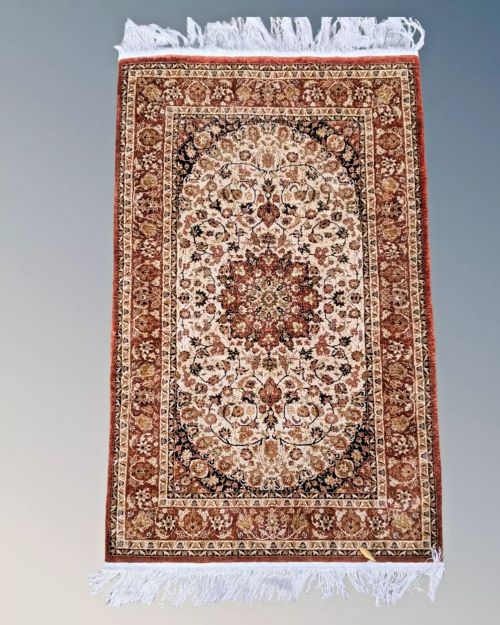
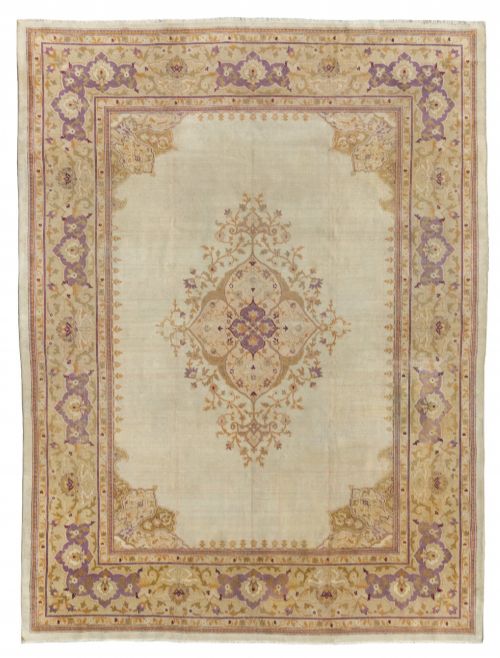


Vintage Indian Carpet
A vintage Indian carpet brings rich pattern and texture into a room, drawing on traditions from Agra, Amritsar, and Kashmir.
Vintage Indian Carpet
When searching for a vintage Indian carpet, buyers encounter floor coverings originating from the nineteenth and early twentieth centuries. The selection spans distinct regional styles, including Mughal, Kashmiri Oriental, Amritsar, and Indo-Persian designs.
The pieces listed on this page appear as rugs, area rugs, and larger carpets spanning several decades of production. Examples range from traditional Kashmiri chain stitch pieces to grand Agra carpets produced in Northern India.
Dated items on this page stretch from the mid-nineteenth century through to 1930, capturing both Victorian Indian interpretations and classic Oriental motifs. Buyers will find cotton dhurries alongside substantial woollen and silk floor coverings.
Materials and construction methods
The construction of these floor coverings relies primarily on wool, cotton, and silk fibres, often worked into dense foundations. Weavers employed durable cotton for warps andwefts while utilising wool and silk for the plush pile.
Specialist techniques define the regional types, seen in the chain stitch embroidery of Kashmiri pieces and the flatwoven structure of cotton dhurries. Crewelwork wall hangings demonstrate additional needlework methods used across Northern India.
The listings span from 1860 to 1930, recording traditional Kashmiri, Agra, and Amritsar styles worked in cotton, wool, and silk.
Assessing quality and execution
Quality in these textiles rests upon the precision of the knotting or stitching and the fineness of the chosen materials. Silk examples and finely knotted Amritsar or Agra pieces demonstrate a higher level of detail in their complex all-over designs.
The integrity of the foundation and the preservation of the pile determine the overall standard of a textile. Richness of dye colour and clarity of the traditional motifs distinguish superior examples from simpler utilitarian pieces.
The Vintage Indian Carpet Glossary
- Agra carpet
- A woven floor covering produced in the city of Agra, known for substantial scale and classic design. These pieces often feature complex all-over patterns influenced by earlier Mughal traditions.
- Amritsar
- A style of carpet originating from the Punjab region, noted for distinctive colour palettes and traditional patterns. Weaving centres here produced notable floor coverings during the nineteenth century.
- Chain stitch
- An embroidery technique forming a looped stitch that resembles a chain, frequently utilised in Kashmiri textiles. This method creates textured surfaces on rugs and wall hangings.
- Dhurrie
- A traditional flatwoven rug from India, typically constructed from cotton without a pile. These pieces offer durable utility and geometric patterns.
- Kashmiri
- Pertaining to the region of Kashmir, renowned for fine silk carpets and needlework floor coverings. These items frequently incorporate intricate floral motifs.
- Mughal
- A design influence stemming from the Mughal Empire, characterised by refined floral arrangements and balanced compositions. This aesthetic informs many classical Indian carpets.
Vintage Indian Carpet: Frequently Asked Questions
How do I clean an old carpet?
Maintenance requires gentle vacuuming without a beater bar to protect the delicate wool or silk pile from damage.
Professional specialist cleaning remains essential for addressing deeper dirt to preserve the integrity of the natural fibres.
Where were these carpets made?
Production centres span various regions across Northern India, including Agra, Amritsar, and the valley of Kashmir.
Each area developed distinct weaving traditions utilising local materials such as cotton, wool, and silk.
Can I use these on the floor?
Most pieces serve well as functional floor coverings in areas with moderate foot traffic.
Lighter textiles, such as crewelwork wall hangings or delicate chain stitch items, suit display on walls rather than the floor.
How do I date an Indian carpet?
Dating relies on stylistic markers, construction techniques, and material analysis characteristic of specific decades.
Comparing structural details against documented nineteenth and early twentieth-century examples helps establish the period.