


Vintage Imari Fruit Bowl
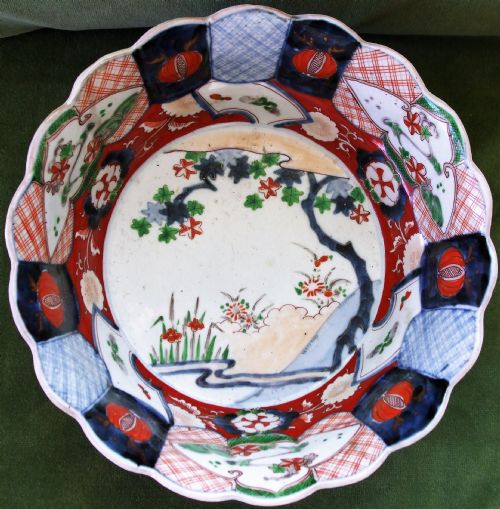
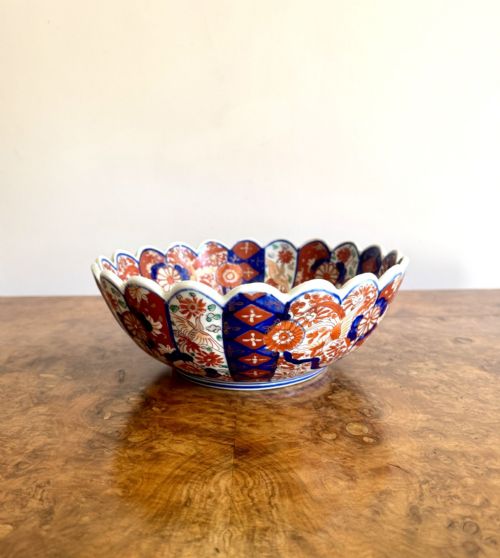
A vintage imari fruit bowl brings dense cobalt underglaze and rich enamel to the table, offering a striking centrepiece for any room.
Vintage Imari Fruit Bowl
When you search for a vintage imari fruit bowl, you encounter pieces that span the nineteenth century, the Meiji period, and the Edwardian era. These decorative bowls serve as practical vessels and decorative statements alike, originating primarily from Japanese workshops alongside British interpretations in ironstone.
The pieces on this page most commonly feature scalloped or fluted edges and traditional saucer or basin forms. You will find standard decorative bowls alongside specific scallop-shaped designs, reflecting both Japanese export ware and Victorian taste for oriental aesthetics.
Materials and construction
The core material is hard-fired porcelain or ironstone, shaped into circular or fluted basins before receiving initial decoration. Artisans applied cobalt underglaze to the raw clay body to establish the deep blue foundation of the design.
Overglaze enamels in iron-red and other mineral colours were then added by hand, frequently accented with gold leaf, gilt, or standard gilding. A clear glaze seal locked the pigments during the final kiln firing, ensuring durability across the surface.
Listings span the nineteenth century, the Meiji period, and 1900, utilising porcelain and ironstone enhanced with gold leaf.
Assessing quality in imari ceramics
The hierarchy of quality rests primarily on the crispness of the cobalt underglaze and the precision of the hand-painted enamel work. Finer examples display tightly controlled brushwork where the iron-red and blue pigments sit in exact register without bleeding.
The application of gold leaf or gilt also distinguishes superior pieces, maintaining its lustre and adherence across complex fluted and scalloped rims. The purity of the underlying porcelain body and the regularity of the form further separate standard utility bowls from exceptional decorative works.
Mason s Ironstone
The Vintage Imari Fruit Bowl Glossary
- Imari
- A style of Japanese porcelain originating from the port of Arita, traditionally characterised by a palette of cobalt blue, iron-red, and gold. This aesthetic heavily influenced both Edo and Meiji period export wares.
- Cobalt Underglaze
- A blue pigment applied directly to the unglazed ceramic body before firing. It withstands high temperatures, resulting in a permanent design beneath the glossy surface layer.
- Meiji Period
- The era in Japanese history spanning from 1868 to 1912, noted for a massive increase in decorative arts produced specifically for Western export markets.
- Ironstone
- A heavy, durable type of British pottery patented in the nineteenth century. It mimics the strength and appearance of true porcelain at a commercial scale.
- Gilt
- A thin layer of gold applied to the ceramic surface to highlight rims, motifs, and moulded details. It adds reflective warmth to the contrasting blue and red enamel palette.
Vintage Imari Fruit Bowl: Frequently Asked Questions
What is a vintage imari fruit bowl?
It is a decorative ceramic basin featuring traditional Japanese or British imari decoration, utilising cobalt blue, red enamel, and gilding. These pieces were designed for both display and table use.
They reflect historical trade and artistic exchange between Japan and the West during the nineteenth and early twentieth centuries.
How were these bowls used historically?
These vessels served primarily as centrepieces on dining tables or sideboards to hold fruit or display ornamental arrangements. Their vibrant colour schemes made them focal points in Victorian and Edwardian interiors.
Over time, many transitioned purely into cabinet pieces or decorative mantel items due to their intricate enamel and gilt surfaces.
How can I tell the period of a bowl?
Examine the weight, body material, and style of the painting to distinguish between nineteenth-century Japanese export pieces and later Victorian or Edwardian interpretations. Meiji period works often feature intricate, densely packed patterns on refined porcelain bodies.
British ironstone examples, such as those by Mason s, present a heavier, denser ceramic substrate with distinct backstamps or characteristic potting traits underneath.