
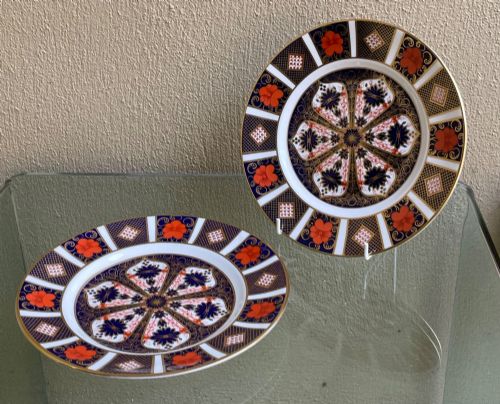
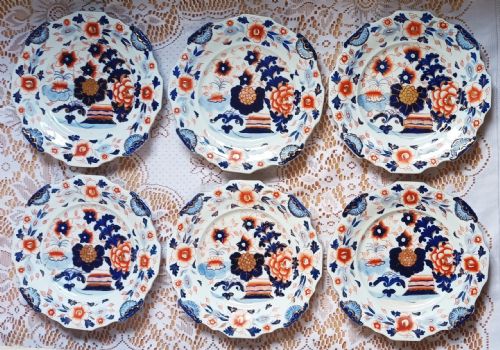


Vintage Imari Cabinet Plate
A vintage imari cabinet plate brings rich ironstone and porcelain decoration into a room, prized for bold contrasting palettes.
Vintage Imari Cabinet Plate
When you search for a vintage imari cabinet plate, you are looking at decorative porcelain, ironstone, and ceramic chargers and plates designed for display rather than dining. The examples you meet on this page span from the Georgian period and Victorian era through to the early twentieth century, incorporating Japanese imari, Victorian imari, and imari style pieces.
The forms range from scalloped edged plates to dessert service pieces and large decorative chargers. British makers like Royal Crown Derby and Mason's sit alongside Japanese porcelain works from the Meiji period and nineteen-hundreds. Each piece reflects either traditional eastern export designs or British interpretations of the Japan pattern.
How they were made
Potters shaped these pieces from fine porcelain, bone china, or robust ironstone ceramic before applying underglaze cobalt blue and vibrant overglaze enamels. Skilled hands then added details in gold leaf or gilt to highlight the intricate motifs.
Firing techniques varied between British earthenware kilns and traditional Japanese kilns, resulting in distinct weights and body densities. The integration of glaze and enamel required multiple firings to achieve the characteristic depth of colour.
Old school house patterns share shelf space with historic Japanese exports, proving that school rooms and samurai kilns ultimately had matching tastes in red and gold.
What varies in quality
The standard of a vintage imari cabinet plate rests upon the precision of the hand-painted enamel work and the crispness of the gilt detailing. Early ironstone examples show weight and depth in the moulded body, while finer porcelain items display translucency and delicate edge shaping.
Artisanal execution separates standard production ware from superior examples. The richness of the cobalt blue against the rust-red and gold leaf dictates the visual hierarchy across different periods.
Royal Crown Derby·Mason's Patent Ironstone
The Vintage Imari Cabinet Plate Glossary
- Cabinet plate
- A decorative plate intended for display in a cabinet or on a wall rather than for everyday dining use. These items usually feature intricate ornamentation and high-status materials.
- Imari style
- A decorative scheme originating in Japan and copied by European potteries, characterised by a palette of cobalt blue, iron red, and gilt. The patterns typically combine floral and geometric compartments.
- Ironstone
- A type of heavy, durable ceramic patented in the nineteenth century as a tougher alternative to porcelain. It takes enamel and transfer-print decoration well.
- Charger
- A large decorative plate or dish used historically for ceremonial service or placed beneath other courses. In later periods, these large pieces functioned purely as wall or sideboard decoration.
- Gilt
- A thin layer of gold applied to the surface of ceramic or porcelain for decorative accent. On older pieces, this embellishment is often hand-painted.
Vintage Imari Cabinet Plate: Frequently Asked Questions
What is an imari plate?
An imari plate is a ceramic or porcelain dish featuring the distinctive palette of underglaze blue, iron red, and gold. The style originated in Japan before being widely adopted by European factories.
These pieces were traditionally made for export or created as British interpretations of eastern aesthetics, resulting in diverse decorative borders and central motifs.
How do I display a cabinet plate?
Cabinet plates are designed for visual display on walls, sideboards, or inside glazed display furniture. Because they are intended for decoration, they are best kept away from heavy handling.
Secure wall hangers or dedicated display stands protect the edges and allow the detailed enamel and gilt work to be easily viewed.
Are these plates meant for food?
Most pieces listed as cabinet plates or decorative chargers are intended solely for display. Their historic nature and delicate overglaze enamels mean daily use is not recommended.
Some ironstone service pieces from the nineteenth century were originally functional, but antique specimens are now preserved primarily for their decorative value.
How do I tell Japanese from English imari?
Distinguishing between Japanese export pieces and English interpretations depends on the ceramic body and potting style. Japanese items often utilise native porcelain bodies, while English makers frequently employ ironstone or bone china.
Maker marks on the underside also help identify nineteenth-century British potteries compared to Meiji period Japanese workshop origins.