



Vintage Hock Glass
These vintage hock glass pieces bring distinctive colour and height to the table, offering a traditional way to serve German white wine.
Vintage Hock Glass
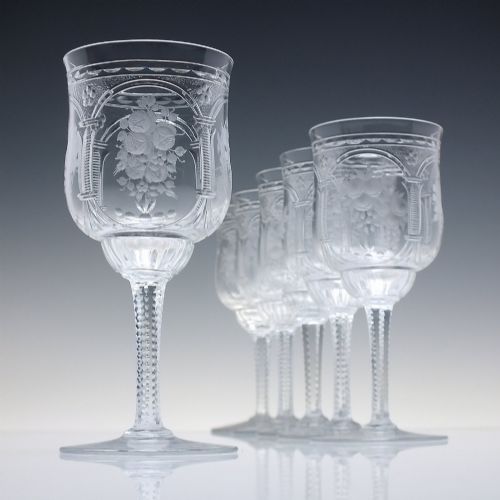
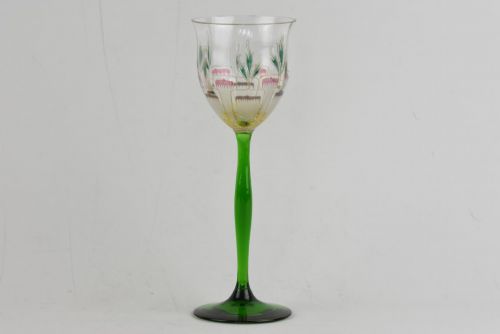
When you search for a vintage hock glass, you are looking at tall stems designed for pouring hock and other white wines. The selection includes examples from the Victorian era up to the 1930s.
The pieces on this page span several distinct aesthetics, including Victorian, Art Deco, Art Nouveau, and Jugendstil designs. You will encounter forms originating from English, French, and Bohemian makers.
Sets frequently appear alongside individual pairs and larger groupings of six. Alongside standard wine glasses and decanters, these pieces bring period character to dining arrangements.
Materials and construction
The pieces on this page utilise glass, lead glass, lead crystal, and cut crystal as the primary foundation. Cased glass and overlay glass techniques create layered colour effects by fusing distinct shades together.
Makers added surface decoration through hand painting, gold leaf detailing, and enamelled floral motifs. Engraving and deep cutting shape the crystal surfaces across Bohemian and French examples.
Listings feature periods spanning from the mid-nineteenth century through to the 1930s, incorporating glass, cut crystal, and gold leaf.
Assessing quality
Quality rests in the crispness of the cutting and the depth of the overlay layers. Thicker cased glass that reveals sharp contrast when cut demands greater skill from the glassblower.
Hand-painted enamel and applied gold leaf show variation in hand dexterity and detail. Finer pieces display precise floral work rather than heavy or simplified brushstrokes.
Baccarat·Theresienthal·St Louis Massenet
The Vintage Hock Glass Glossary
- Hock glass
- A tall-stemmed wine glass traditionally used for German Rhine wines. These vessels often feature coloured bowls atop clear or tinted stems.
- Overlay glass
- A glass object made with two or more distinct layers of colour, where the outer layer is partially cut away to reveal the contrasting colour beneath. This technique creates striking patterns and depth.
- Roemer
- A traditional Germanic drinking vessel with a large rounded bowl resting on a cylindrical stem decorated with applied prunts. These often appear in green or amber glass.
- Enamel
- A decorative glassy substance fused to the surface of the glass through firing. It allows for colourful floral and geometric patterns.
- Cased glass
- Glass formed by blowing one layer of molten glass inside another of a different colour. The resulting material combines varied hues within a single wall.
Vintage Hock Glass: Frequently Asked Questions
What is a hock glass used for?
A hock glass serves German hock and other aromatic white wines. The tall stem keeps the hand away from the bowl, maintaining the temperature of the wine.
The elongated form also allows the complex aromas of the wine to collect properly within the bowl before reaching the palate.
How do I identify a Victorian hock glass?
Victorian examples often feature rich green or amber glass paired with heavy cutting or hand-applied enamelling. The proportions tend to be robust and grounded.
Looking closely at the weight and the pontil mark on the underside helps confirm the nineteenth-century origins of the piece.
Can I use these glasses for daily dining?
These pieces function well for special meals and formal dinners when handled with appropriate care. Hand washing protects the delicate gold leaf and enamel work.
Storing them securely in a dedicated cabinet prevents accidental chips to the tall stems and decorated rims.
What makes Bohemian hock glasses distinct?
Bohemian pieces frequently showcase deep amber or green shades combined with intricate engraved patterns. Makers in this region excelled at surface carving.
The roemer form and heavy cut crystal are particularly common among pieces originating from Bohemian workshops.