
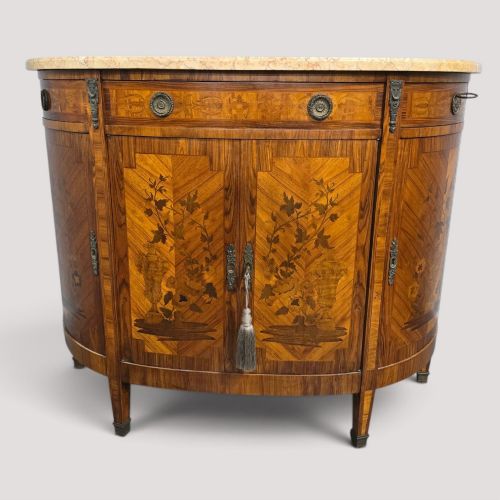
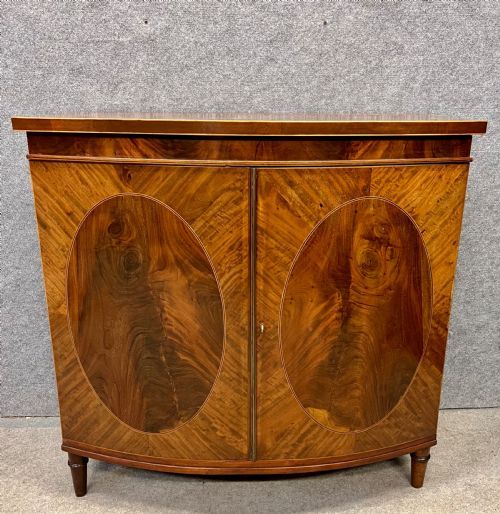
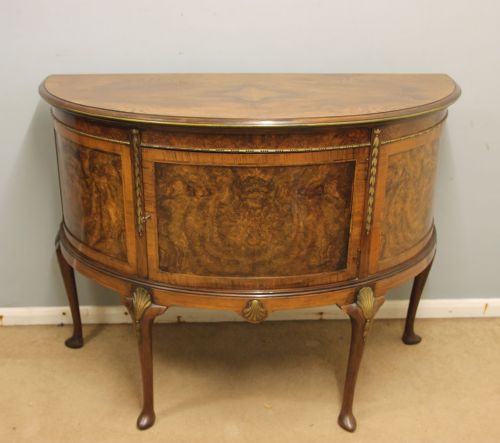


Vintage Half Moon Cabinet
A vintage half moon cabinet brings a graceful curve to a tight corner.
Vintage Half Moon Cabinet
A vintage half moon cabinet presents a flat back to the wall and a curved front, making it an intelligent choice for hallways and compact rooms. These pieces appear in forms ranging from bedside tables and display cabinets to larger sideboards and commodes.
The selections encountered here span the Edwardian era through to the 1920s and 1930s, alongside nineteenth-century examples. Revivalist tastes dominate, drawing heavily on Sheraton, Hepplewhite, Chippendale, and French Louis styles.
Most items met on this page are side cabinets or console pieces built with a semi-circular footprint. They serve primarily as decorative storage surfaces where floor space is at a premium.
How they were made
Cabinet makers relied on a foundation of mahogany, walnut, and satinwood, often enhanced with burr walnut and kingwood veneers. These woods provided stable surfaces for complex curved construction.
Decoration frequently involved detailed marquetry and inlay work to accentuate the sweeping lines of the demi lune shape. Brass fittings, ormolu mounts, and occasional marble tops completed the construction of finer pieces.
The listings span the nineteenth century up to the 1930s, featuring woods like mahogany, walnut, satinwood, and kingwood.
What varies in quality
The distinction between standard examples and superior pieces rests on the precision of the timber matching and the intricacy of the inlay. Finely executed marquetry and hand-painted details elevate a cabinet well above simpler veneered versions.
Hardware and mounts also signal grade, with solid brass handles and chased ormolu indicating a higher standard of manufacture. The integrity of the curved framework and the quality of the polished finish determine the overall presence of the piece.
Kaufman
The Vintage Half Moon Cabinet Glossary
- Demi lune
- French for half moon, describing furniture with a semi-circular top and a flat back designed to stand against a wall.
- Marquetry
- The art of applying pieces of veneer to a structure to form decorative patterns and pictures. It requires considerable skill to fit the thin wood sections across curved surfaces.
- Ormolu
- Gilded bronze mounts applied to furniture for decoration. This technique adds metallic contrast to polished timber.
- Satinwood
- A durable hardwood with a yellowish sheen and a satin-like texture. Cabinet makers prized it for light-coloured decorative banding and panels.
- Sheraton Revival
- A late nineteenth and early twentieth century design movement inspired by the lightness and classical motifs of eighteenth-century designer Thomas Sheraton.
Vintage Half Moon Cabinet: Frequently Asked Questions
Where should I place a half moon cabinet?
These cabinets suit hallways, landings, and dining rooms where a standard rectangular piece would block foot traffic. Their curved fronts soften the geometry of a room while providing useful surface space.
They also function effectively as bedside tables or compact console units against narrow wall spaces.
How do I identify an Edwardian piece?
Edwardian cabinets often feature lighter timbers such as satinwood and mahogany, frequently decorated with delicate line inlay. They tend to reflect eighteenth-century revival styles with a lighter touch than their Victorian predecessors.
Construction methods from this period typically show machine-cut elements alongside hand-finished details.
What is the difference between a commode and a side cabinet?
A commode traditionally refers to a low chest of drawers or a cabinet with doors, often of French origin, designed for formal rooms. Side cabinets encompass a broader category of storage furniture intended for dining rooms and hallways.
Both forms appear in demi lune shapes across the available selections.
How do I care for polished veneer surfaces?
Polished wood surfaces require regular dusting with a soft, dry cloth to prevent micro-abrasions. Avoid placing them in direct sunlight or near heat sources to protect the underlying veneers from drying out.
Application of traditional wax polish helps maintain the lustre of mahogany and walnut.