

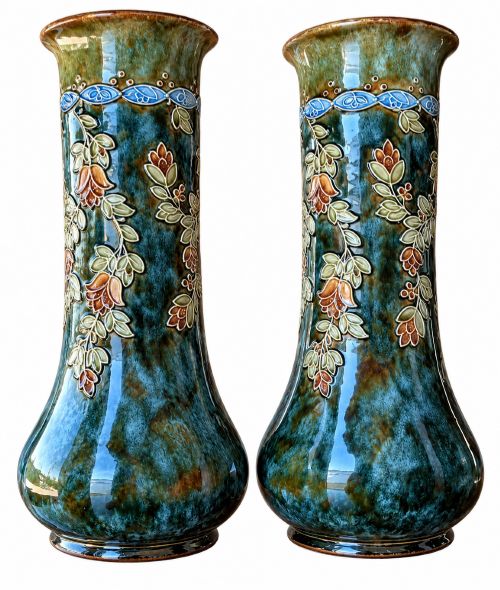

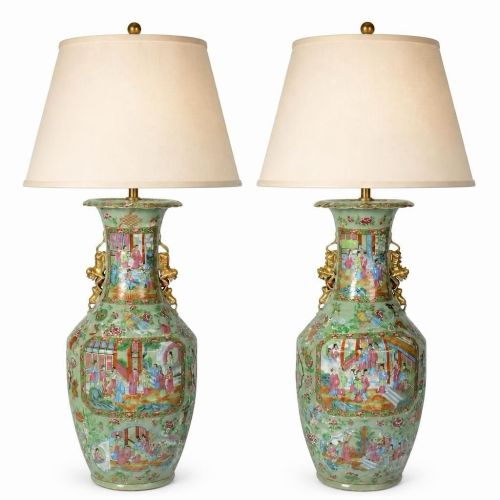


Vintage Green Vase Pair
A vintage green vase pair brings symmetry and rich colour to a room, ranging from moulded glass table lustres to glazed ceramics.

Vintage Green Vase Pair
A vintage green vase pair encompasses matching vessels created across the nineteenth and twentieth centuries in various regional traditions. These decorative objects serve both ornamental purposes and functional display roles within domestic interiors.
The most common examples on this page include Victorian green glass table lustres, Art Nouveau ceramic vessels, and nineteenth-century Chinese porcelain pieces. Buyers encounter forms ranging from shaped earthenware to heavy cast iron garden urns and opaline glass.
Originating from English, French, Austrian, and Chinese workshops, these matching pairs reflect the distinct aesthetic priorities of periods such as the Victorian era, the Aesthetic Movement, and the Art Nouveau movement.
Materials and construction
Makers utilised glass, porcelain, ceramic, stoneware, and cast iron, often applying coloured glazes, enamel, or hand-painted raised designs to achieve deep green hues. Glass vessels frequently incorporate cut or shaped profiles, while metal elements such as brass or pewter provide structural mounts.
Techniques varied from the wheel-thrown earthenware of English potteries to the mould-blown art glass of French and Austrian makers. Surface decoration ranges from floral enamel motifs to intricate Chinoiserie and Famille Verte painting.
Vintage Green Vase Pair Retail Price Guide 2026
Typical asking prices for vintage green vase pair among the pieces listed under this phrase on Sellingantiques today, from the lower quarter to the upper quarter. They describe what is for sale here now, not the wider market.
Listings span the nineteenth century through the early twentieth century, featuring ceramics, glass, iron, and stoneware across multiple decorative styles.
Assessing the craftsmanship
Quality reveals itself in the crispness of moulded or cast details, the evenness of green glazes and enamel work, and the precision with which matching pairs mirror one another. Finer pieces demonstrate superior control during firing or glass-blowing, resulting in balanced proportions and clean lines.
The sophistication of the surface decoration, whether hand-painted floral subjects or integrated pewter mounts, separates standard production wares from finer workshop outputs.
TG Green·Doulton Lambeth·Bretby·Royal Doulton·Baccarat
The Vintage Green Vase Pair Glossary
- Table lustre
- A decorative glass or ceramic vase fitted with hanging crystal prisms designed to reflect candle or gas light. These pieces typically date from the Victorian period.
- Famille Verte
- A Chinese porcelain palette dominated by green enamels, developed during the Qing dynasty and widely imitated in nineteenth-century European production.
- Opaline glass
- An opaque or translucent glass developed in France, frequently tinted in soft or vivid shades and decorated with gilt or raised floral enamel patterns.
- Art Nouveau
- A turn-of-the-century design style characterised by flowing, organic lines inspired by natural plant forms.
- Faience
- Tin-glazed earthenware produced across Europe, known for its smooth ceramic surface and painted decoration.
Vintage Green Vase Pair: Frequently Asked Questions
How do I style a pair of antique vases?
Symmetrical placement on a mantelpiece, sideboard, or console table creates a balanced focal point in a traditional or eclectic interior.
Matching pairs also function effectively as sculptural objects when left empty to showcase their coloured glass or glazed ceramic surfaces.
Are these vases suitable for holding water?
While many ceramic and glass pieces were designed to hold fresh flowers, older porous earthenwares and items with delicate enamel or metal mounts require caution.
Using a discreet inner liner protects the interior of antique vessels from moisture damage.
How do I distinguish Victorian from Art Nouveau pieces?
Victorian designs tend to rely on formal symmetry, rich colours, and classical or ornate motifs, particularly in glass table lustres.
Art Nouveau pieces introduce whiplash curves, stylised floral patterns, and fluid organic profiles inspired by nature.
What is a table lustre?
A table lustre is a decorative Victorian vase fitted with a rim hung with cut glass spear prisms.
These pendants catch and refract ambient light, adding sparkle to nineteenth-century dining tables and mantelpieces.