



Vintage Glass Corner Cabinet
These vintage glass corner cabinets turn wasted angles into striking display space, combining timber and glazing to frame your finest pieces.
Vintage Glass Corner Cabinet
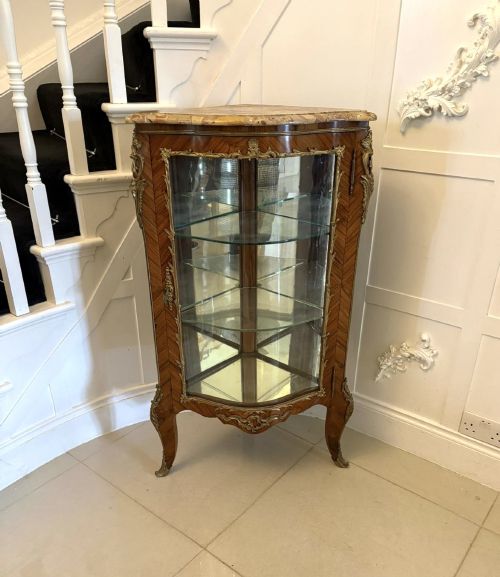
A vintage glass corner cabinet solves the problem of difficult room angles while providing vertical display space. The pieces seen here span centuries of British and continental cabinet-making, with Edwardian mahogany and Georgian examples appearing alongside later interpretations.
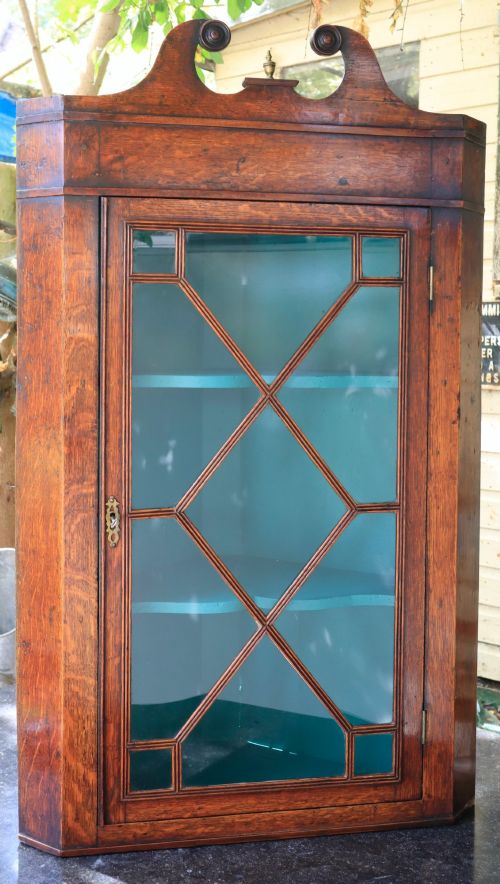
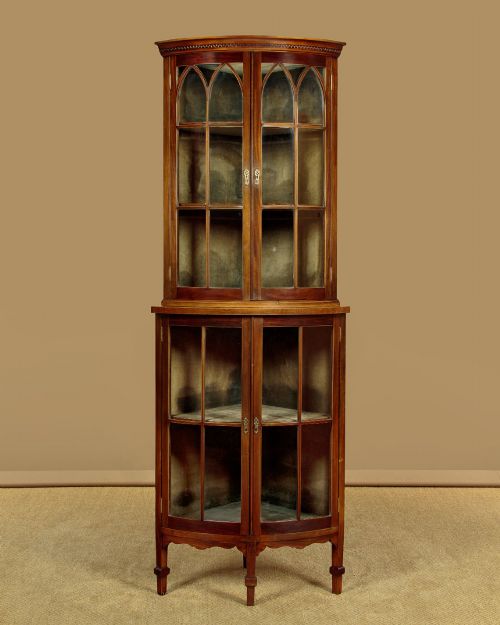
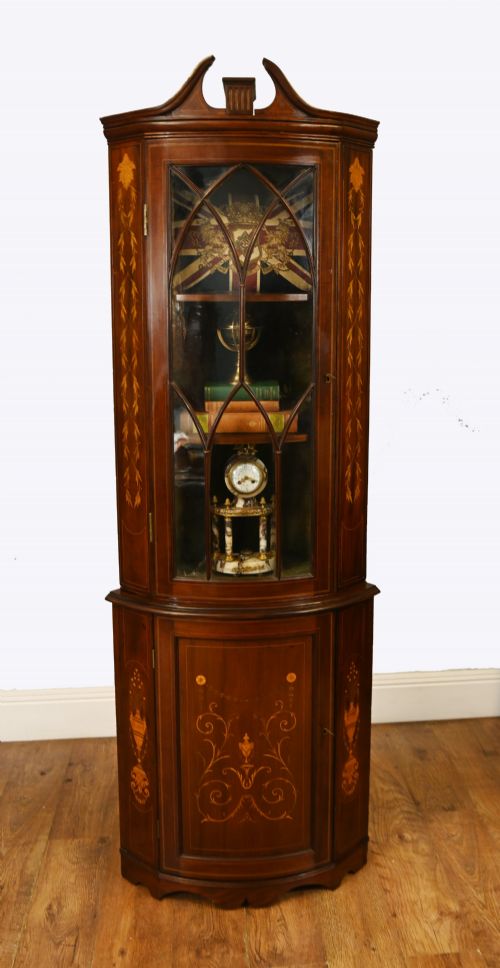
Most entries on this page rely on Edwardian production, often featuring inlaid mahogany and glazed doors designed to sit neatly in a domestic corner. Alongside these, earlier Georgian designs and later oak or ebonised interpretations offer varied silhouettes from wall-hanging to standing double height forms.
Materials and Construction
Makers relied heavily on mahogany as a primary timber, frequently embellished with satinwood inlay or brass mounts. Glass forms the primary door panels or side inserts, allowing light to reach the interior shelves.
Construction techniques range from traditional cabinet joinery on Georgian and Edwardian examples to the distinctive craftsmanship seen in Arts and Crafts or Cotswold School oak pieces.
The listings here feature periods ranging from the 18th-century Georgian era through Victorian, Edwardian, and 1930s designs.
Distinguishing Quality in Cabinetry
Superior execution shows in the crispness of marquetry inlay, the integration of ormolu mounts, and the choice of serpentine or bow fronts. Simpler country house iterations rely on sturdy timber and straightforward glazing without decorative flourish.
The sophistication of internal shelving, original brass hardware, and timber selection ultimately separate standard utility cupboards from fine architectural display pieces.
Maurice Adams·Edwards And Roberts·Sage And Co
The Vintage Glass Corner Cabinet Glossary
- Bow Front
- A convex curved cabinet front that projects outward. This shape softens the hard angles of a room.
- Marquetry
- Decorative woodwork where pieces of veneer are fitted into a background to form designs. It frequently appears on Edwardian mahogany pieces.
- Ormolu
- Gilt-bronze mounts applied to furniture for ornamentation. This technique appears on French revival pieces.
- Serpentine
- A cabinet front featuring a concave centre flanked by convex outer curves. It requires advanced carpentry skill to execute.
Vintage Glass Corner Cabinet: Frequently Asked Questions
How do I choose the right size corner cabinet?
Measure the wall depth and available corner width carefully before selecting either a wall-hanging or standing floor model.
Consider whether you need a single height cupboard or a double height version to accommodate your collection.
Are these cabinets suitable for small rooms?
Corner cabinets utilise dead space effectively, making them ideal for compact interiors where flat wall space is at a premium.
Glazed doors also help reflect light and maintain an open feel in smaller spaces.
How do I date an Edwardian inlaid cabinet?
Edwardian pieces often utilise mahogany combined with satinwood inlay, reflecting the Sheraton revival styles popular around the turn of the twentieth century.
Examine the internal construction and backboards for clues regarding manufacturing techniques of that period.
What is the difference between Georgian and Edwardian styles?
Georgian cabinets from the eighteenth century typically exhibit restrained lines, solid proportions, and architectural cornices.
Edwardian revivals often incorporate lighter timbers, delicate stringing, and marquetry inlay.