


Vintage Gilt Pier Table
A vintage gilt pier table brings architectural elegance to a hallway, defined by its wall-mounting or narrow stance and gleaming gilded finish.
Vintage Gilt Pier Table
When you search for a vintage gilt pier table, you are looking at narrow console tables designed to sit flush against a wall, frequently paired with matching mirrors. The examples available span from the eighteenth century through to the 1920s, with nineteenth-century pieces appearing most often on this page.
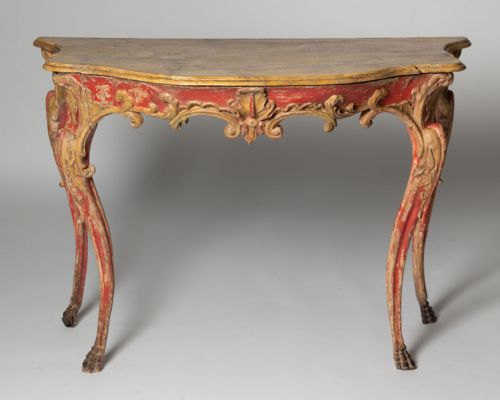
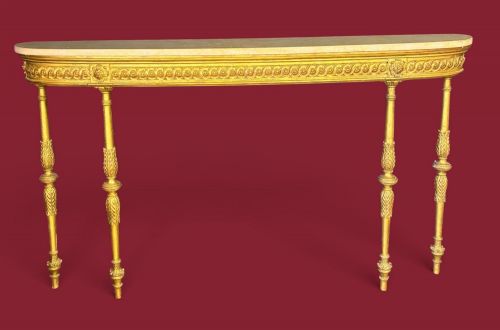
The forms encompass serpentine outlines, console tables with marble tops, and substantial sets that incorporate wall mirrors. Origins skew towards French and Italian workshops, channelling Rococo, Neoclassical, and Louis XVI styles.
Makers often drew upon earlier design vocabulary, producing revival pieces in carved walnut, giltwood, and painted finishes alongside authentic period furniture. These tables serve primarily as focal points for entrance halls and principal reception rooms.
How they were made
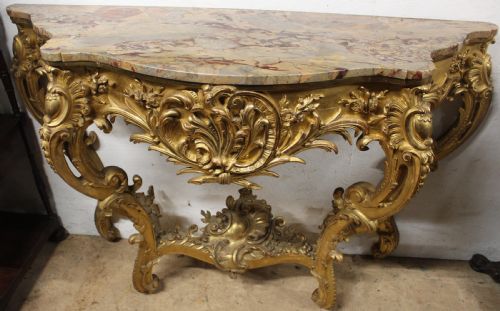
Carpenters constructed the structural frames from solid timbers including walnut, applying layers of gesso to the carved wood details before adding gold leaf or paint. Giltwood and parcel-gilt treatments provide the characteristic metallic sheen seen across these tables.
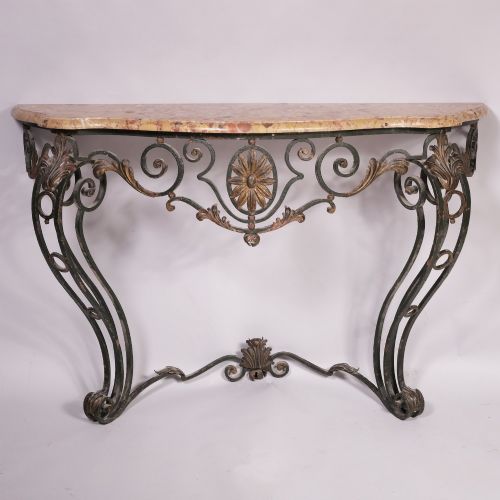
Heavier stone elements, principally marble slabs, form the upper surfaces of the console tables, resting directly upon the wooden framework. Wrought iron also appears in select structural builds, offering alternative support beneath stone tops.
Wrought iron makes a surprising appearance among the gilded wood, proving that even grand salons occasionally needed sturdy industrial muscle.
What varies in quality
The sophistication of the wood carving dictates much of the distinction between pieces, where fluid, deeply undercut foliage differs from rigid, shallow ornamentation. Hand-applied gesso and gold leaf exhibit varying degrees of crispness and depth across different workshops.
The integration of materials also defines the tier of execution, particularly the thickness and figuring of the marble top in relation to the precision of the joinery beneath. Regional provenance and stylistic adherence to French or Italian design idioms further separate standard examples from finer works.
The Vintage Gilt Pier Table Glossary
- Giltwood
- Wood that has been coated with gold leaf or powder. This finish is typical of decorative interior furniture from the eighteenth and nineteenth centuries.
- Gesso
- A plaster-like mixture applied to wood surfaces as a base for gilding or painting. It allows craftsmen to carve intricate relief details before applying gold leaf.
- Serpentine
- A furniture outline characterised by a curving line that bends inward and outward. This contour is frequently seen on the marble tops and aprons of console tables.
- Parcel-gilt
- A decorative technique where only specific portions of a wooden object are gilded, leaving the underlying painted or polished wood exposed elsewhere.
- Console
- A table designed to be fixed against a wall, often supported by ornate brackets or front legs rather than four standard vertical posts.
Vintage Gilt Pier Table: Frequently Asked Questions
Where do you put a pier table?
These narrow tables are traditionally placed against the wall between two windows or in entrance halls where floor space is limited. They fit snugly in hallways and reception rooms without obstructing walkways.
Pearing them with an overmantel mirror creates a cohesive vertical display that draws the eye upward and reflects light across the room.
Are these tables freestanding?
Most console tables designed for wall placement rely on the wall for stability, sometimes featuring brackets or legs that touch the floor at the front. Some variations require secure attachment to the wall to prevent tipping.
Heavier marble-topped versions often utilise their own weight to stay balanced, but checking the physical support structure remains essential for safe placement.
What is the difference between Rococo and Neoclassical styles?
Rococo styling emphasises asymmetrical curves, C-scrolls, and elaborate natural motifs inspired by shell and plant forms. It creates a sense of fluid movement across the carved wooden surfaces.
Neoclassical design shifts towards symmetry, straight lines, and classical architectural motifs derived from ancient Greece and Rome. This aesthetic introduces geometric balance and restrained ornamentation.
How do I clean a giltwood frame?
Dusting giltwood requires a very soft dry brush or a feather duster to avoid disturbing delicate gold leaf layers. Moisture can damage old gesso and gilding rapidly.
Harsh cleaning products should be avoided entirely on both the gilded wooden surfaces and the marble tops to preserve the historic finish.