


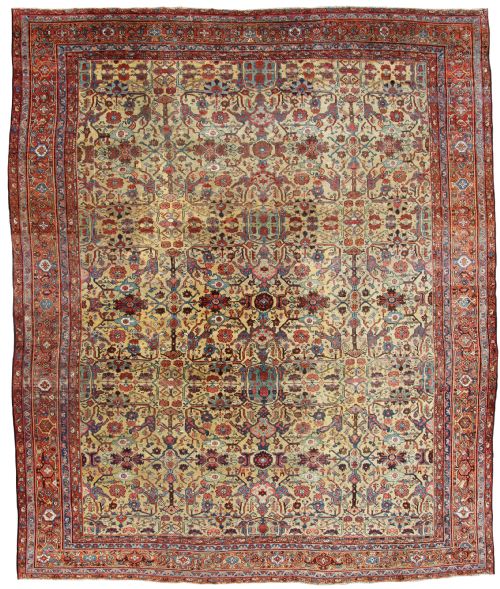
Vintage Fereghan Rug
A vintage fereghan rug brings dense Persian design and robust wool construction into a room, offering enduring floor coverings shaped by traditional village weaving.

Vintage Fereghan Rug
When searching for a vintage fereghan rug, a buyer looks at hand-knotted Persian floor coverings originating from the Fereghan region, spanning the nineteenth century up to the early twentieth century. These pieces appear in various formats on this page, ranging from expansive carpets and broad area pieces to narrow hallway runners.
The selections recorded here include specific design variations such as the Fereghan Sarouk, alongside pieces featuring pictorial elements like birds and pomegranates or distinctive golden fields. Most examples belong to the nineteenth century, with individual pieces carrying dates from eighteen fifty through to nineteen hundred and twenty.
How they were made
These rugs rely entirely on wool piles knotted over cotton foundations, a material combination that provides both structural stability and a dense surface texture. The weaving traditions of nineteenth century Persian workshops utilise these durable textiles to handle heavy foot traffic while maintaining intricate patterns.
Makers constructed these carpets using traditional hand-knotting techniques characteristic of Persian rug production, creating robust floor coverings designed to endure across generations.
Vintage Fereghan Rug Retail Price Guide 2026
Typical asking prices for vintage fereghan rug among the pieces listed under this phrase on Sellingantiques today, from the lower quarter to the upper quarter. They describe what is for sale here now, not the wider market.
Some rugs unexpectedly trade standard florals for migrating birds and plump pomegranates hiding within the wool.
What varies in quality
The distinction between standard examples and superior pieces rests on the precision of the knotting and the complexity of the design layout. Finer items exhibit greater density in the weave, allowing pictorial motifs like birds and pomegranates or overall field patterns to emerge with sharp definition.
Condition and scale also define the hierarchy among these rugs, where larger carpets or narrow runners with intact borders and uniform pile depth command greater appreciation among collectors.
The Vintage Fereghan Rug Glossary
- Fereghan
- A style of Persian rug originating from the Fereghan district, known for traditional village patterns and balanced compositions. These pieces often feature fine wool on cotton foundations.
- Sarouk
- A village and weaving tradition associated with Persian carpet production, frequently linked with Fereghan pieces. Sarouk rugs typically display dense floral motifs and robust construction.
- Runner
- A long, narrow format of rug designed specifically for hallways and corridors. Runners accommodate restricted spatial dimensions while retaining full traditional patterns.
- Pile
- The raised surface of a rug formed by the cut ends of knotted yarn. Pile density contributes to the weight and tactile quality of the textile.
Vintage Fereghan Rug: Frequently Asked Questions
What is a fereghan rug?
A fereghan rug is a hand-knotted Persian floor covering originating from the Fereghan region during the nineteenth or early twentieth century. These textiles are known for traditional village designs and durable wool construction.
They appear in various formats on this page, including large carpets, area rugs, and narrow hallway runners suited to different domestic spaces.
How do I live with one?
Living with a vintage fereghan rug involves placing it in low to moderate traffic areas to preserve the wool pile and cotton foundation over time. Regular gentle vacuuming without a rotating brush helps maintain the fibres.
These Persian carpets add warmth and historic character to traditional or contemporary interiors when paired with a quality underlay to prevent slipping.
How are periods told apart?
Periods are identified by examining the specific structural traits, material wear, and design characteristics recorded in the piece details. Nineteenth century examples often show distinct village knotting styles and traditional Persian motifs.
Later pieces from the early twentieth century reflect shifts in production while retaining the foundational techniques of earlier regional weaving.
Where were they made?
These rugs were made in Persia, specifically within the Fereghan region and associated weaving villages. Local artisans utilised regional materials like wool and cotton to produce these distinctive floor coverings.
The craft was passed through generations of workshops, resulting in the varied carpets and runners available today.