

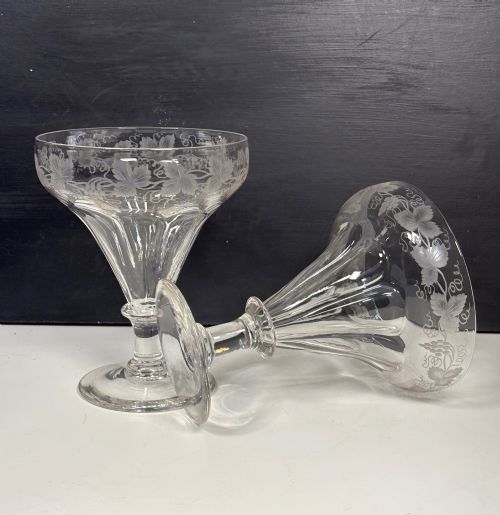


Vintage Etched Wine Glasses
These vintage etched wine glasses bring nineteenth-century weight and delicate wheel-cut botanical motifs directly to the modern dining table.
Vintage Etched Wine Glasses
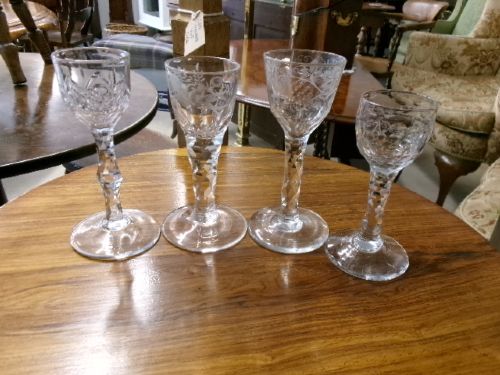
Vintage etched wine glasses encompass drinking vessels produced primarily during the Victorian and Edwardian eras, spanning the mid-nineteenth century up to the Art Deco period of the nineteen-thirties. Buyers searching this phrase meet matching forms that range from individual dessert wine glasses to harlequin sets and larger hock goblets.
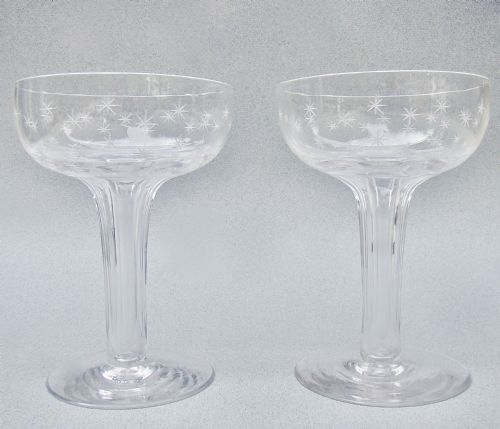
The material composition spans clear glass, lead crystal, and coloured flash glass such as cranberry and ruby overlays. These pieces often feature botanical motifs like fruiting vines alongside geometric facets.
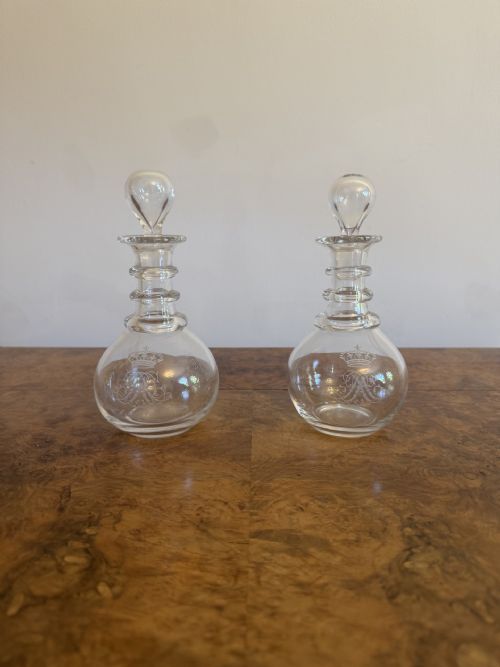
While the phrase directs attention to wine glasses, the wider selection includes matching decanters, claret jugs, and champagne coupes that share the same decorative wheel-engraved or acid-etched vocabulary.
Materials and techniques
Makers utilised lead crystal and clear or coloured glass, frequently blowing vessels by hand before applying surface decoration. The weight of these pieces depends upon the lead content and the thickness of the original gathering.
Decoration relied upon wheel-engraving, acid-etching, and cameo cutting to bite floral and foliate designs into the surface. Coloured pieces often employed a thin layer of coloured glass cased over a clear crystal body, allowing the artisan to cut through the outer layer and reveal the contrasting colour underneath.
Listings feature Victorian, Edwardian, and Art Deco periods alongside mid-nineteenth-century items.
Judging quality and execution
Quality rests upon the crispness of the wheel-cut lines and the depth of the engraving on the bowl. Superior examples display precise symmetry in the star or vine motifs without surface waviness in the glass itself.
The balance of the stem and the clarity of the metal determine the refinement of the piece. Fine glass shows minimal internal bubbles and possesses a resonant ring when struck gently.
Stevens & Williams·Orfèvrerie Produx Saint Hilaire·Adelbert Niemeyer
The Vintage Etched Wine Glasses Glossary
- Acid-etching
- A decoration technique using acid to eat away exposed areas of glass through a resist. This method creates soft-edged patterns rather than the sharp facets left by a stone wheel.
- Cased glass
- Glass made by fusing one or more coloured layers over a clear body. Cutting through the outer layer produces sharp contrast and colour variation.
- Hock glass
- A tall-stemmed wine glass traditionally used for white wine. These vessels often feature coloured bowls or elaborate engraved decoration.
- Roemer
- A traditional Germanic drinking glass featuring a wide foot and a studded or ribbed stem. The bowl is frequently green or amber glass.
- Wheel-engraving
- A technique where glass is held against rotating abrasive wheels of various sizes. It produces deep, polished incisions with crisp edges.
Vintage Etched Wine Glasses: Frequently Asked Questions
Are these old glasses safe for daily use?
Most nineteenth-century and early twentieth-century table glass remains fully functional for modern dining. Handle them with care due to their thinner rims and delicate stems.
Check each piece for structural cracks before use, particularly around the junction where the stem meets the foot.
How can I tell Victorian glasses from Edwardian ones?
Victorian glasses often feature heavier lead crystal with dense, deep wheel-engraving such as star motifs and fruiting vines. The silhouettes tend to be robust and firmly weighted.
Edwardian and later pieces frequently display lighter forms, softer floral garlands, and stylistic influences from Art Nouveau or Art Deco movements.
What is flash glass?
Flash glass consists of a thin layer of coloured glass fused over a clear crystal core during the blowing process. Artisans cut through this outer skin to expose the clear glass beneath.
This technique produced striking red, amber, and cranberry wine glasses with dramatic contrast between the decorated bowl and the clear stem.