




Vintage English Village Painting
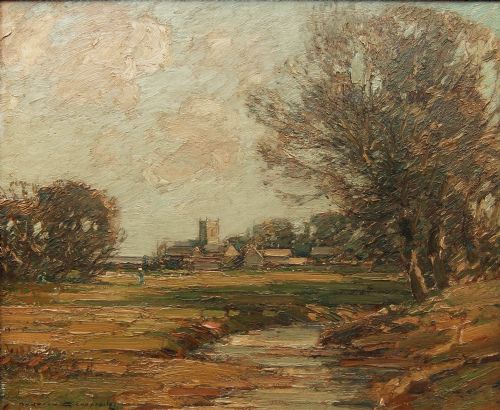
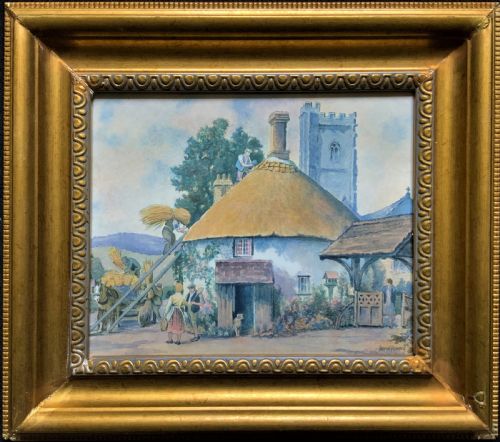
A vintage english village painting captures rural community life through the observed details of country lanes, stone cottages, and historic inns.
Vintage English Village Painting
A vintage english village painting represents settled rural life across England, depicting locations from Yorkshire and Devon to Suffolk and Hampshire. These works record local landmarks including village churches, High Streets, and traditional inns.
Buyers encounter watercolours on paper and oil paintings on canvas or panel. The selections span the nineteenth century through the mid-twentieth century, including Edwardian, Victorian, and mid-century realist approaches.
Materials and Application
Artists worked primarily with oil paint on stretched canvas or wooden panel, and watercolour pigment applied to paper. These mediums were often housed within wooden frames, sometimes accented with gilt mouldings and protected under glass.
Brushwork ranges from the fluid washes of regional watercolourists to the thicker impasto of impressionist oil painters. Support materials such as paper and canvas boards reflect the standard artist supplies of the respective periods.
Mediums documented in the collection include watercolour on paper alongside oil paint applied to canvas, board, and wood.
Judging the Composition
Quality rests upon the artist's handling of local light, perspective, and architectural accuracy within the rural streetscape. Stronger examples demonstrate confident draughtsmanship in stone cottages and figures, whereas weaker works rely on generic formulas.
The preservation of the pigment and the integrity of the original paper or canvas surface dictate the visual impact. Works retaining their initial colour saturation without heavy fading or excessive restoration command greater attention.
Arthur Tucker·M. C. Hider·Charles Vickers·Louie Stanley Maurice Prince·John Smith Atherton·Percy Brooke·David Woodlock·Kershaw Schofield·Walter Henry Sweet·Herbert Royle·Fred Lawson·David Heward·Martin Lamotte·Stephanie Cooper·John Holland Snr·Alfred Leyman·Maurice Long·Arnold Denby·Owen Bowen
The Vintage English Village Painting Glossary
- Watercolour
- A painting method where fine pigment is suspended in a water-based, translucent solution. It is typically applied to heavy paper stocks.
- Impasto
- Paint laid thickly on a canvas or panel, standing out from the surface. This technique gives visible texture to foliage and stonework.
- Gilt
- A thin layer of gold leaf applied to wooden frames. It adds a reflective border around the painted landscape.
- Provincial
- Artwork depicting regional life outside major urban centres. These pieces record local topographical details and rural architecture.
Vintage English Village Painting: Frequently Asked Questions
What periods do these paintings date from?
The available selection spans the nineteenth century through the mid-twentieth century. Works emerge from distinct eras including the Victorian, Edwardian, and mid-century decades.
Dates on individual pieces are established through signatures, stylistic traits, and framing materials. Many works carry specific dates from the 1900s to the 1960s.
Are watercolours as durable as oils?
Watercolour paintings require protection behind glass to prevent atmospheric damage and pigment fading from direct light exposure. Oil paintings on canvas or panel offer a more robust surface but still benefit from stable indoor environments.
Both mediums have survived a century or more when housed in appropriate frames. Proper preservation maintains the original tone of the pigments.
How should I display a vintage painting?
Display these works away from direct sunlight and sources of extreme heat to protect both the paper or canvas and the wooden frame. Hanging them on interior walls ensures stable humidity levels.
Matching the frame style to the period of the painting enhances the visual presentation. Many pieces retain their original period framing.