
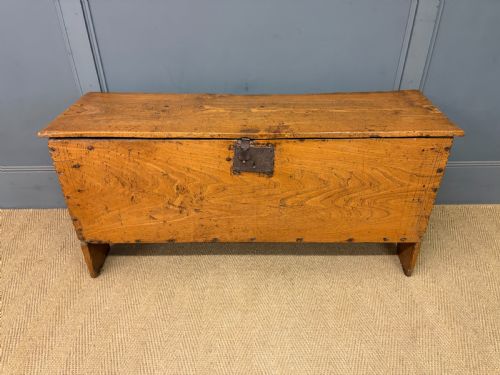
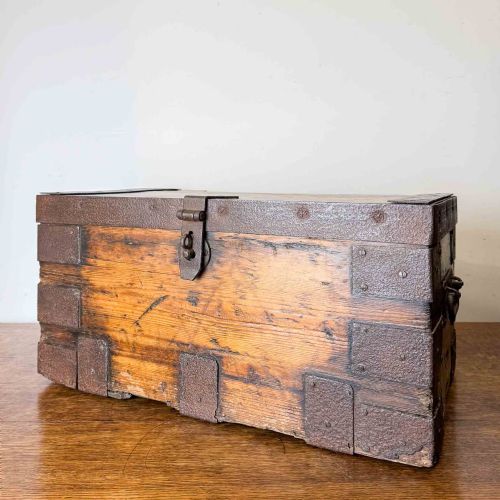


Vintage Elm Coffer
A vintage elm coffer offers honest utility and tactile warmth, bringing robust country character and rich grain directly into any interior.
Vintage Elm Coffer
A vintage elm coffer provides sturdy storage with a distinct regional identity, drawing from traditions across 18th century and 19th century workshops. These timber receptacles appear as blanket chests, dough bins, strongboxes, and sideboards, reflecting varied domestic and working functions.
The versions most frequently encountered here hail from rural British, French, and Chinese vernacular traditions, often displaying the characteristic golden-brown tones and swirling grain of elm. Carpenters and joiners built these items to endure hard daily use, utilising solid timber planks and simple construction methods.
Buyers seek out a vintage elm coffer for its enduring practicality and the deep patina that accumulates over generations of handling. Each piece tells a visual story through its surface wear, dovetail joints, and occasional iron or brass mounts.
Materials and construction methods
Makers relied primarily on solid elm for its toughness and resistance to splitting, frequently pairing it with secondary woods like pine in concealed sections. Blacksmiths provided hand-wrought iron hinges, hasps, and carrying hoops, while others utilised brass mountings for travelling chests.
Joiners shaped these heavy planks using traditional hand tools, employing simple pegging, dovetailing, and iron binding to secure the heavy lids and sides. Surfaces were often left unpainted to highlight the timber's natural figure, sometimes receiving a light application of wax or polish.
Materials across these listings span solid elm, pine, brass, and wrought iron, reflecting both British country workshops and traditional Chinese cabinet-making.
Distinctions in quality and finish
Quality rests in the integrity of the timber selection and the restraint of subsequent restoration, where original ironwork and fixings remain intact. Pieces retaining their early surface polish and original hinges command greater appreciation among collectors than those stripped bare.
Structural honesty sets the finer examples apart, visible in well-proportioned proportions, tight joinery, and the natural ageing of the elm board. The presence of maker-related elements, such as robust locking mechanisms or custom carrying handles, further elevates the piece.
The Vintage Elm Coffer Glossary
- Cofer
- A large wooden chest used for storing valuables, linens, or provisions. These items often feature hinged lids and sturdy boarded construction.
- Dough bin
- A specialised form of chest or trough used historically for mixing and rising bread dough. They frequently sit on splayed legs with removable or hinged tops.
- Bandaji chest
- A traditional Korean storage chest characterised by front metal strapwork and hinges. They utilise native elm timbers and serve as decorative storage furniture.
- Strongbox
- A heavily reinforced chest designed for secure transport or storage of money and documents. Iron bands and robust locks typify this utilitarian form.
- Vernacular furniture
- Domestic pieces made by local craftsmen for everyday use, prioritising function and regional materials over academic architectural styles.
Vintage Elm Coffer: Frequently Asked Questions
What were elm coffers used for originally?
These chests served primarily for storing household textiles, blankets, and dry foodstuffs in domestic settings. Workshops and travellers also utilised reinforced variants to secure tools and valuable possessions.
Over time, their robust nature made them reliable fixtures in farmhouses, workshops, and merchants' quarters alike.
How do I care for a vintage elm surface?
Maintain the timber by applying a microcrystalline wax sparingly and buffing gently with a soft cloth. Keep the piece away from direct heat sources and drastic humidity shifts to prevent the wood from splitting.
Avoid modern liquid polishes containing silicone, which can build up and dull the natural grain over years.
How can I distinguish regional styles?
British and French country pieces often display exposed dovetails, boarded lids, and simple iron strap hinges. Chinese and Korean examples frequently incorporate elaborate brass or iron hardware, distinctive frame-and-panel construction, and different handle placements.
Examining the underlying secondary woods and mounting types helps clarify the geographic origin.