
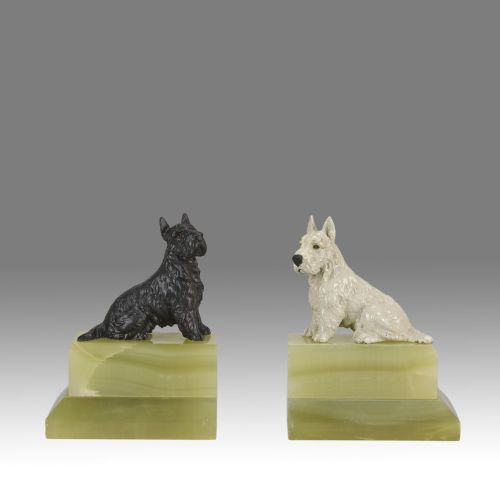


Vintage Dog Bookends
These vintage dog bookends keep shelves orderly while displaying breeds from terriers to hounds cast in bronze, marble, iron and wood.
Vintage Dog Bookends
Vintage dog bookends combine utility and decorative sculpture, holding volumes upright while portraying specific canine breeds. These items appear in materials ranging from cast iron and cold-painted bronze to marble, onyx, bamboo and hardwood.
The selection on this page spans several eras, including Victorian, Edwardian, Art Deco and the 1930s interwar period. Forms stretch beyond standard bookends to include sculptures, decorative figures, desk accessories, doorstops and desk seals.
Specific breeds dominate the inventory, such as terriers, greyhounds, spaniels, bulldogs and Chinese foo dogs or Shi Shi lions. These pieces originate from diverse stylistic traditions, encompassing English folk art, French Art Deco, Chinese Qing style and Grand Tour classical motifs.
How they were made
Foundries and workshops cast metals such as bronze, brass, spelter and iron to create sturdy figures capable of supporting heavy volumes. Cold-painted bronze and silvered bronze pieces receive careful surface finishes to highlight the contours of the dogs.
Stonemasons and carvers shape natural materials like marble, onyx, jade marble, granite and soapstone into heavy plinths or sculptural figures. Artisans also utilise organic materials such as bamboo and hardwood, alongside plaster and applied paint.
Makers combine materials to build balanced weight, mounting metal canine figures onto stone bases or integrating carved wooden and bamboo elements. Surface decoration involves polychrome paint, patination and metal plating.
Listings feature materials spanning cold-painted bronze, marble, bamboo, cast iron and soapstone across periods from the nineteenth century to the 1930s.
What varies in quality
Material selection alters the weight and presence of the piece, with dense stones like marble and onyx or solid metals providing superior heft for holding books. Artisanal skill appears in the complexity of the design, whether an unusual bamboo construction or a detailed cold-painted bronze patination.
Karl Hagenauer
The Vintage Dog Bookends Glossary
- Cold-painted bronze
- Bronze sculpture finished with non-fired oil paint applied over a metallic base. This technique was widely utilised in Vienna during the early twentieth century.
- Foo dog
- A traditional Chinese guardian lion, also known as a Shi Shi or Dog of Fo. These mythological beasts often appear in pairs guarding entrances or supporting texts.
- Spelter
- A zinc alloy used as a substitute for bronze in decorative figures and bookends. It frequently receives a bronze-toned or painted surface finish.
- Grand Tour
- Nineteenth-century cultural travel tradition where wealthy collectors acquired classical art and marble sculptures. This influence appears in antique hound figures.
- Art Deco
- Design style of the 1920s and 1930s characterised by streamlined geometric forms and stylised depictions of animals. Pieces from this era often employ experimental material combinations.
Vintage Dog Bookends: Frequently Asked Questions
How do I identify Art Deco dog bookends?
Art Deco pieces typically date from the 1920s and 1930s, displaying streamlined styling and geometric influences. They frequently feature materials like bamboo, silvered bronze or stylised metalwork.
Look for simplified anatomical lines and modern decorative motifs that break away from Victorian realism.
What are Chinese foo dog bookends?
Chinese foo dogs, or Shi Shi lions, are traditional guardian figures rendered in materials such as cast iron, soapstone and jade marble. They serve as protective symbols in Chinese art.
In bookend form, these mythical beasts are paired to face one another and anchor volumes on a shelf.
How heavy are vintage dog bookends?
Weight varies considerably depending on the materials used in construction. Solid metal castings and natural stone bases like marble and onyx provide the substantial heft needed to support heavy books.
Lighter materials such as bamboo or hollow-cast spelter rely on balanced design and sturdy bases to maintain stability on a desk.