




Art Deco Bronze Bookends
Art deco bronze bookends bring sculptural animal figures and modernist forms directly to the shelf, anchoring heavy volumes with distinct period style.
Art Deco Bronze Bookends
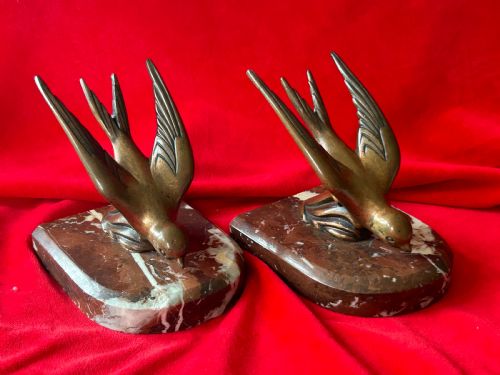
Art deco bronze bookends combine functional shelf support with sculptural forms, predominantly featuring animal subjects such as dogs, birds, and marine life alongside figural designs. These pieces date chiefly from the 1920s and 1930s, reflecting the sleek geometry and stylised motifs characteristic of the period.
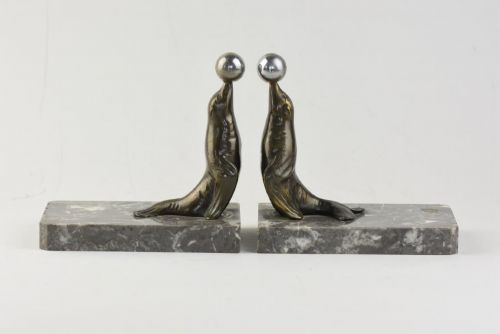
You will encounter French and Austrian examples most frequently on this page, often pairing cast metal figures with heavy stone bases. The selection ranges from naturalistic depictions of greyhounds, spaniels, and squirrels to stylised pelicans, seals, and dolphins.
Beyond pure animals, the category extends to literary subjects like William Shakespeare and mythological scenes involving nymphs and satyrs. Most survive as matched pairs, designed specifically to balance the weight of books on either end.
How art deco bronze bookends were made
Maker's workshops cast these figures primarily in bronze or spelter, frequently applying silvered, gilt, or cold-painted surface treatments to enhance the metalwork. Spelter served as a common, cost-effective alternative to solid bronze during the period.
The metal sculptures were then mounted onto substantial bases of marble, alabaster, or stone to provide the necessary weight for holding books upright. Craftspeople utilised various grades of veined marble and pale alabaster to complement the metallic tones of the figures.
Greyhounds and sea lions prove remarkably popular guard dogs for shelves.
What varies in quality
The choice and finish of the base material also define the tier of the piece, with dense, polished marbles and finely grained alabasters holding a higher status than basic metals or plain stone. Signed works by recognised artists command greater attention due to documented foundry provenance.
Franz Gruber·C Omin·Karl Hagenaur·Herzig·Max Le Verrier·H Wandaele·GUAL
The Art Deco Bronze Bookends Glossary
- Spelter
- A zinc alloy commonly used as a substitute for bronze in decorative figures. It takes patination well but is softer and lighter than genuine bronze.
- Cold-painted
- A method where paint is applied to a bronze or metal object without heat firing. This technique allowed for vibrant surface detailing on animal sculptures.
- Alabaster
- A fine-grained, translucent stone used extensively for the heavy bases of desk and shelf objects. Its pale appearance contrasts sharply with dark patinated metals.
- Patina
- The natural surface sheen developed on metal over time or applied chemically by the maker. It gives depth and character to the bronze figures.
- Foundry mark
- A stamp or signature cast into the metal indicating the workshop or maker responsible for production. These marks confirm the origin and period of the casting.
Art Deco Bronze Bookends: Frequently Asked Questions
Are these bookends heavy enough for large books?
Most pairs are mounted on dense marble or stone bases designed specifically to anchor heavy volumes securely on the shelf. The combined weight of the metal figure and the stone base provides reliable support.
Lighter examples made entirely of metal or spelter rely more on a wide footprint than sheer mass. Checking the material of the base helps determine how well a pair will hold up oversized books.
How do I identify a signed piece?
Signatures or foundry stamps usually appear near the base of the metal sculpture itself, often discreetly cast into the side or back. A magnifying glass helps read faint foundry marks or artist incisions.
Not all genuine period pieces carry signatures, as many quality items were produced anonymously for department stores or general retailers. Unsigned examples are judged purely on the quality of the casting and materials.
What is the difference between bronze and spelter?
Bronze is a durable copper alloy that patinates richly and holds fine casting details for generations. Spelter is a softer, zinc-based metal that was widely utilised during the period as an affordable alternative.
Underneath the surface finish, spelter is lighter and more brittle than bronze. Experienced handlers identify the metal by examining any areas where the finish has worn to reveal the base material.
How should I clean these bookends?
Dusting gently with a soft, dry cloth is usually all that is required to maintain the surface. Avoid using chemical polishes or water, which can strip away the original patina or damage stone bases.
Marble and alabaster bases should also be kept dry to prevent staining. Professional conservation is recommended if deeper cleaning becomes necessary.