
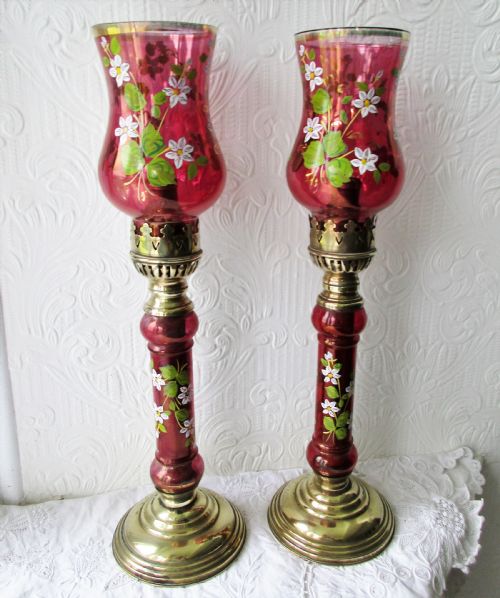


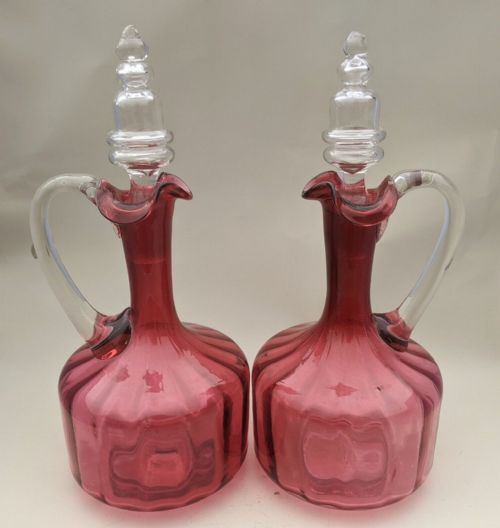


Vintage Cranberry Glass Pair
These vintage cranberry glass pair selections bring rich crimson colour and nineteenth-century craftsmanship to a room.
Vintage Cranberry Glass Pair
A vintage cranberry glass pair consists of matching dual items created in deep pinkish-red glass, spanning the Victorian and Edwardian eras. These items appear in forms such as decanters, champagne coupes, candle lamps, table lamps, mantel lustres, vases, candle holders, beakers, tumblers, salts, wall lights, and oil peg lamps.
The objects frequently originate from English workshops or Bohemian makers dating from the mid-nineteenth century through to nineteen hundred. Common decorative treatments involve hand-engraved motifs like birds, vines, convolvulus, and hunting themes, sometimes paired with overlay techniques over clear crystal.
Buyers encounter matching pairs that combine the characteristic glass with brass mountings, silver plating, or enamel detailing. These coordinated sets serve both decorative and functional roles in traditional dining and drawing room settings.
Materials and production methods
The distinct colour of cranberry glass and ruby glass is achieved by adding gold chloride to the molten glass batch during production. Artisans often utilised an overlay method, casing a layer of red glass over clear crystal before cutting or engraving through the outer layer to reveal the contrasting clear glass beneath.
Many examples incorporate secondary materials such as brass for lamp bases and wall brackets, or silver plating for candle holders. Engravers worked by hand to apply detailed floral, faunal, or pictorial scenes directly onto the surface of the glass.
Several Victorian glass pairs feature cunningly engraved hunting scenes where tiny hounds chase hares across the bowl.
Distinctions in quality and execution
Quality rests upon the depth and saturation of the glass colour, alongside the crispness of the hand-engraving or cutting. Pieces with finely detailed motifs, such as birds among vines or botanical convolvulus patterns, show superior artisan skill compared to plain surfaces.
The integration of secondary materials also dictates standard, where heavy cast brass mounts and well-fitted components elevate the piece. The overall balance and exact matching of the pair determine the standard of the ensemble.
The Vintage Cranberry Glass Pair Glossary
- Cranberry Glass
- A transparent pinkish-red glass coloured with gold oxide. It became particularly popular during the Victorian period for tableware and decorative objects.
- Overlay Glass
- A technique where a layer of coloured glass is fused over a base of clear crystal or another colour. Artisans then cut away parts of the outer layer to create contrasting patterns.
- Mantel Lustre
- A decorative glass or porcelain vase hung with cut glass prisms. These ornaments were typically placed on fireplace mantels in pairs during the nineteenth century.
- Champagne Coupe
- A shallow, broad-bowled stemmed glass designed for sparkling wine. Victorian examples in coloured glass were often deeply engraved.
- Oil Peg Lamp
- A small font holding oil and a wick, fitted with a burner and shade, designed to sit inside an existing candlestick or holder.
Vintage Cranberry Glass Pair: Frequently Asked Questions
How do I clean vintage cranberry glass?
Wash the glass gently in lukewarm water using mild washing-up liquid and a soft cloth. Avoid abrasive sponges and harsh chemical cleaners that can scratch the surface or damage engraved details.
Dry the pieces thoroughly with a lint-free towel to prevent water spots. If the items include brass mounts or silver plating, take care to keep metal polishes away from the glass surface.
Are these glass items safe for daily use?
Most nineteenth-century glassware is delicate and best reserved for display or occasional gentle use. Hand-blown and engraved pieces lack the durability of modern machine-made equivalents.
Decanters and coupes can be utilised for special dining occasions provided they receive careful hand-washing afterwards. Sudden temperature changes should be avoided to prevent thermal shock and cracking.
What is the difference between cranberry and ruby glass?
Cranberry glass typically exhibits a brighter, pinker red hue achieved through gold particles in the glass recipe. Ruby glass often appears darker and deeper in tone.
Both terms describe types of red decorative glass from the Victorian era, though makers and collectors sometimes use them interchangeably to describe similar items.
How can I date my glass pair?
Dating relies on stylistic clues, manufacturing techniques, and the form of the object. Mid-nineteenth-century pieces often feature intricate hand engraving and heavy lead crystal bases.
Later Victorian and Edwardian examples may show influences like Art Nouveau or simpler moulded forms combined with brass or silver-plated fittings.