


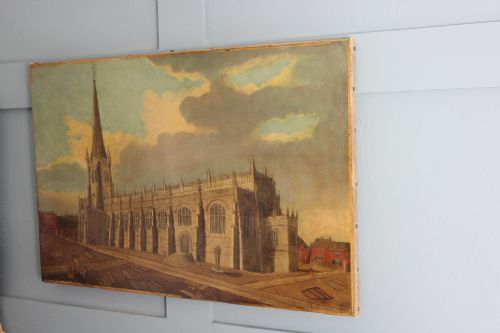


Vintage Church Artwork
Vintage church artwork captures ecclesiastical architecture and rural parishes through oils, watercolours, and detailed ink drawings spanning multiple centuries.
Vintage Church Artwork
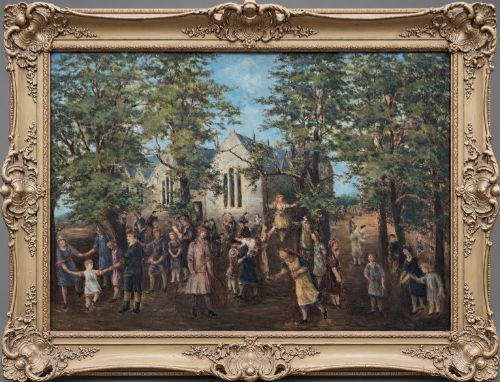
When you search for vintage church artwork, you encounter visual records of ecclesiastical buildings, cathedrals, and rural parishes rendered across various historic periods. These pieces range from naive folk art panels to professional architectural drawings and Impressionist canvases.
The selections on this page rely heavily on nineteenth-century and early twentieth-century interpretations. Painters and draughtsmen depicted specific locations such as Yorkshire churches, Oxford colleges, and London parishes using traditional media.
Buyers select these items to bring historic architecture, coastal parish scenes, and contemplative landscapes into domestic interiors. The works vary from intimate watercolour studies to large framed oil paintings.
Materials and techniques
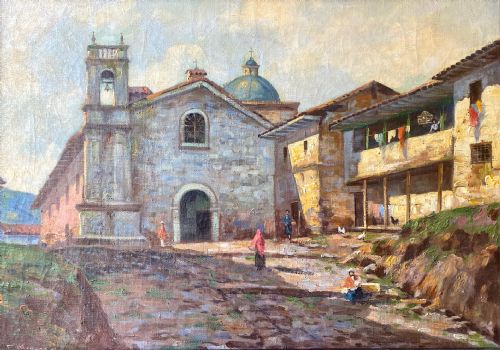
Artists recorded ecclesiastical subjects using oil paint on canvas or board, watercolour on paper, and precise pen and ink techniques. Oil paintings provide rich texture and depth, particularly when capturing sunlight on stone walls and surrounding churchyards.
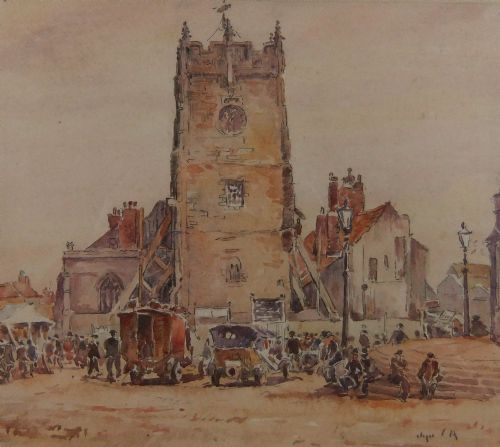
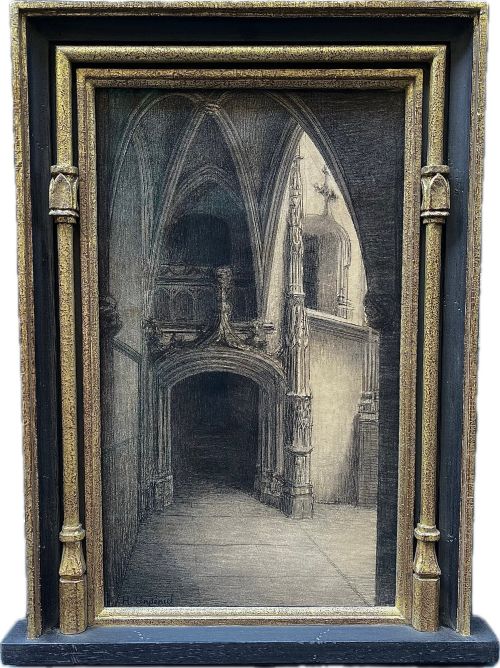
Watercolours and ink drawings rely on delicate washes and fine lines to delineate Gothic arches, stained glass, and architectural stone tracery. Paper and canvas supports from the nineteenth and early twentieth centuries establish the primary physical framework of these works.
Listings feature works executed in oil, watercolour, and ink across periods spanning from eighteen hundred to the mid-twentieth century.
Distinctions in quality
The distinction between standard decorative pieces and superior works lies in the artist's command of perspective, light, and structural proportion. Skilled hands render stonework, light quality, and atmospheric depth with precise observation rather than formulaic repetition.
Compositional strength and the handling of medium define the upper tier of these works. A successful oil or watercolour balances architectural precision with the surrounding landscape to create a cohesive historical record.
John Smith Atherton·Henri Charles Angéniol·Joan Gillchrest·William Greaves·Sir William Nicholson·Kershaw Schofield·John Cawthorn·Rowland Henry Hill·Maurice Asselin·John Jaques·Henri Therme·Joseph Hansom·Stephanie Cooper·Daniel Sherrin·John Thistle
The Vintage Church Artwork Glossary
- Gothic Revival
- An architectural and artistic movement reviving Gothic forms, visible in pointed arches and ornate stonework depicted in nineteenth-century drawings. This style dominated church design and associated visual arts across the Victorian era.
- Impressionism
- A style focused on accurate depiction of light and its shifting qualities rather than rigid linear detail. Works in this manner often capture outdoor scenes and sunlight falling upon stone facades.
- Provenance
- The documented history or origin of an artwork, establishing its authenticity and previous ownership. Clear attribution connects a painting to a specific artist or regional school.
- Naive Art
- Visual art created by a person without formal training, characterised by a childlike simplicity in perspective and scale. These primitive works offer direct, unpretentious interpretations of rural parishes.
- Wash
- A thin, semi-transparent layer of diluted watercolour paint applied to paper. Artists utilise this technique to create smooth backgrounds and atmospheric skies behind architectural subjects.
Vintage Church Artwork: Frequently Asked Questions
What periods do these church artworks cover?
The available selection spans from the early nineteenth century through the Edwardian era and into the mid-twentieth century. Pieces reflect prevailing aesthetic movements of their respective decades.
Examples range from early nineteenth-century topographical watercolours to mid-century oil paintings by established regional artists.
What media were used to create these pieces?
Artists employed oil paint on canvas and board, watercolour pigments, and pen and ink on paper. Each medium offers a distinct visual texture suited to architectural subjects.
Oils provide rich colour saturation, while ink and watercolour allow for delicate linear detail and atmospheric washes.
Are these works signed by the artists?
Many listings feature works bearing original signatures, inscriptions, or direct attributions to named painters and draughtsmen. Unsigned pieces are typically attributed to period English schools.
Inscriptions often identify specific locations, including named Yorkshire churches, London parishes, and Oxford colleges.
How do I choose the right piece for a room?
Consider the scale of the artwork and the framing style in relation to your interior space. Large oil paintings command attention, whereas delicate ink drawings suit more intimate settings.
Matching the period of the artwork to your interior architecture or selecting contrasting naive folk art creates distinct visual focal points.