
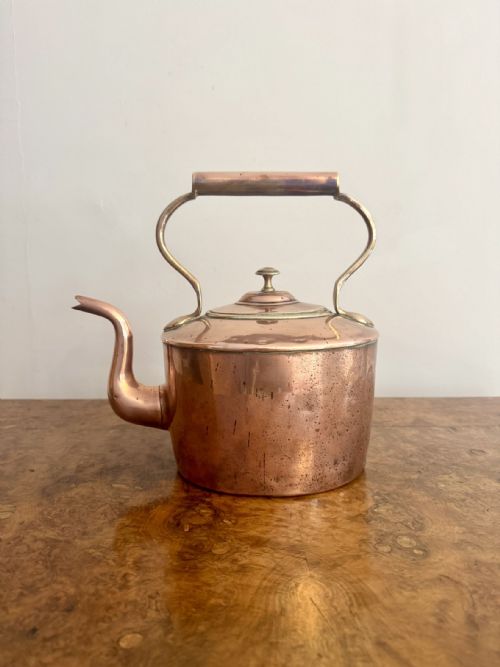
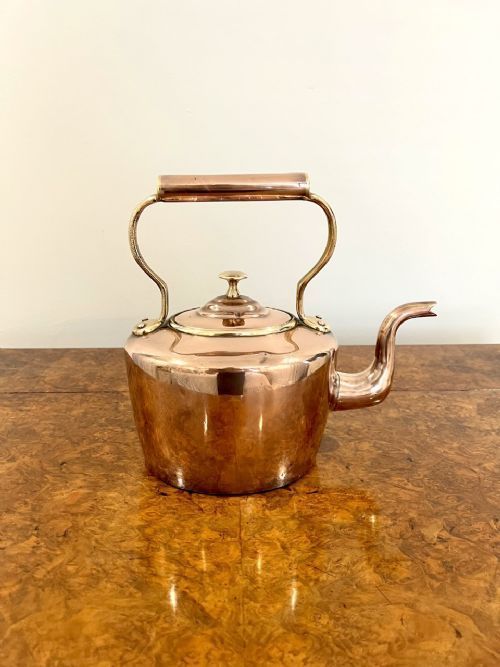


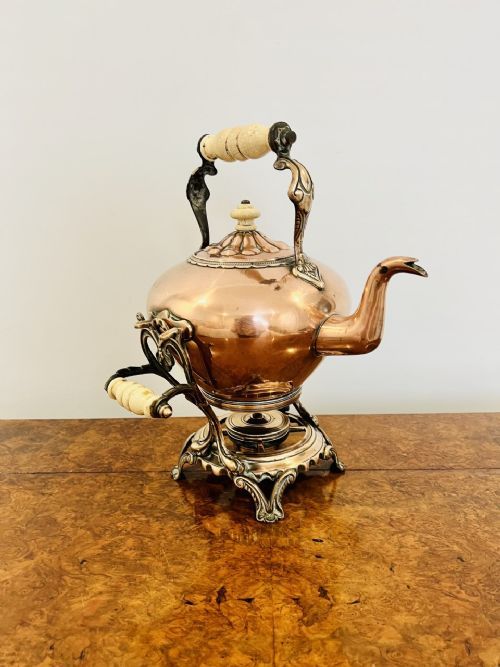


Vintage Brass Teapot
These vintage brass teapot examples span Georgian to mid-century periods, offering practical warmth and period charm for a traditional interior.

Vintage Brass Teapot
When you search for a vintage brass teapot, you encounter a selection spanning the Georgian, Victorian, and mid-twentieth century eras. The items range from standalone vessels to complex sets complete with matching stands and trivets.
Most examples you meet on this page lean heavily towards heavy-gauge copper bodies combined with brass fittings, alongside distinct brass or cloisonne enamel tea vessels. Forms vary from traditional round shapes to Dutch pear-shaped profiles and Persian foldable service tables.
Origin styles stretch from traditional Chinese and Persian aesthetics to classic English Georgian and Victorian designs. Buyers seek these objects for their robust utility and the distinct character they bring to a period room.
Materials and construction
Construction relies upon heavy metals such as brass and polished copper, frequently shaped into robust vessels designed for boiling water. Handles often incorporate insulating materials like ebonised wood or bone to prevent heat transfer during use.
Decorative finishes include cloisonne enamel in navy blue and gold, alongside gilded metal accents applied to select Chinese and Persian pieces. Stands and trivets employ matching brass or iron to support the weight of the filled containers securely.
Listings feature items spanning the Georgian, Victorian, and 1930 to 1950 periods, utilising brass, copper, cloisonne enamel, and bone.
Distinctions in quality
Quality rests upon the weight of the metal and the integrity of the original construction rather than surface shine alone. Heavier gauge brass and copper indicate superior durability and skilled hand-hammering or spinning techniques.
The presence of original matching components, such as stands, trivets, and ebonised wooden handles, elevates an example significantly. Finer pieces demonstrate precise joinery, clean enamel work, and well-preserved decorative etching.
The Vintage Brass Teapot Glossary
- Cloisonne
- Enamel work created by placing metal wire compartments on a metal base before firing. This technique produces intricate patterns in colours like navy blue and gold.
- Ebonised wood
- Timber treated to resemble ebony, frequently utilised for cool-to-touch handles on metal teapots and kettles. It provides a dark, durable contrast to polished brass and copper.
- Spirit kettle
- A water vessel mounted on a metal stand containing a small burner underneath. This setup kept water hot continuously at the tea table.
Vintage Brass Teapot: Frequently Asked Questions
How do I clean a brass teapot?
Clean brass surfaces with a mild metal polish and a soft cloth to remove tarnish while preserving the underlying metal. Avoid abrasive pads that scratch the polished finish.
Take care around enamel or ebonised wood components to prevent harsh chemical exposure. Regular gentle dusting maintains the lustre without stripping historical patina.
Can I still use these kettles for boiling water?
Many of these metal vessels remain physically robust enough for daily use on a modern heat source. However, older linings may require inspection before boiling water for consumption.
Most collectors prefer to display these pieces as decorative items rather than risking damage to historical interiors or soldered joints.
What is the difference between a kettle and a teapot?
Kettles are designed specifically for boiling water over a heat source and typically feature a fixed overhead handle and a secure lid. They often appear alongside stands and trivets in period collections.
Teapots are intended for steeping loose leaves using water that has already been boiled. They usually feature side handles and are not meant to sit directly over an open flame.
How do I date a brass or copper tea vessel?
Dating relies upon observing manufacturing techniques, such as hand-hammered seams versus machine-rolled sheets. Style indicators like Georgian or Victorian silhouettes also help determine the era of production.
Associated stands, maker marks, and material combinations provide further clues to pin down whether a piece originates from the nineteenth century or earlier.