


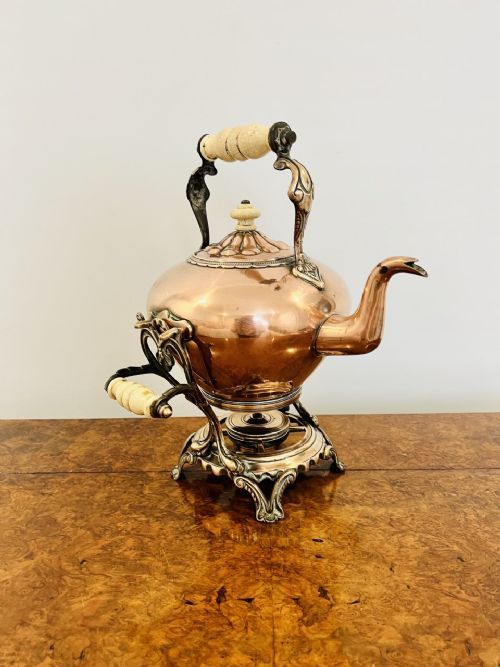

Victorian Brass Teapot
These Victorian brass teapots and related stands deliver solid nineteenth-century weight and warmth to a room, offering practical utility alongside tactile metal surfaces.
Victorian Brass Teapot
When you search for a victorian brass teapot, you encounter robust domestic metalware designed for heating and serving water in nineteenth-century households. The listings here include standard kettles, spirit kettles mounted on stands, and associated two-tier trivets.
The objects span dates from eighteen-fifty to eighteen-eighty, categorised broadly within the Victorian period. Alongside pure brass, many examples incorporate paired copper elements, creating contrast between the body and the lid or mountings.
Forms vary from round kettles to specialised vessels elevated on supportive frames with spirit burners. Makers such as William Soutter and Sons produced sturdy English examples that survive alongside collections of multiple vessels.
Materials and construction methods
Makers shaped these pieces predominantly from heavy sheet brass and copper, hammering and joining the metal to withstand daily kitchen or hearth use. Many examples combine both metals to achieve visual and structural distinction.
Handles and insulators incorporated auxiliary materials such as wood, ebonised wood, bone, and glass to protect hands from conducted heat. These tactile additions provide structural contrast against the polished metal bodies.
Victorian Brass Teapot Retail Price Guide 2026
Typical asking prices for victorian brass teapot among the pieces listed under this phrase on Sellingantiques today, from the lower quarter to the upper quarter. They describe what is for sale here now, not the wider market.
Assessing quality and craftsmanship
Superior pieces display clean joinery, balanced proportions, and careful integration of auxiliary materials like bone or ebonised wood handles. The weight of the metal and the crispness of the round or spirit kettle form indicate the maker's competence.
Inclusion of original matching stands, spirit burners, or two-tier trivets elevates a vessel's completeness and historical interest. Simple kettles without stands rely purely on the quality of the hammered brass or copper construction.
William Soutter and Sons
The Victorian Brass Teapot Glossary
- Spirit kettle
- A kettle mounted on a metal stand above a small alcohol burner used to keep water hot at the table. This setup was common in larger nineteenth-century homes.
- Trivet
- A metal stand or support placed near the hearth or table to hold a hot kettle. Examples here include two-tier designs in brass.
- Ebonised wood
- Timber treated to resemble ebony, frequently utilised for kettle handles and knobs to provide a dark, durable grip.
- Copper
- A reddish-brown metal frequently paired with brass on these nineteenth-century vessels for contrast and durability.
Victorian Brass Teapot: Frequently Asked Questions
What is the difference between a kettle and a spirit kettle?
A standard kettle was heated directly on the kitchen stove or hearth fire to boil water for domestic tasks. A spirit kettle includes its own dedicated stand and small burner underneath to keep the water warm.
Spirit kettles served a more social function in the Victorian parlor or dining room rather than heavy kitchen duty.
How do I use a kettle stand?
A kettle stand or trivet provides a safe, elevated resting place for a hot vessel away from polished table surfaces. Two-tier versions allow space for accessories or additional vessels beneath the main kettle.
These stands match the brass and copper construction of the companion kettles.
How do I clean brass and copper?
Traditional nineteenth-century metalware responds best to gentle cleaning that preserves the underlying patina and historical surface texture. Avoid harsh modern abrasives that strip away the aged character accumulated over decades.
Regular dusting and occasional mild polishing maintain the visual appeal of the mixed metal surfaces.
What materials are used for handles?
Handles incorporate materials that resist heat transfer, protecting the user's hand during pouring. You will find examples utilising ebonised wood, bone, and glass fitted to the metal loops.
These contrasting materials add subtle textural variety to the utilitarian design.