



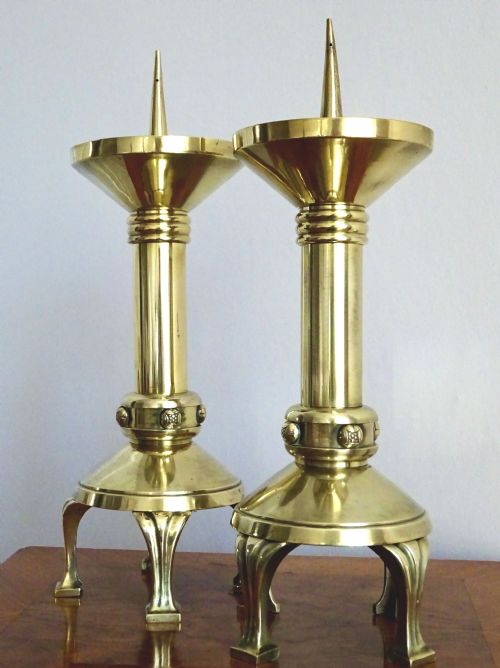

Vintage Brass Pricket Holders
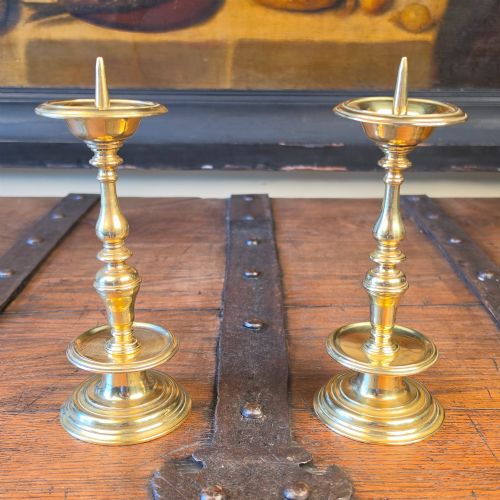
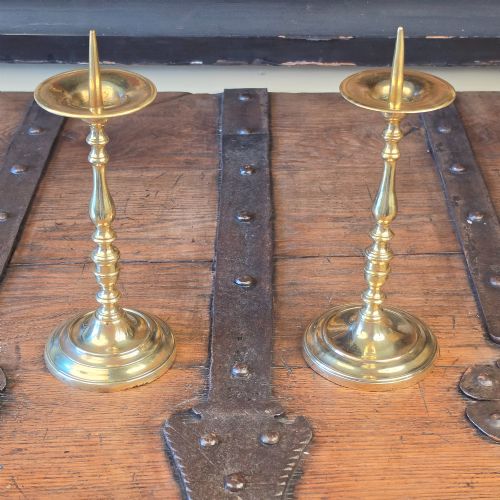
These vintage brass pricket holders are altar lights and spike candlesticks built to hold church candles upright with architectural gravity.
Vintage Brass Pricket Holders
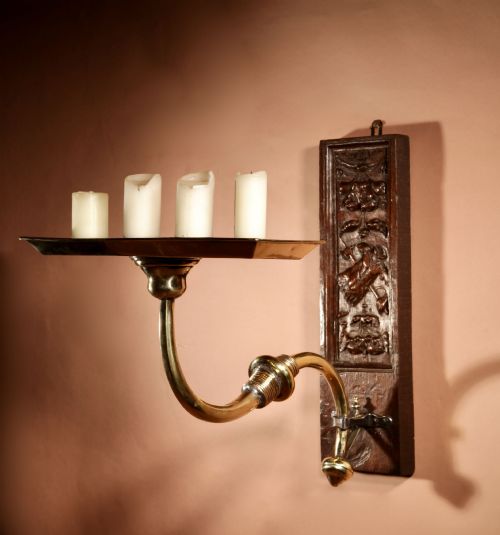
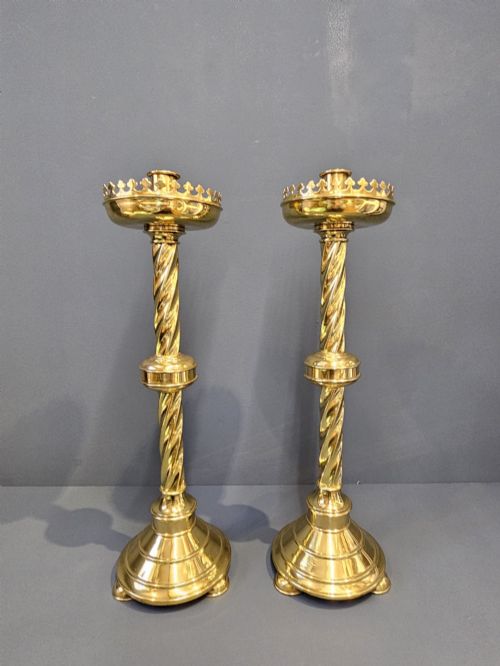
Vintage brass pricket holders take the form of church candlesticks, wall sconces, and floor standing holders designed with a central spike rather than a socket to secure the candle. These pieces emerge from the nineteenth century and the early twentieth century, spanning periods such as the Victorian era, the nineteen hundreds, and nineteen forty.
The dominant aesthetic draws heavily on Gothic Revival, Victorian Gothic, seventeenth-century baroque styles, and the distinct architectural lines of the Amsterdam School. Forms range from domestic wall-hanging brackets to imposing floor-standing church candle holders and grand pairs of altar candlesticks.
Most examples found here combine cast brass with materials like bronze, iron, wrought iron, and oak or hardwood elements. Buyers will frequently encounter tall pairs or sets originating from ecclesiastical contexts alongside secular interpretations from later decades.
What varies in quality
The weight and substantial thickness of the cast brass or bronze separate utilitarian items from imposing architectural pairs. Heavier castings maintain truer vertical alignment on the pricket spike and provide greater stability for large candles.
Design ambition dictates the upper tier of the range, where complex stylistic elements like Amsterdam School geometry or detailed Victorian Gothic Revival ornamentation are executed with crisp precision. Finer examples display integrated secondary materials, such as oak mounts and patinated metal details, that enhance the overall presence of the holder.
Vintage Brass Pricket Holders Retail Price Guide 2026
Typical asking prices for vintage brass pricket holders among the pieces listed under this phrase on Sellingantiques today, from the lower quarter to the upper quarter. They describe what is for sale here now, not the wider market.
Listings feature items spanning the nineteenth century, nineteen hundred, Victorian era, nineteen ten, eighteen sixty, and nineteen forty.
The Vintage Brass Pricket Holders Glossary
- Pricket
- A sharp metal spike projecting upwards from the centre of a drip pan to impale and secure a candle. This form predates the standard socket candlestick.
- Gothic Revival
- An architectural and decorative style drawing inspiration from medieval forms, featuring pointed arches and heavy vertical lines. It heavily influences Victorian church candlesticks.
- Amsterdam School
- An architectural and design movement from the early twentieth century characterised by expressive forms, traditional craftsmanship, and tactile material combinations. Pieces from this style often pair brass with iron or wood.
- Drip Pan
- A wide circular tray positioned beneath the candle to catch melting wax. In these pieces, it sits immediately surrounding the base of the pricket spike.
- Patinated Metal
- Metal surface treated or aged naturally to produce a specific tone and texture. This finish develops character over decades of exposure to air and handling.
Vintage Brass Pricket Holders: Frequently Asked Questions
What is a pricket holder?
A pricket holder is a candlestick that uses an upright metal spike to impale the base of a candle rather than enclosing it in a socket.
This traditional ecclesiastical design ensures the candle remains firmly positioned above a wide drip pan.
How were these used originally?
These holders served primarily on church altars and in large halls to provide steady illumination during services and gatherings.
Floor-standing and wall-hanging versions directed light across larger architectural spaces.
How do I clean a brass pricket?
Cleaning requires a soft cloth to remove dust and loose debris without disturbing the aged surface finish.
Harsh chemical polishes should be avoided to preserve the natural patina developed over the nineteenth and twentieth centuries.
How do I identify a Victorian piece?
Victorian pieces typically display heavy brass casting and distinct Gothic Revival or baroque design motifs.
They often appear as tall church candlesticks or ornate pairs intended for formal display.