



Vintage Blessed Mother Pendant
A vintage blessed mother pendant brings devotional art close to the heart, combining French religious heritage with precious metals and meticulous miniature craftsmanship.
Vintage Blessed Mother Pendant
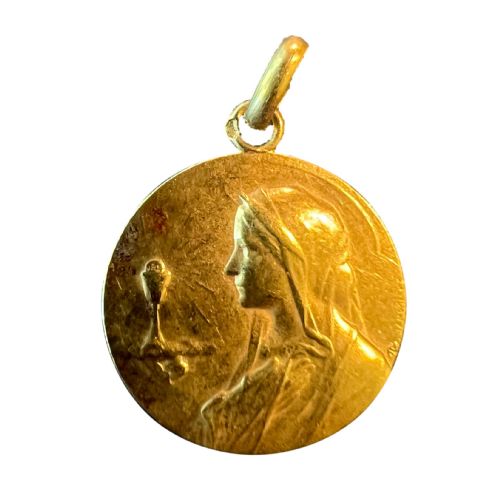
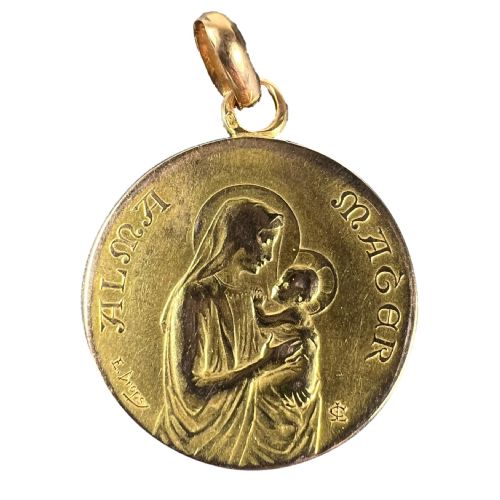
A vintage blessed mother pendant represents a devotional jewel, most often encountered as a French religious medal or charm. These pieces are designed to be worn on a chain as a personal expression of faith or cherished as an heirloom object.
The selections available span from the early years of the twentieth century through to the nineteen-fifties. French devotional pieces dominate the field, frequently taking the form of circular or oval pendants stamped with the image of the Virgin Mary or Notre Dame of Lourdes.
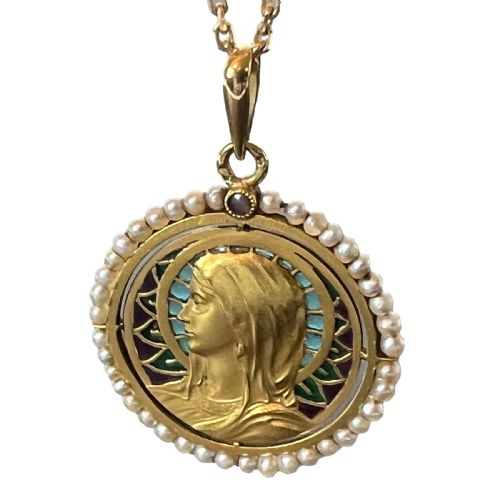
Makers and workshops from France produced the vast majority of these medals, often combining traditional religious iconography with the prevailing aesthetic movements of their decade of manufacture. Buyers meet everything from austere early examples to more ornate designs set with seed pearls or enamel.
Materials and Techniques
Gold forms the primary structural material for these pendants, with eighteen-carat yellow gold and white gold appearing consistently across the items. Goldsmiths utilised this precious metal to cast and stamp detailed devotional imagery, creating durable frames and suspension loops.
Enamelwork and plique-a-jour feature significantly in the decorative execution of the pieces, adding translucent colour behind or around the sacred figures. Mother of pearl also provides a luminous backing for carved reliefs of the Madonna and Child.
Gemstones such as seed pearls and small diamonds occasionally accent the borders or halos within the design. These stones are bead-set or grain-set into the gold mounts to enhance the visual focus upon the central devotional subject.
Vintage Blessed Mother Pendant Retail Price Guide 2026
Typical asking prices for vintage blessed mother pendant among the pieces listed under this phrase on Sellingantiques today, from the lower quarter to the upper quarter. They describe what is for sale here now, not the wider market.
Some French medals bear the signature of master engravers who spent their entire careers carving microscopic holy faces into tiny rounds of gold.
Assessing Quality
The crispness of the relief work on the religious medal dictates much of the visual appeal. Medals struck with deep, sharp definition in the gold display the engraver's skill far more effectively than worn or shallow stampings.
The integration of secondary materials such as enamel and mother of pearl marks another distinction in standard. Intact plique-a-jour enamel requires precise firing and handling, and its preservation elevates the refinement of the jewel.
Maker marks and French hallmarks stamped onto the gold jump rings or borders provide clear evidence of origin and metal purity. Pieces bearing the signatures of known medallists command attention through their documented provenance.
Emile Monier·Emile Dropsy·Augis and Mazzoni
The Vintage Blessed Mother Pendant Glossary
- Plique-a-jour
- An enamelling technique where enamel is applied in cells without a backing, allowing light to shine through the transparent or translucent colour much like stained glass.
- Medal
- A flat piece of metal stamped or cast with commemorative or religious imagery, frequently worn as a pendant rather than kept in a cabinet.
- Mother of pearl
- The iridescent inner layer of mollusc shells, carved and polished to provide a shimmering, organic background for miniature religious reliefs.
- Seed pearl
- Very small natural or cultured pearls, often used in historic jewellery to trace delicate borders or accent floral and halo motifs.
- Charm
- A small decorative trinket attached to a bracelet or worn upon a chain, sharing much of the same scale and manufacture as a small pendant.
Vintage Blessed Mother Pendant: Frequently Asked Questions
How can I date my pendant?
Dating relies primarily on the style of the metalwork, the hallmarks stamped on the gold, and the overarching aesthetic movement of the piece. Art Nouveau and early twentieth-century examples often display flowing organic lines, while later pieces shift towards mid-century minimalism.
Maker signatures stamped onto the medal surface also help pinpoint the active years of the workshop. French assay marks provide additional clues regarding the precise decade of manufacture.
What materials were used?
The pieces are constructed predominantly from eighteen-carat yellow or white gold. This metal provides a sturdy and lustrous frame for the religious iconography.
Secondary materials include iridescent mother of pearl, colourful enamel work, plique-a-jour, and small seed pearls or diamonds. These elements highlight the central figure of the Virgin Mary.
How do I wear these pendants?
These pendants are best suspended from a fine gold chain that matches the carat weight and colour of the medal mount. Their modest scale makes them suitable for daily wear either alone or layered with other small chains.
Care should be taken to protect any delicate enamel or mother of pearl elements from physical impact. Removing the pendant before swimming or strenuous activity ensures the longevity of the materials.