





Vintage Altar Candlestick Lamps
Vintage altar candlestick lamps bring ecclesiastical presence into domestic rooms, combining ritual metalwork or carved timber with everyday lighting.
Vintage Altar Candlestick Lamps
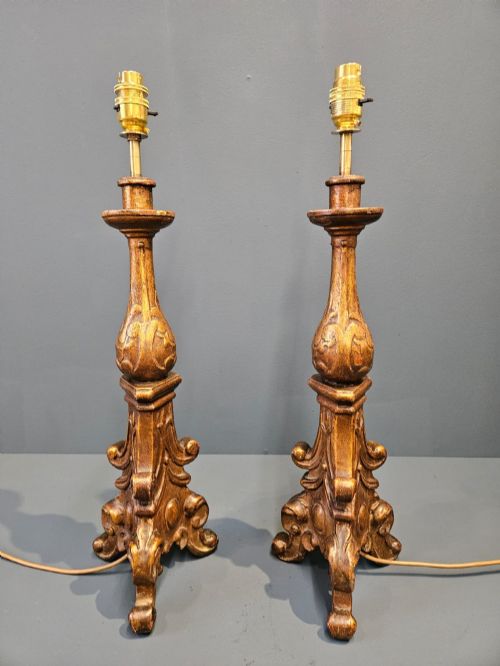
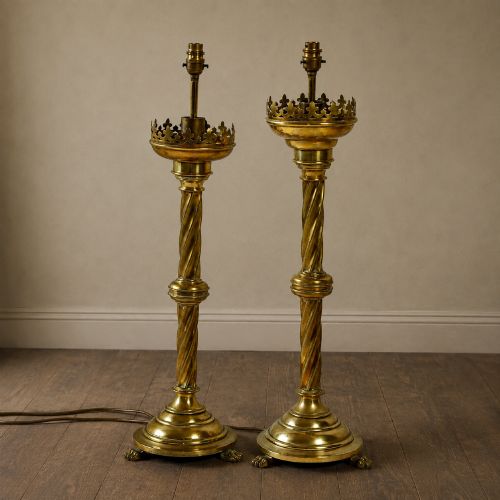
Vintage altar candlestick lamps derive from church fittings and ecclesiastical furnishings, repurposed into practical lighting for the home. When you search for vintage altar candlestick lamps, you encounter pieces that began life as heavy brass altar sticks, prickets or carved wooden candlestands before receiving electrical fittings.
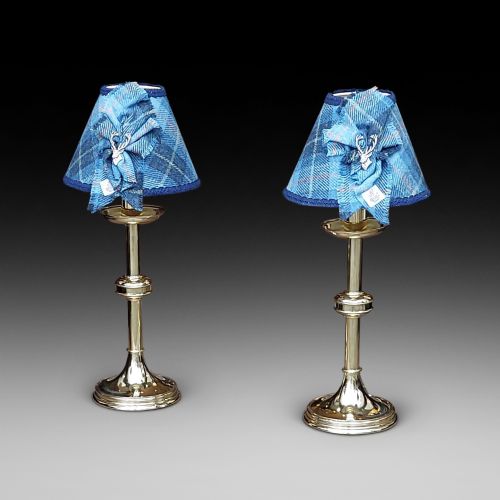
The selection ranges across several centuries, with Victorian and 19th-century continental examples appearing most frequently. These pieces span compact table lamps and tall standard lamps, often constructed from brass, giltwood or silver plate.
Stylistic influences lean heavily into Gothic Revival, Baroque Revival and French ecclesiastical designs. This mix of architectural brass and gilded woodwork gives the category its distinctive sculptural weight.
Distinctions in quality and execution
Quality rests upon the crispness of the original casting or the depth of the hand-carving in the wood. Superior examples display sharply defined ecclesiastical details and substantial weight, rather than superficial surface decoration.
Proportion and scale dictate the success of the conversion from altar stick to lamp. Finer pieces retain their architectural balance and structural integrity without appearing awkwardly altered by electrical adaptation.
Listings feature brass, giltwood, and silver plate across periods spanning the eighteenth to the early twentieth century.
The Vintage Altar Candlestick Lamps Glossary
- Pricket
- A sharp metal spike on a candlestick designed to hold a candle with a socket base. In lamp conversions, this spike often remains visible beneath or beside the bulb fitting.
- Giltwood
- Timber that has been coated with a thin layer of gold leaf or gilt paint. This finish frequently shows patination and wear across older surfaces.
- Gesso
- A plaster-like mixture applied to wood surfaces to create a smooth base for gilding and carving. It allows for intricate relief ornamentation before finishing.
- Ecclesiastical
- Relating to the Christian Church or its clergy. Pieces described thus originate from liturgical settings such as chapels and altars.
Vintage Altar Candlestick Lamps: Frequently Asked Questions
How do I place a tall altar lamp in a room?
These tall pieces demand consideration of ceiling height and surface stability, particularly for standard lamps or heavy brass pairs. Position them where their vertical form can anchor a corner or flank a substantial piece of furniture.
Ensure the weight of the base is supported safely, as solid metal and carved timber editions carry considerable heft. Pairing them with simple fabric shades helps balance the ornate character of the stems.
Can I use standard bulbs in these lamps?
Most converted altar lamps accept standard modern lamp fittings installed during their adaptation for domestic use. The wiring and bulb holders are typically updated to meet contemporary electrical standards.
Check the internal wiring and consult an electrician if the fitting appears dated or unverified. The original candle platform often houses the modern bulb socket.
How do I distinguish Gothic Revival from Baroque styles?
Gothic Revival pieces display architectural elements inspired by medieval churches, such as pointed arches, quatrefoils and heavy vertical lines in brass or dark timber. They feel structural and austere.
Baroque items lean towards theatrical curves, exuberant acanthus leaf carving, twisted stems and rich gilding. These designs emphasise movement and ornate surface decoration.
Are these lamps usually found as pairs?
Many ecclesiastical items were made for symmetry on church altars, meaning pairs frequently survive together. Matching pairs offer balance for sideboards or mantelpieces.
Single lamps and near pairs also appear, having been separated over time or manufactured individually. Near pairs share similar heights and motifs rather than exact symmetry.