


Victorian Watercolour Pair
These Victorian watercolour pair selections comprise balanced twin paintings on paper, prized for matching compositions and period framing.
Victorian Watercolour Pair
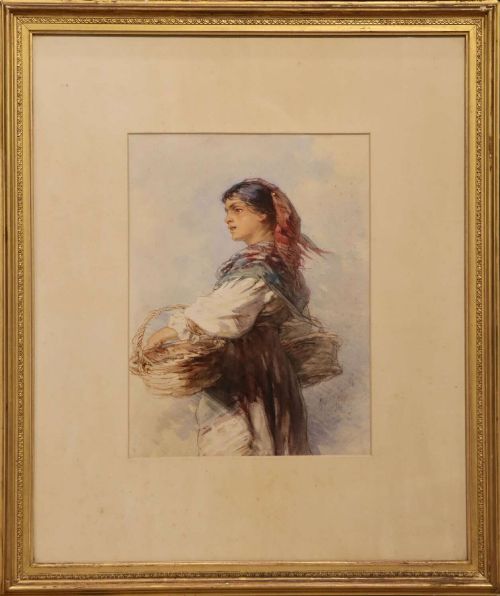
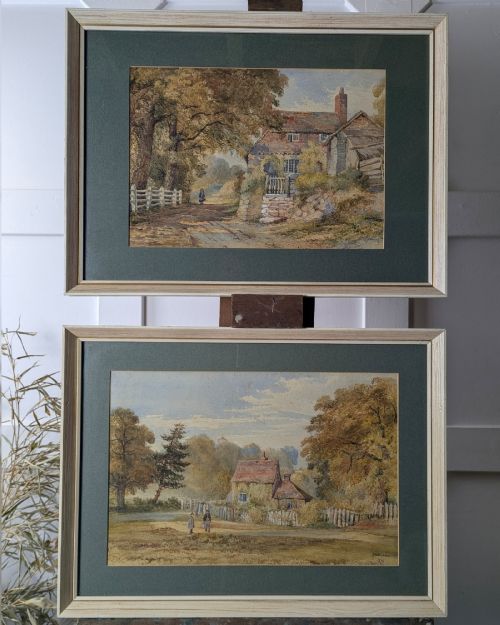
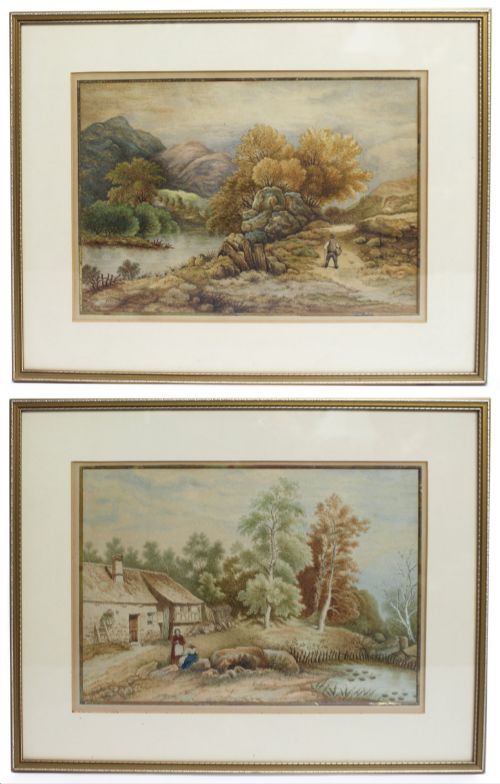
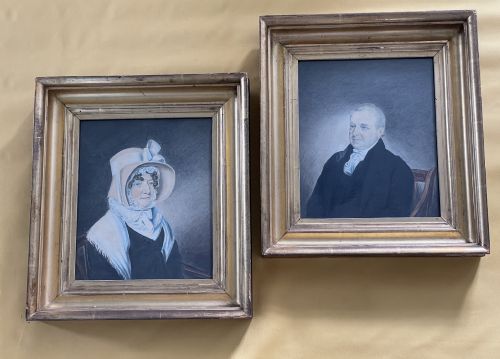
A victorian watercolour pair consists of two related paintings on paper created to hang together as a matched set, often depicting complementary subjects such as companion portraits, paired landscapes, or matching coastal scenes. Buyers searching for a victorian watercolour pair typically encounter works dating from the nineteenth century, ranging from mid-century river scenes to late-century continental views.
The subjects span country landscapes, architectural studies, portraits of children and adults, and marine views, frequently presented in period gilt wood frames under glass. These pairings offer a cohesive decorative impact that single works cannot achieve, providing balanced symmetry for wall display.
How they were made
Artists applied watercolour pigment to paper using washes and fine brushwork, sometimes adding sepia tones or bodycolour for depth and detail. These works were mounted behind glass and housed in wooden frames, often finished with gilt to complement the delicate tones of the painting.
The preservation of these works relies upon the quality of the paper and the protective seal of the frame, which shields the water-soluble pigments from moisture and light damage over decades of display.
Several Victorian pairs record domestic animals sharing the domestic sphere, including children posing alongside their faithful dogs.
What varies in quality
Quality in a victorian watercolour pair rests upon the sureness of the brushwork, the expressiveness of the figures or precision of the architecture, and the harmony between the two companion pieces. Superior examples demonstrate confident handling of light and atmosphere by named artists or skilled practitioners of the period.
The condition of the paper surface and the originality of the matching frames significantly influence the standing of a pair. Faded pigments or mismatched replacement frames alter the visual balance intended by the creator.
Guido Bach·Robert A. Nottingham·Th. Thibault·Alfred George Morgan·Robert Buchan Nisbet·Robert Richard Scanlan·Jan van Couver·Benedetto Salviati·James H Hulse·Thomas Bush Hardy·Arthur Claude Strachan·Leon Girardet·Alfred Rimmer·Frank Dadd·Karl Feiertag·JS Cooper·James M. Mackay·Henry Booth
The Victorian Watercolour Pair Glossary
- Watercolour pigment
- Finely ground colour particles mixed with a water-soluble binder, applied to paper to create translucent layers of tone.
- Gilt wood
- Wood framing finished with a thin layer of gold leaf or metallic paint, common in nineteenth-century presentation.
- Miniature painting
- A highly detailed portrait or scene executed on a small scale, often housed in a compact frame.
- Diptych
- A pair of art works painted on two separate panels or sheets of paper intended to be viewed together as a single concept.
Victorian Watercolour Pair: Frequently Asked Questions
How should I hang a pair?
Hang the two watercolours at eye level with a small, consistent gap between them to maintain their visual dialogue. Aligning the centre points ensures the balanced composition works effectively on the wall.
Keep them away from direct sunlight to prevent the watercolour pigments from fading over time.
Are these works always signed?
Many nineteenth-century watercolours bear signatures, monograms, or initials from the artist, though numerous fine pieces remain unattributed to a specific hand. Unsigned works were frequently produced by skilled regional artists or members of recognised art schools.
Signatures or contemporary annotations on the reverse often provide helpful clues regarding the subject matter and date.
What frames are period correct?
Period frames for these watercolours are typically made of wood with gilt finishes, often featuring moulded decoration suited to the nineteenth century. Glass protects the delicate paper surface from atmospheric dust and direct contact.
Makeshift or modern framing can sometimes obscure the original character of the piece.
Why were they painted as pairs?
Artists and commissioners favoured pairs to create symmetrical displays over mantelpieces or within domestic drawing rooms. Companion pieces allowed for narrative contrasts, such as morning and evening scenes or portraits of husbands and wives.
This format offered collectors a unified decorative scheme from a single purchasing decision.