


Victorian Walnut Semainier
A Victorian walnut semainier offers a tall, narrow silhouette designed for daily storage, combining rich timber figure with practical vertical drawer space.
Victorian Walnut Semainier
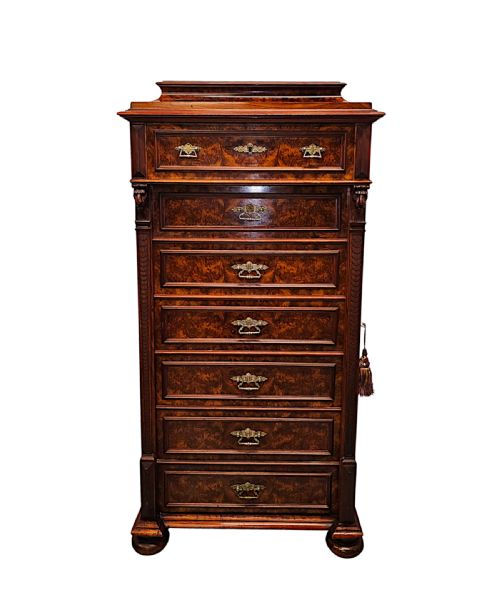
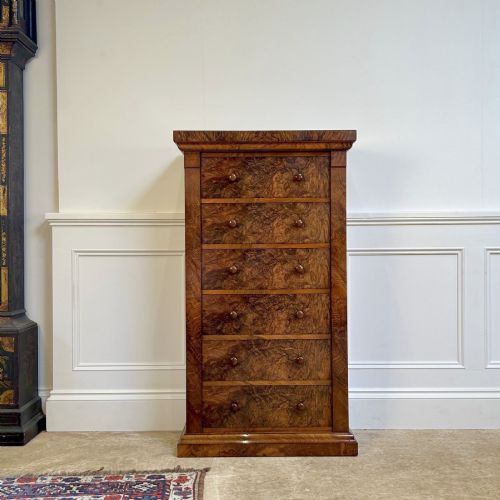
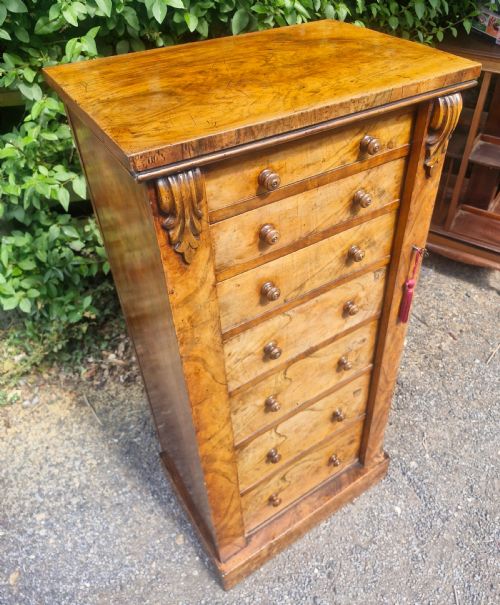
A Victorian walnut semainier appears on this page as a tall, narrow chest of drawers spanning the nineteenth century, including pieces built in the eighteen-sixties and eighteen-seventies. These pieces take the form of Wellington chests and tall filing cabinets designed to maximise storage while occupying minimal floor space.
The material palette centres on walnut and burr walnut, frequently enriched by walnut veneer, walnut wood, ebonised wood, and marquetry. Continental and French regional influences sit alongside standard Victorian cabinet-making traditions across the selection.
Most examples function as tall chests of drawers, though specific variants incorporate secretaire elements or ormolu mounts alongside traditional locking mechanisms.
How they were made
Cabinet-makers constructed these tall chests using solid walnut and structural timbers overlaid with carefully selected burr walnut veneer to create striking figured surfaces on the drawer fronts. Marquetry inlay and ebonised wood accents appear on selected pieces to add visual contrast.
Mounts and locking mechanisms utilise brass and ormolu, fastened with iron hardware to secure the deep vertical stacks of drawers characteristic of the form.
Several chests feature locking side-bars designed to keep your secrets safe behind a single turn of a brass key.
What varies in quality
The visual strength of the burr walnut figure across the drawer fronts dictates the initial impact of the piece, with complex grain patterns marking out finer examples. The crispness of marquetry inlay and the quality of ormolu mounts further separate standard production from superior cabinet-making.
Structural integrity in a tall, narrow carcase depends on the stability of the walnut veneer and the precise alignment of the deep drawers over decades of use.
Gillows
The Victorian Walnut Semainier Glossary
- Semainier
- A tall, narrow chest of seven drawers traditionally used in France to hold a week of clothing. This form aligns closely with the tall Wellington chests seen in the inventory.
- Burr walnut
- A wood derived from the wart-like growths on walnut trees, yielding highly figured, swirling grain patterns. Cabinet-makers sliced this timber into thin veneers for decorative surfaces.
- Ormolu
- Gilded bronze mounted onto furniture as decorative highlights. This technique gives metallic enrichment to drawer surrounds and corners.
- Marquetry
- The art of applying small pieces of veneer to a structure to form decorative patterns and pictures. Floral and geometric motifs appear frequently in nineteenth-century work.
- Secretaire
- A desk disguised as a chest of drawers, featuring a drop-down writing surface. This addition provides a functional workspace within the vertical frame.
Victorian Walnut Semainier: Frequently Asked Questions
What is a Victorian walnut semainier?
A Victorian walnut semainier is a tall, narrow chest of drawers designed to provide substantial storage within a compact footprint. These pieces rely on figured walnut and burr walnut veneers for their distinct appearance.
Built during the nineteenth century, they often take the form of Wellington chests or specialised tall cabinets featuring multiple stacked drawers.
How were these tall chests used?
These pieces served as vertical storage units for clothing, documents, or personal items in nineteenth-century interiors. Their narrow proportions allowed them to fit into tight spaces where wide drawer units proved impractical.
Some variants incorporated secretaire drop-fronts to double as writing desks, while others functioned as tall filing cabinets.
How do I date a walnut semainier?
Dating relies on observing construction methods, timber choices, and stylistic markers across the nineteenth-century period. Pieces attributed to the eighteen-sixties and eighteen-seventies often show specific use of burr walnut veneers and ormolu mounts.
French and continental examples from the same decades display distinct regional hardware and marquetry details.
Where did the seven drawer tradition come from?
The term semainier originates from the French word for week, denoting a chest built with seven drawers for daily organisation. English cabinet-makers adopted similar tall proportions in Wellington chests.
This vertical layout prioritized height over width to conserve floor space in period rooms.