



Victorian Walnut Bookstand
A victorian walnut bookstand brings warmth and practical desk organisation to a room, offering sturdy shelves or expandable slides for heavy volumes.
Victorian Walnut Bookstand
When you search for a victorian walnut bookstand, you encounter a selection of nineteenth-century desk accessories, revolving cases, and sliding book stands designed to keep working volumes close at hand. The pieces on this page span the Victorian and Edwardian eras, alongside related nineteenth-century forms.
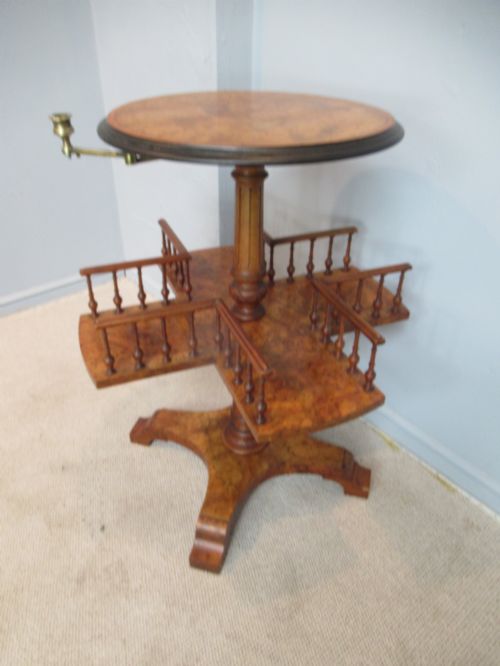
The objects take several distinct shapes, from rotating table models and folding stands to expanding book slides fitted with metal mounts. Walnut and burr walnut dominate the construction, often enhanced with brass or ceramic details.
Materials and construction
Cabinet makers utilised solid walnut and decorative burr walnut veneers to construct these pieces, applying timber known for rich grain patterns and dark warmth. Brass hinges, mounts, and ratchets provide structural strength and smooth movement for sliding or folding actions.
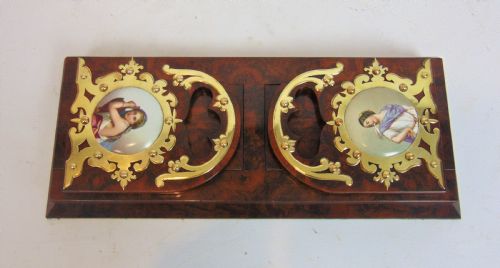
Many examples incorporate contrasting decorative elements such as painted porcelain plaques, bone inlay, or wood mosaic work. Iron mechanisms occasionally support the internal framework of revolving models.
Listings on this site feature walnut as the primary timber, frequently combined with brass mounts, porcelain plaques, and iron mechanics across nineteenth-century and Edwardian pieces.
Judging quality and execution
The distinction between standard items and superior examples lies in the selection of timber and the finesse of the secondary decoration. Highly figured burr walnut and intricately painted porcelain plaques elevate an ordinary desk accessory into a piece of fine furniture.
Mechanical precision also separates the output of workshops, particularly in the smooth operation of brass-mounted sliding bookends and revolving tabletops. Well-integrated joinery and intact hardware indicate higher levels of original craftsmanship.
The Victorian Walnut Bookstand Glossary
- Walnut
- A hard, dark brown timber prized for its rich grain and stability in Victorian cabinet making. It serves as the primary material for the majority of these stands.
- Burr walnut
- A prized veneer taken from the growth excrescences of the walnut tree, showing swirling, highly decorative patterns. It appears on finer library pieces.
- Book slide
- An expanding stand with sliding sides that holds a row of books upright on a desk. Metal ratchets or hinges often permit adjustment.
- Revolving bookcase
- A freestanding or table-standing unit designed to rotate on a central pivot for easy access to volumes. These units utilise internal timber or iron mechanisms.
- Tunbridge ware
- Small wooden objects decorated with tiny mosaic tesserae to form geometric or pictorial patterns. This technique appears on specific book racks.
Victorian Walnut Bookstand: Frequently Asked Questions
What is a revolving bookstand?
A revolving bookstand is a small table-top or floor-standing case designed to rotate on a central axis, allowing a reader to browse several titles from a seated position.
These pieces were common in nineteenth-century studies and libraries where space efficiency and quick access to reference volumes were necessary.
How do sliding bookends work?
Sliding bookends feature an expandable wooden base fitted with hinged or sliding arms that extend to accommodate a varying number of books.
Brass mounts and hinges provide the mechanism that keeps the ends upright and stable as the span is adjusted.
How do I care for walnut furniture?
Walnut requires protection from direct sunlight and excessive humidity to prevent the wood from drying out or the veneer from lifting.
Regular dusting with a dry cloth and occasional application of appropriate furniture wax helps maintain the lustre of the timber.
Were these pieces used at desks?
Many of these items, particularly book slides and folding stands, were created specifically for use on top of large library desks or writing tables.
They kept active volumes tidy and upright without requiring a full bookcase.