
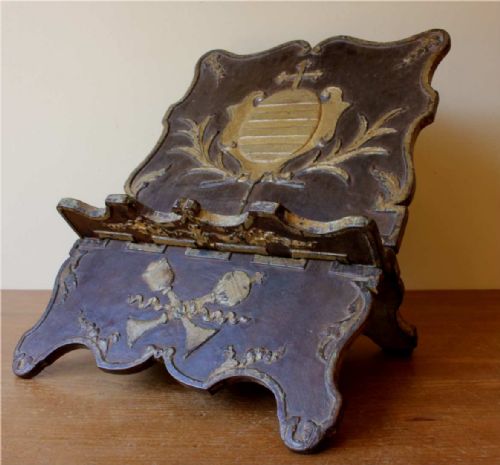


Folding Book Rest
These folding book rests are practical supports for volumes and folios, offering adjustable viewing angles for desks and reading rooms.
Folding Book Rest
A folding book rest provides a stable surface for holding open volumes, manuscripts, and periodicals at a convenient reading angle. When you search for a folding book rest, you encounter examples designed for domestic libraries, studies, and ecclesiastical settings.
The versions met most frequently on this page date from the Victorian period, alongside earlier eighteenth-century and Regency pieces. Forms range from compact desktop stands to extending slides and dedicated lecterns.
Origin and stylistic variety span English workshops, French religious settings, and Anglo-Indian production. Buyers find both simple utilitarian stands and more decorative pedestals intended for display.
How they were made
Constructed from a variety of woods including teak, walnut, oak, mahogany, and ebonised timber, these pieces often incorporate folding mechanisms for portability. Cabinetmakers shaped and joined these materials to create adjustable supports that collapse flat.
Metal components appear in brass and enamel-coated elements, providing durability to hinges and folding struts. Decorative treatments include mother of pearl inlay, carved detailing, gesso, and gold leaf.
Specialised techniques such as fretwork, transfer printing on whitewood, and intricate carving distinguish regional styles from standard domestic production.
Periods represented span the eighteenth century, the Regency era, and the Victorian period.
What varies in quality
Quality in a folding book rest relates to the precision of the joinery and the smoothness of the folding mechanism. Superior examples feature well-fitted hinges and stable supports that hold heavy folios without slipping.
The choice of materials and the execution of decorative elements, such as hand-carved teak or precise mother of pearl inlay, separate standard utility items from finer decorative pieces. The integrity of structural pivots determines the longevity of the stand.
The Folding Book Rest Glossary
- Lectern
- A reading desk with a sloping surface designed to support a book at an angle for a standing reader. They often feature folding frames for ease of storage.
- Book slide
- An extending desk accessory with adjustable ends used to keep a row of volumes upright. These frequently incorporate folding book rest elements.
- Mauchline ware
- Nineteenth-century wooden smallware featuring photographic transfers or tartan designs on whitewood surfaces. Items often include small reading stands and stationery boxes.
- Ebonised wood
- Timber treated with a dark stain or finish to imitate ebony. This technique was popular in Victorian cabinetmaking for creating high-contrast decorative effects.
Folding Book Rest: Frequently Asked Questions
How do you use a folding book rest?
Place the base on a stable desk or table surface and unfold the support strut to the desired angle. The ledges hold the pages of a heavy volume open for reading.
Fold the mechanism flat when not in use to store the stand in a bookcase or desk drawer.
Were these stands only for books?
Many examples served multiple purposes, supporting sheet music, missals, and periodicals in addition to bound volumes. Some larger pieces function as magazine stands or music lutrins.
Adjustable ledges accommodated different thicknesses of paper and cardboard bindings.
How do I care for wooden folding rests?
Keep wooden surfaces away from direct heat sources and strong sunlight to prevent the timber from warping or splitting. Dust regularly with a dry cloth.
Apply a suitable wax polish occasionally to nourish woods such as walnut, teak, and mahogany.
How do I date a folding book rest?
Examine the materials, hinge construction, and decorative style to determine the period of manufacture. Victorian pieces often use ebonised wood or mother of pearl inlay, while eighteenth-century examples lean towards religious or ecclesiastical forms.
Mechanisms and joining techniques also provide clues regarding the workshop era.