



Oriental Folding Stand
An oriental folding stand brings centuries of craftsmanship into a room, offering adaptable surfaces and screens that fold away when space demands.
Oriental Folding Stand
An oriental folding stand encompasses occasional tables, side tables, book stands, coffee tables, and folding screens spanning the Victorian era through the early twentieth century. Buyers seeking this phrase encounter pieces designed for portability and decorative presence, drawing on diverse regional traditions from China, Japan, India, and Burma.
The most frequent examples on this page are occasional and side tables featuring folding wooden bases, alongside multi-fold screens and specialised reading stands. These items combine practical surface utility with intricate surface decoration, reflecting the global trade and aesthetic exchanges of the nineteenth and twentieth centuries.
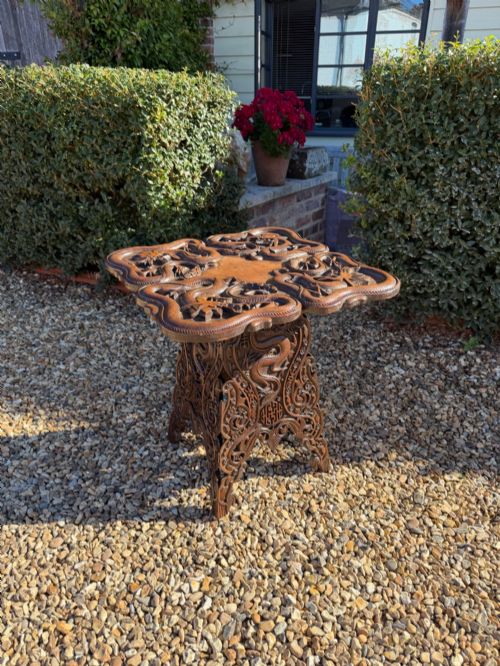
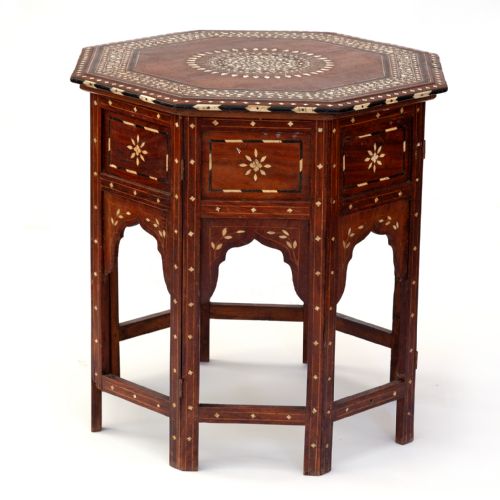
Originating across different workshops and export markets, these stands demonstrate how domestic furniture adapted to travel and display. The grouping ranges from small Hoshiapur tables with inlaid tops to substantial carved wooden structures and lacquer screens from the nineteen-thirties.
How they were made
Makers constructed these pieces from dense timbers such as teak, sheesham wood, and general hardwoods, providing a sturdy foundation for intricate surface work. Folding mechanisms relied on hinged or interlocking wooden frames designed to collapse flat without compromising stability when open.
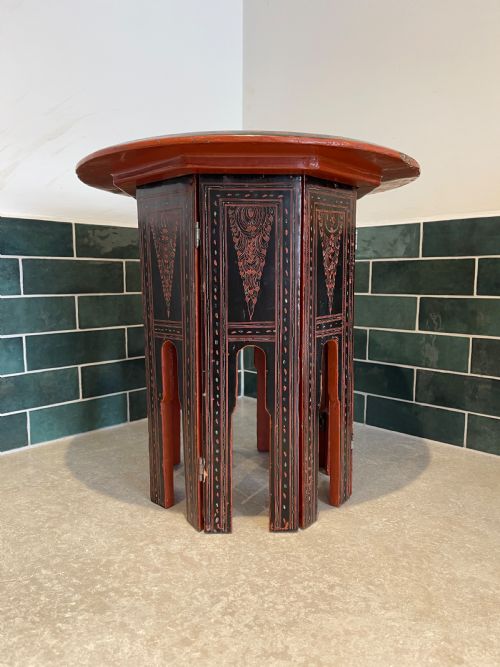
Surface ornamentation involved extensive hand-carving, alongside inlaid details in brass, copper, bone, mother of pearl, and hardstone. Lacquer and painted decoration also appeared on screens and tables, applied in layers to create glossy or textured finishes characteristic of Chinese export and Japanese export styles.
Travelling traders needed furniture that vanished into flat packs before railways made bulky sideboards standard.
What varies in quality
The depth and precision of the carving dictate the visual impact of a wooden stand, separating hurried production from patient handwork. Sharp, well-defined motifs in timber indicate a skilled hand, whereas softer or shallower cuts suggest simpler execution.
The integration of inlaid materials such as brass, bone, and mother of pearl marks another distinction in standard. Securely fitted inlays flush with the surrounding wood demonstrate careful assembly, while poorly anchored pieces disrupt the tactile uniformity of the surface.
The Oriental Folding Stand Glossary
- Anglo-Indian
- Furniture made in India during the British period, combining British furniture forms with traditional Indian carving and inlay techniques. These pieces often feature dense floral patterns.
- Chinoiserie
- European artistic styles reflecting Chinese motifs and decorative techniques, popular in screens and lacquerwork. It interprets Eastern designs through a distinct Western decorative lens.
- Hoshiarpur
- A town in Punjab known for intricate woodwork involving brass, copper, or bone inlay set into shisham wood. Tables from this region show dense geometric and floral designs.
- Lacquer
- A durable resin finish applied in multiple layers to wood, often polished or painted with decorative scenes. It creates a smooth surface resistant to moisture.
Oriental Folding Stand: Frequently Asked Questions
How do I care for an inlaid wooden stand?
Keep wooden surfaces away from direct heat sources and sudden humidity shifts to prevent the timber from warping or splitting.
Dust gently with a dry cloth and avoid harsh chemical polishes that can dislodge delicate brass, bone, or mother of pearl inlays.
Were these stands meant to be moved often?
Many folding tables and screens originated as portable furniture for travellers, traders, or colonial officials who required adaptable interiors.
Their collapsible frames allowed them to be packed flat during transit and set up quickly in temporary living spaces.
How do I distinguish between Chinese export and Anglo-Indian styles?
Chinese export pieces frequently feature black lacquer, painted scenes, hardstone mounts, or structured screen panels.
Anglo-Indian items tend to display all-over carved wood, sometimes accented with metal wire or bone inlays in dense foliage patterns.
Can I use a folding book stand for modern reading?
Scholars' reading stands and book pedestals provide sturdy sloped surfaces well-suited for holding heavy volumes, tablets, or open display books.
Their adjustable or folding designs let you alter the reading angle to suit a desk or tabletop.