
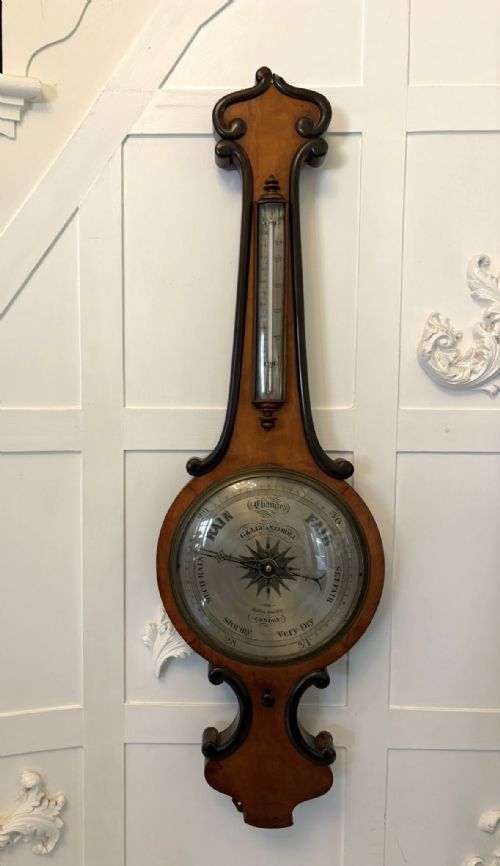


Victorian Walnut Barometer
A victorian walnut barometer brings rich timber grain and reliable weather tracking into a room.
Victorian Walnut Barometer
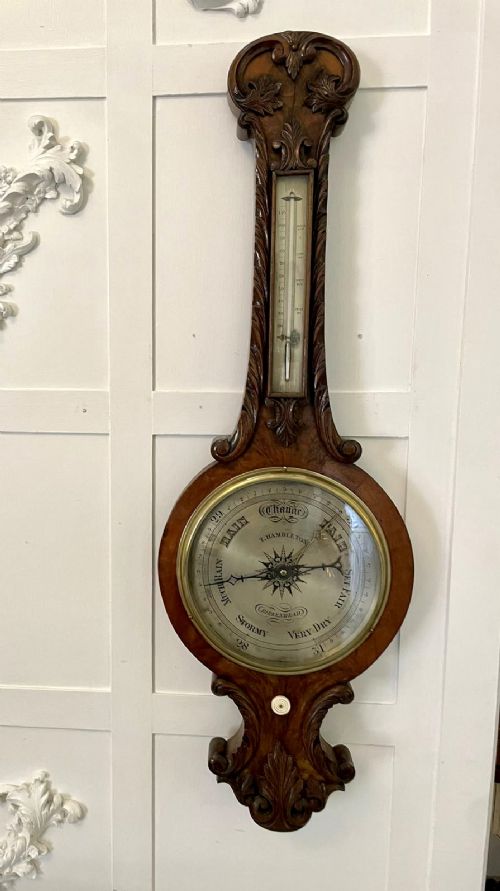
A victorian walnut barometer is a functional weather-measuring device housed in a dark timber case, often shaped as a banjo, wheel, or stick instrument. These pieces record atmospheric pressure using mercurial tubes or aneroid dials, frequently combining thermometers or porcelain dials into the design.
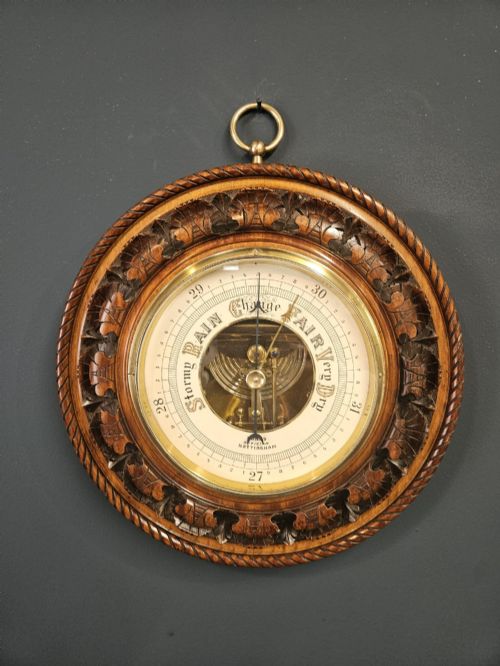
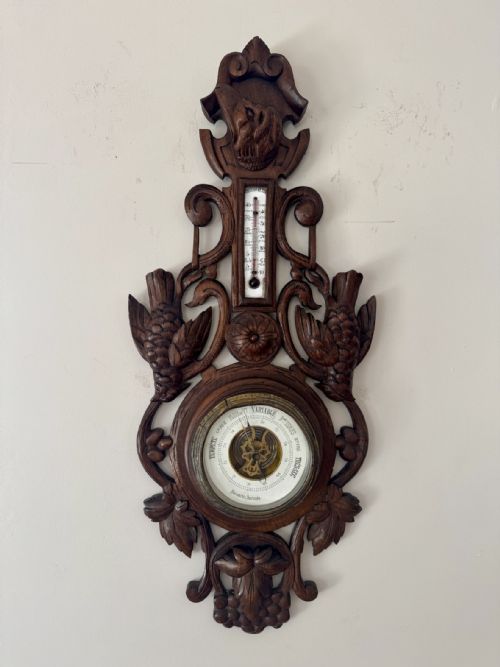
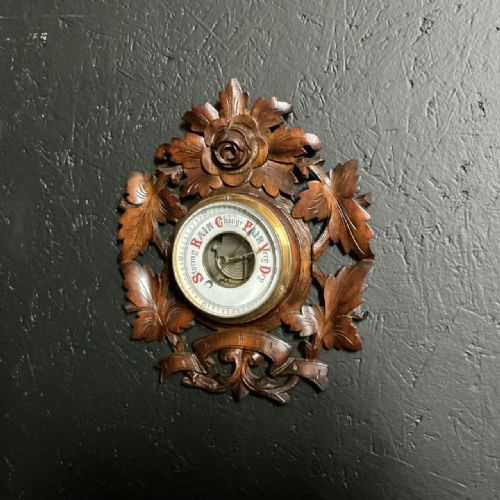
The version most commonly met on this page is the carved aneroid wall barometer, often featuring deep foliage motifs or exposed skeletal works. Examples range from simple pendant forms to complex combinations housing clocks and ceramic dials together in the case.
Materials and construction
Makers utilised solid timber and burr walnut veneers over secondary woods, shaping the cases through turning and deep carving. Many incorporate applied details like carved acorn and oak leaf borders or rococo scrollwork around the bezel.
Internal mechanisms rely on brass components, glass face covers, and porcelain or ceramic dial plates. Mercurial stick instruments house sensitive glass tubes filled with mercury alongside engraved brass scale plates.
The listings show pieces spanning the nineteenth and early twentieth centuries, constructed primarily in walnut, glass, and brass.
Distinctions in quality
The standard of carving defines the upper tier of these instruments, where deep relief work on burr timber displays sharp leaf edges and balanced proportions. Finer examples combine multiple functions, such as integrated thermometers or visible skeletonised dials, within robustly constructed cases.
Simpler turned variants and plainer wheel barometers represent the everyday end of the range. The reputation of the maker, evident on signed brass or porcelain dials, elevates the standing of an individual piece.
G and L Guanziroli London·Negretti and Zambra London·Wheeler·Aitchinson of London·A Franks of Manchester·Steward
The Victorian Walnut Barometer Glossary
- Aneroid barometer
- An instrument that measures air pressure using a flexible metal box rather than liquid mercury. The expansion and contraction moves a pointer across a dial face.
- Banjo barometer
- A domestic weather glass housed in a shaped wall case resembling a banjo, typically featuring a circular dial at the top and a thermometer along the stem.
- Barograph
- A self-recording barometer that draws a continuous line of atmospheric pressure onto a rotating paper chart using clockwork mechanisms.
- Skeletonised barometer
- An aneroid instrument designed with an open dial that exposes the brass levers, springs, and gears of the internal mechanism.
- Stick barometer
- A tall, narrow wall instrument containing a vertical glass tube of mercury paired with an ivory or brass scale for measuring barometric pressure.
Victorian Walnut Barometer: Frequently Asked Questions
How do I read a stick barometer?
Observe the height of the mercury column within the vertical glass tube against the engraved brass scale plate. Rising levels indicate improving weather conditions while falling columns suggest approaching rain or storms.
Most stick instruments include a sliding metal pointer called a vernier, which you align with the top of the mercury column to track daily changes accurately.
Where should I hang a wall barometer?
Select an interior wall away from direct sunlight, central heating radiators, and draughty doorways. Stable ambient temperatures ensure the internal mechanism responds solely to natural barometric shifts.
Ensure the wall fixing securely supports the weight of the timber case, particularly with larger banjo or wheel instruments.
How do aneroid barometers work?
An aneroid instrument contains a sealed corrugated metal capsule that expands or contracts as atmospheric pressure rises and falls. A system of delicate springs and levers transmits this movement to the visible dial pointer.
These mechanical units require no liquids, making them suitable for domestic wall hanging.
Can antique barometers be calibrated?
Most instruments feature a small adjustment screw accessible from the back or through the dial face. Turning this screw aligns the indicator hand with local barometric readings obtained from a reliable meteorological source.
Allow the instrument to settle in its permanent location for twenty-four hours before attempting any adjustment.