
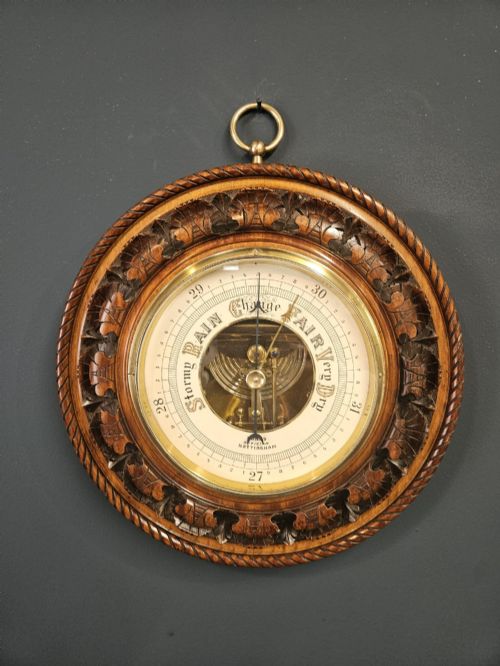
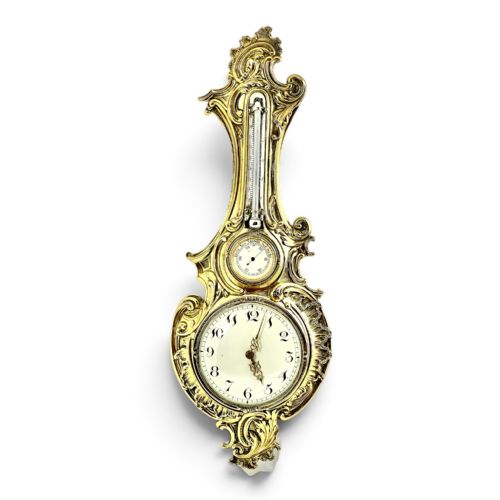
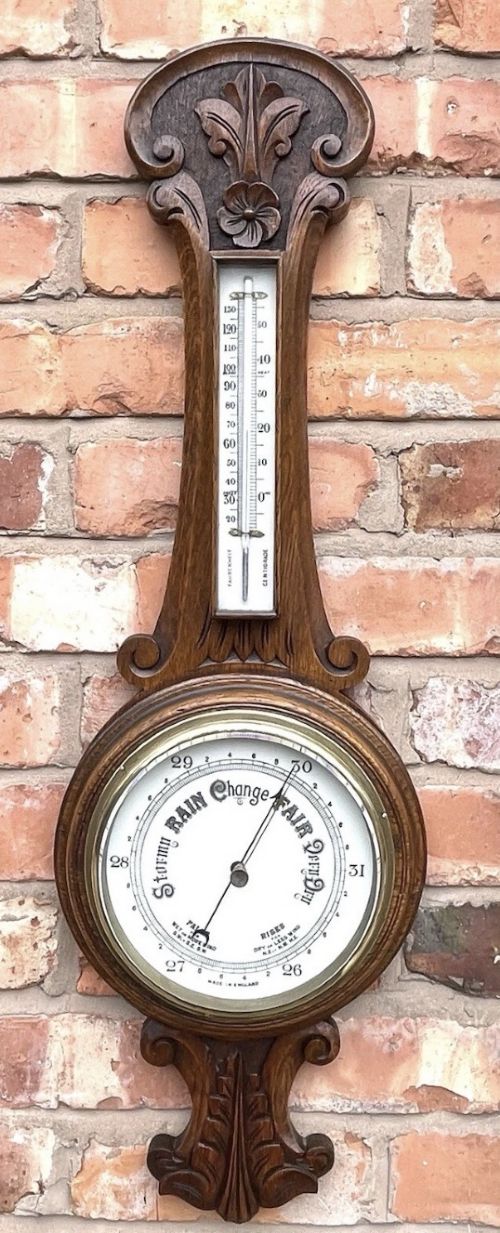


Victorian Wall Clock Barometer
These victorian wall clock barometer pieces combine timekeeping and atmospheric measurement in a single timber wall-hanging instrument.
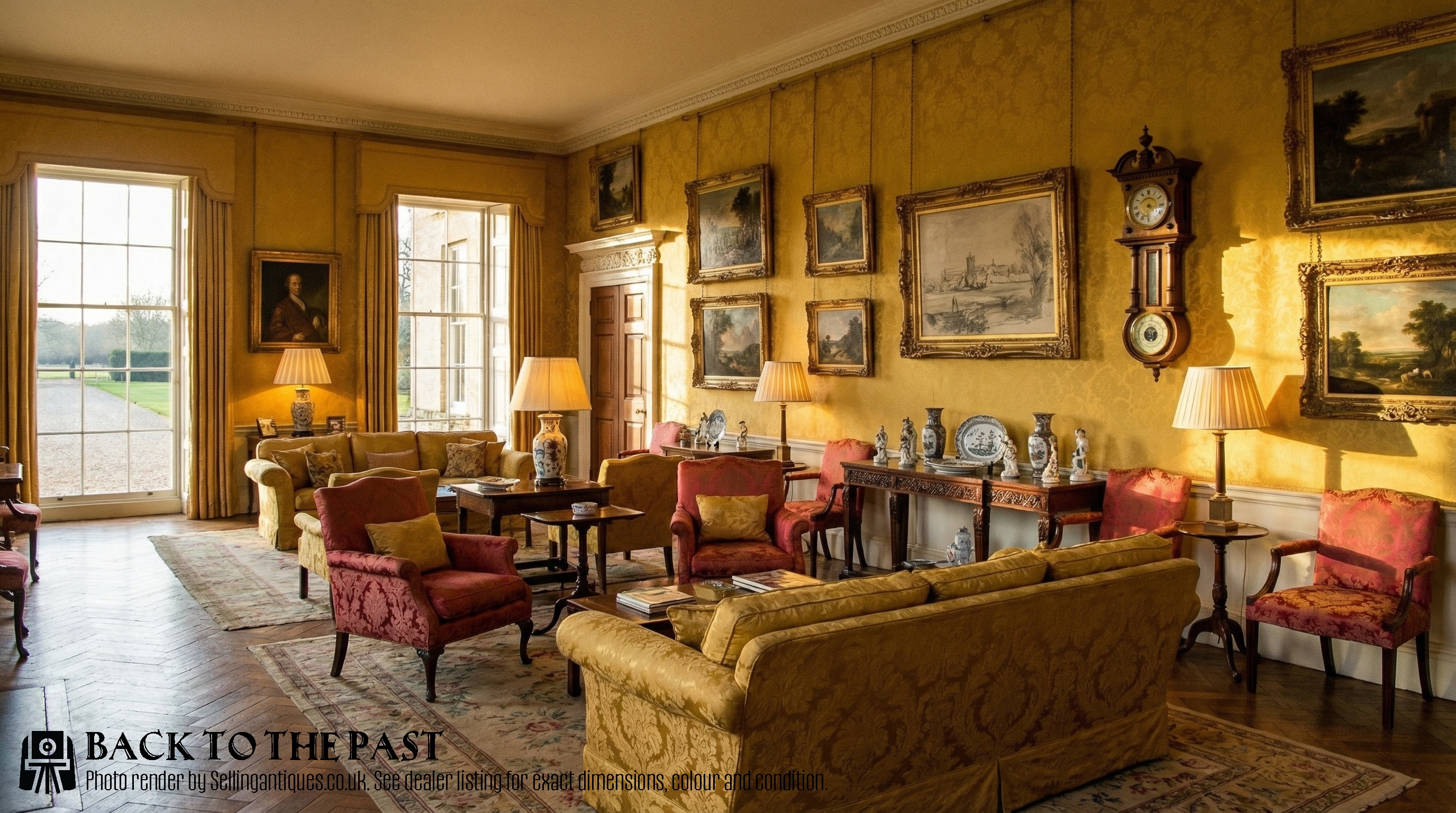
Victorian Wall Clock Barometer
A victorian wall clock barometer combines dials for time and weather into a single housing designed to hang upon a wall. You will most frequently encounter banjo shapes, drop-dial combinations, and carved wooden stations spanning the nineteenth century.
The evidence shows forms ranging from standard aneroid banjo instruments to complex stations incorporating thermometers and fusee movements. Walnut and oak predominate amongst the timber housings, often decorated with elaborate carvings.
Origin points span British workshops alongside occasional American and Continental examples like Black Forest carvings. These multi-function instruments served as domestic meteorological centres in period hallways and parlours.
Materials and construction
Wood selection focuses on durable hardwoods, specifically walnut and mahogany, alongside carved oak and regional timbers. These surrounds are shaped into banjo profiles or drop-dial wall cases.
Dials employ enamel, ceramic, and brass surfaces to display barometric pressure, temperature, and time. Glass covers protect delicate hands and mercurial or aneroid internal mechanisms.
Recorded periods span the Victorian era, Edwardian period, and Georgian survivals alongside 19th Century American imports.
Judging quality and execution
Quality rests upon the crispness of the timber carving and the complexity of the integrated combination. Simpler single-dial models contrast with comprehensive stations featuring multiple working gauges.
Maker attribution elevates standard examples, with notable firms signing dials or movements. The integration of precision fusee movements or mercury tubes alongside aneroid dials marks higher workmanship.
Negretti and Zambra·Russell of Liverpool
The Victorian Wall Clock Barometer Glossary
- Aneroid barometer
- An instrument measuring atmospheric pressure through the expansion and contraction of a sealed metal capsule without liquid. This mechanism allowed instruments to take on compact banjo and wall-hanging shapes.
- Banjo barometer
- A household weather glass housed in a vertically elongated wooden case resembling a banjo. The top typically holds the circular dial while the lower bulb contains the reservoir or thermometer.
- Fusee movement
- A conical pulley mechanism designed to equalise the declining power of a mainspring as it unwinds. This device ensures consistent timekeeping across the duration of the wind.
- Mercurial barometer
- A weather instrument utilising a column of mercury balanced against atmospheric pressure. Changes in air pressure cause the column to rise or fall within a glass tube.
- Drop-dial clock
- A wall clock featuring a circular dial above an extended wooden case used to accommodate a pendulum or barometer tube. This configuration creates a balanced vertical profile.
Victorian Wall Clock Barometer: Frequently Asked Questions
How do I hang a wall clock barometer?
Secure the piece directly into structural wall timbers or utilise heavy-duty wall anchors appropriate for the substantial weight of hardwood and glass. Ensure the instrument hangs completely plumb so the internal pendulum and mechanical parts operate freely.
Avoid positioning the instrument near direct heat sources, radiators, or exterior doors subject to heavy vibrations. Environmental extremes can affect timber expansion and disrupt delicate mechanical gauges.
Did Victorians use mercury or aneroid barometers?
Both types saw domestic use during the Victorian period, though aneroid mechanisms became increasingly popular for household wall instruments. Aneroid designs offered safer operation without liquid mercury and allowed for varied banjo shapes.
Mercurial instruments remained valued for their traditional accuracy and direct atmospheric response. Traditional drop-dial combinations frequently retained mercury tubes alongside pendulum clocks.
How do I set the barometer?
Adjust the indicator needle using the small control knob on the glass face to match a known local weather reading. The secondary pointer remains stationary so you can track whether pressure rises or falls over subsequent hours.
Regular tapping on the glass helps overcome friction within the mechanical linkages before taking a reading. This ensures the pointer registers the true atmospheric change accurately.
What woods were used for clock barometers?
Walnut and mahogany dominate Victorian wall instruments, chosen for their rich grain and structural stability. Oak also appears frequently, particularly on pieces featuring heavy relief carving and Black Forest influences.
Cabinetmakers selected these hardwoods to withstand the tension of internal springs and heavy glass bezels. The timber cases were typically polished to a deep sheen that highlighted the natural grain.