
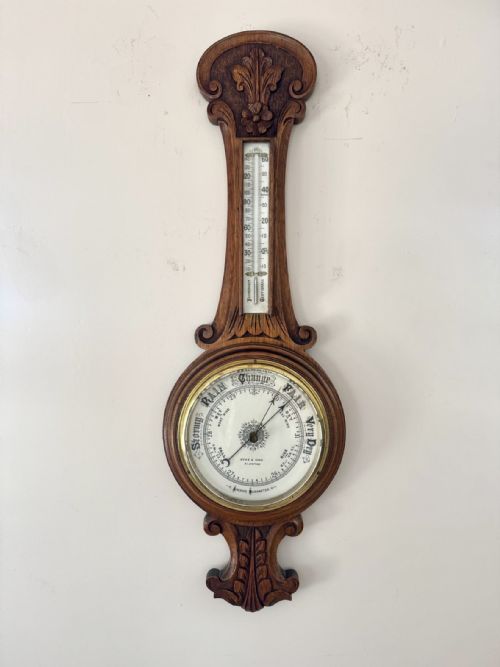


Antique Weather Glass Clock
An antique weather glass clock combines timekeeping with atmospheric measurement, offering both practical meteorological tracking and period charm.
Antique Weather Glass Clock
When you search for an antique weather glass clock, you are exploring combined instruments and clocks dating from the nineteenth and early twentieth centuries. These pieces encompass barometers, wall clocks, mantel clocks, and barographs housed in various wooden cases.
The selections on this page predominantly feature Victorian and Edwardian examples from the 1870s to 1920, with styles ranging from plain Georgian forms to ornate Victorian Black Forest carvings.
Most items integrate dials for tracking weather alongside functioning timepieces, presenting dual instruments mounted within carved oak, walnut, mahogany, or rosewood surrounds.
How they were made
Cabinetmakers constructed the housings using solid hardwoods such as oak, walnut, and mahogany, often applying detailed hand-carving to the surrounds. These wooden bodies secure the delicate aneroid barometer mechanisms and clock movements safely within the frame.
Instrument makers fitted ceramic or metal dials into the timber cases, alongside glass viewing panels that protect the indicator needles and thermometer tubes. Metal components, including brass bezels and skeletal frames, were shaped to house the mechanical gears.
One unusual piece takes the form of a caduceus, blending ancient medical symbolism with practical nineteenth-century meteorology.
What varies in quality
Quality rests in the crispness of the timber carving and the complexity of the combined movement, distinguishing standard workshop pieces from master creations. Finer examples display meticulous joinery and integrated dual functions signed by known makers.
The distinction also lies in the material selection, where rich veneers, substantial brass fittings, and unblemished ceramic dials indicate superior craftsmanship. Simpler barometers without clocks or plain uncarved cases sit at the accessible end of the range.
Hyde & Sons Sleaford·Ganthony of London·Negretti & Zambra
The Antique Weather Glass Clock Glossary
- Aneroid barometer
- An instrument that measures atmospheric pressure without using liquid, relying instead on a flexible metal box. This mechanism expands and contracts with pressure changes to move the dial pointer.
- Barograph
- A recording meteorological instrument that plots barometric pressure over time onto a paper chart. It translates atmospheric shifts into a continuous ink line.
- Skeletonised movement
- A clock or barometer mechanism stripped of extraneous metal plates to reveal the internal gears and springs. This design exposes the working mechanics to view.
- Bezel
- The metal ring that holds the glass cover in place over the dial face. It protects the delicate hands and instrument face from damage.
Antique Weather Glass Clock: Frequently Asked Questions
What is an antique weather glass clock?
These instruments combine a timepiece with a barometer or thermometer within a single housing, serving both decorative and practical domestic functions.
Originating mostly in the nineteenth and early twentieth centuries, they allow owners to check both the time and impending atmospheric changes from one device.
How do aneroid barometers work?
An aneroid barometer uses a sealed metal capsule that flexes as atmospheric pressure rises and falls. Internal springs translate these microscopic movements into the rotation of the dial pointer.
Unlike traditional mercury barometers, these sealed units contain no liquid, making them safer and easier to mount on interior walls.
Where were these instruments placed?
Households typically hung them in hallways, libraries, or drawing rooms where guests and residents could easily consult the weather before going out. Mantel versions sat atop fireplaces alongside other decorative ornaments.
Their substantial wooden cases were designed to complement the interior wood panelling and furniture of Victorian and Edwardian homes.
How do I identify the period?
Stylistic clues within the timber case, such as heavy Victorian Black Forest carvings or clean Art Nouveau lines, help narrow down the manufacturing era. The materials used, including specific woods like rosewood or walnut, also point toward distinct decades.
Signatures or maker inscriptions on the dials provide further evidence for dating the piece accurately.